
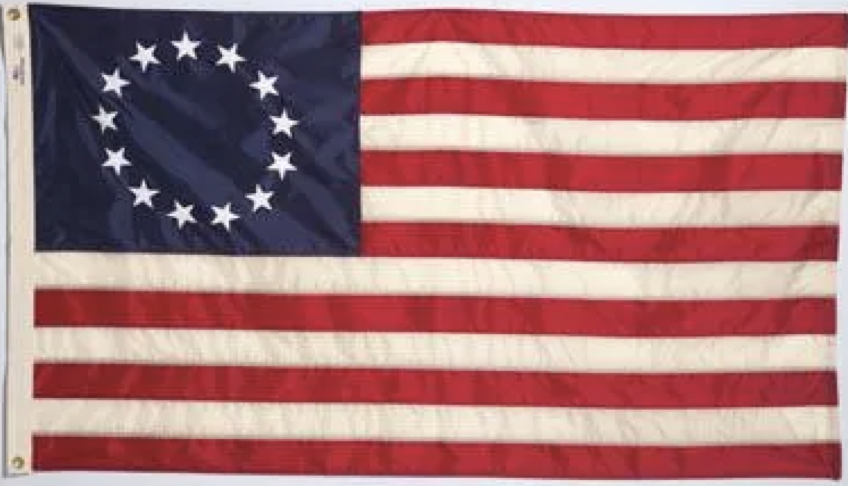
On June 14, 1777, Congress adopted the following resolution: “Resolved that the Flag of the thirteen United States be thirteen stripes, alternate red and white: that the union be thirteen stars, white on a blue field, representing a constellation.” Based on this action, we celebrate Flag Day on every June 14.
Although not proven, evidence suggests that Betsy Ross, a Philadelphia seamstress and upholsterer, created the first stars and stripes U.S. flag with the circle of 13 stars on a blue union in May 1776, based on a pencil sketch drawn by General George Washington, with whom she worshipped at church. Washington said, “We take the stars and blue union from heaven, the red from our mother country (England), separating it by white stripes, thus showing we have separated from her, and the white stripes shall go down to posterity representing liberty.”
For generations, Ross’ descendants recounted the story and maintained the Betsy Ross House in Philadelphia, contributing to her emergence as a significant patriotic icon late in the 19th century. They ensured that the Betsy Ross flag, with its 13 stripes and circle of 13 stars, would remain a powerful symbol of the American Revolution and the fight to establish and preserve the principles of liberty.
In 1795, the Flag Act authorized a new 15-star and 15-stripe flag in order to represent the admission of Vermont and Kentucky to the union. This edition of the flag is known as the Star-Spangled Banner because it was flown over Fort McHenry and served as the inspiration for Francis Scott Key’s 1814 poem “The Defence of Fort McHenry.” Fort Commander Major George Armistead had commissioned Baltimore seamstress Mary Pickersgill to construct the exceptionally large 30-by-42-foot flag to inspire his troops after the British had marched into Washington, D.C. and burned the Capitol, the White House and other federal buildings. Key was stranded on a British truce ship overnight and was thrilled to see by the dawn’s early light that our flag was still there o’er the land of the free and the home of the brave. Many began singing his poem to the tune of a popular drinking song “To Anacreon in Heaven” and it became a huge hit, ranked as the most popular national song in 1861. In March 1931, it became our National Anthem by Act of Congress.
In April 1818, President James Monroe enacted a new policy that provided for a constant 13 stripes representing the 13 original colonies/states on all American flags, with one star for each state. The act stated that the flag would be officially modified on the 4th of July following the admission of each new state. On July 4, 1890, five new stars were added for the admission of North Dakota, South Dakota, Montana, Washington (all 1889), and Idaho (1890). The 50-star flag became the official American Flag on July 4th, 1960, for the admission of Hawaii (1959) and continues to this day.
In 1909, the Daughters of the American Revolution established a Flag of the United States of America Committee to encourage patriotic reverence for our flag and to educate citizens regarding its care and purpose. Since then, Daughters have distributed millions of Flag Code leaflets, table-size flags and flag pins to schools, veterans’ facilities, retirement homes, presented Braille flags, promoted flag information and distributed the Pledge of Allegiance book marks to young people, and included a “flag moment” at chapter meetings, at https://www.dar.org/national-society/education/dar-educational-resources.
Wreaths Across America has created Flag Day lesson plans for K-8 (available at https://bit.ly/39K6j8M), assumed Flag Waving Tuesday from the ladies of Freeport, Maine, and developed a Mobile Education Exhibit (MEE), which will stop in Helena Saturday, July 23, from 10 a.m. to 2 p.m. at the Lowes parking lot, 3291 N. Sanders Street for a free event and WAA museum-on-wheels tours for our community.
The American Legion has an Americanism program that provides flag education, notably the Ceremony of the Fourteen Folds, and serves communities through state departments and local posts.
Based on actions of the 2021 Montana State Legislature in HB 543, the pledge of allegiance to the flag of the United States of America is required to be recited in all public schools at the beginning of every day in K-6 and the start of every week in grades 7-12. HB 611 requires a U.S. flag outdoors at each school and in each classroom, when the school can afford room flags, or when $10 contributions for flags and brackets are made through an online Stars and Stripes Initiative, which allows you optionally designate your gift to the school(s) of your choice. Billings American Legion Post 117 supports the project, accessed at https://opi.mt.gov/Leadership/Management-Operations/Office-of-the-Superintendent/Stars-Stripes-Initiative .
The flag, or “Old Glory,” stands for our nation, our history, our values, and most importantly our freedom. It is a symbol that is meant to unite us. Nearly every celebration, government meeting, and event begins with a pledge of allegiance to the flag. That pledge is a solemn promise; allegiance means faithfulness to our country, which is one nation under God. We note that our pledge affirms a Republic which cannot be divided and that gives liberty and justice to all its inhabitants. We are grateful and blessed to call Montana home where most revere our flag and are proud to be an American.


