
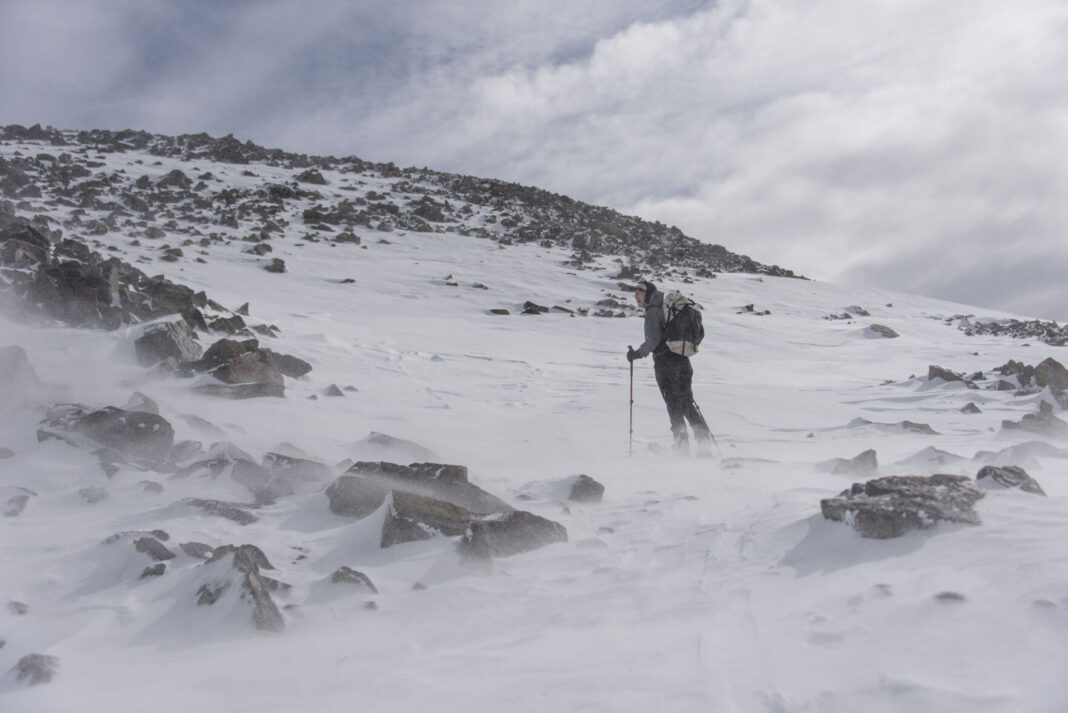
Despite its many mountains and usually snowy winters, there aren’t any ski lifts or downhill ski areas in Jefferson County. Ski runs served by rope tows existed near Elkhorn and on the Boulder Hill in the late 1930s and early 1940s, but they closed after the U.S. entered World War Two. And a ski area near Pipestone Pass in the far southwest corner of the county closed in 1974.
But there’s still good downhill (and Nordic) skiing throughout the county for those who know where to look and are willing to earn their turns.
The Elkhorns
Every winter, hardy skiers make the trek to Elkhorn ghost town near Boulder to grind along a 4-mile route that rises nearly 3,000 vertical feet to the summit of Elkhorn Peak. The reward, if they’re lucky: Weather and snow conditions could align to provide vast expanses of untracked powder or soft spring skiing, and views that extend more than 70 miles in some directions.
“Jefferson County’s a little tough,” said Micah Vitoff, the operations manager at Great Divide Ski Area between Helena and Lincoln. Vitoff has lived in Helena for four years and has been touring in the backcountry since 2011. His wife is a professional avalanche safety instructor.
Often, he said, the key to finding good touring is figuring out when conditions might align to provide good snow—or any snow at all in areas frequently scoured down to rock by strong winds.
It takes specialized equipment to get up the slopes before skiing down. Unlike alpine skis used in resorts, backcountry ski setups are designed to be as light as possible and feature bindings and boots that allow a skier’s heel to be free—the boot pivots in the binding at the toe — on the hike up. Mohair and nylon climbing skins, the modern synthetic version of animal skins used long ago, attach to the underside of skis and allow them to slide forward and grip the snow to take steps uphill, often referred to as “skinning” uphill. Skins come off and bootheels lock in for the ski back down. Backcountry snowboards, called “splitboards,” break in half to mimic skis for the skin up.
The W
Sometimes the walk on the skintrack is long, such as the approach to a zone referred to as The W on the northeast-facing slope of the Occidental Plateau. Located above the Montana Tunnels mine about 7 miles southwest of Jefferson City, The W is a series of east- to northeast-facing bowls and chutes running from the edge of the plateau at about 7,600 feet of elevation down into Kady Gulch and Clancy Creek at around 5,800 feet of elevation, though much of that vertical drop is timbered and only the upper portions feature open bowls.
“It’s a big approach and it’s only a four, five-hundred-foot line, but it makes for a good day,” Vitoff said, noting that the Elkhorns and The W are “pretty much the go-tos for Jefferson County.”
Slope angles on The W are often in the 35–45 degree range: Prime terrain for avalanches.
“I wouldn’t trust those chutes one bit unless it’s spring skiing, the snow is good and compacted,” Karson Klass, a Helena-based backcountry skier and Jefferson High School’s cross-country coach, said. Klass was referring to the consolidation of unstable layers within the snowpack during springtime that can lead to greater stability and less dangerous travel through avalanche terrain, which includes any slope 30 degrees or steeper, as well as terrain near and below such slopes—avalanches can be remotely triggered from afar.
Klass generally tours in the Elkhorns, where he said he’s found some places that generally hold good snow. He’s also skied bowls off of the top of Casey Peak, about 8 miles east of Clancy, but that “it’s a little bit of work to get out there,” and the terrain is quite steep.
Editor’s note: Backcountry skiing is an inherently dangerous activity involving exposure to avalanche terrain, extreme weather conditions and possible injury in remote locations. Formal avalanche safety training and specialized self-rescue equipment are necessary to travel safely in the backcountry. If available, always check the daily avalanche forecast for your area before venturing out. Visit avalanche.org for more information.
Nordic skiing in Jefferson County
Not every ski adventure in the county has to be a backcountry epic requiring specialized equipment and training to navigate hard conditions and avalanche danger: Jefferson County offers ample opportunities for cross-country skiing, also called Nordic skiing, from informal community trails to professionally maintained tracks.
John Smith, a semi-retired dentist from Helena who has a cabin, and ancestral ties, in Elkhorn, helps to “groom” about 6 miles of cross-country trails around the ghost town using a stripped-down bedspring dragged behind a snowmobile. The trails generally go along the railroad grade east of town, up Diego Town Road north of town and out Queen Gulch south of town.
And Homestake Lodge, located at 530 Upper Rader Creek Road near Homestake Pass and Interstate 15 between Butte and Whitehall, offers more than 20 miles of Nordic trails maintained with professional grooming equipment. Dogs are allowed on nearly half the network.
The lodge and trail network offers lighted night skiing, food and drinks, equipment rentals and lessons, and has snowmaking in some areas. For more information, including snow conditions, hours and pricing, visit homestakelodge.com.