
Excerpted from Boulder: Its Friends and Neighbors, written by Boulder’s only female mayor, Olive Hagadone, and originally published serially in The Monitor in 1985-86.
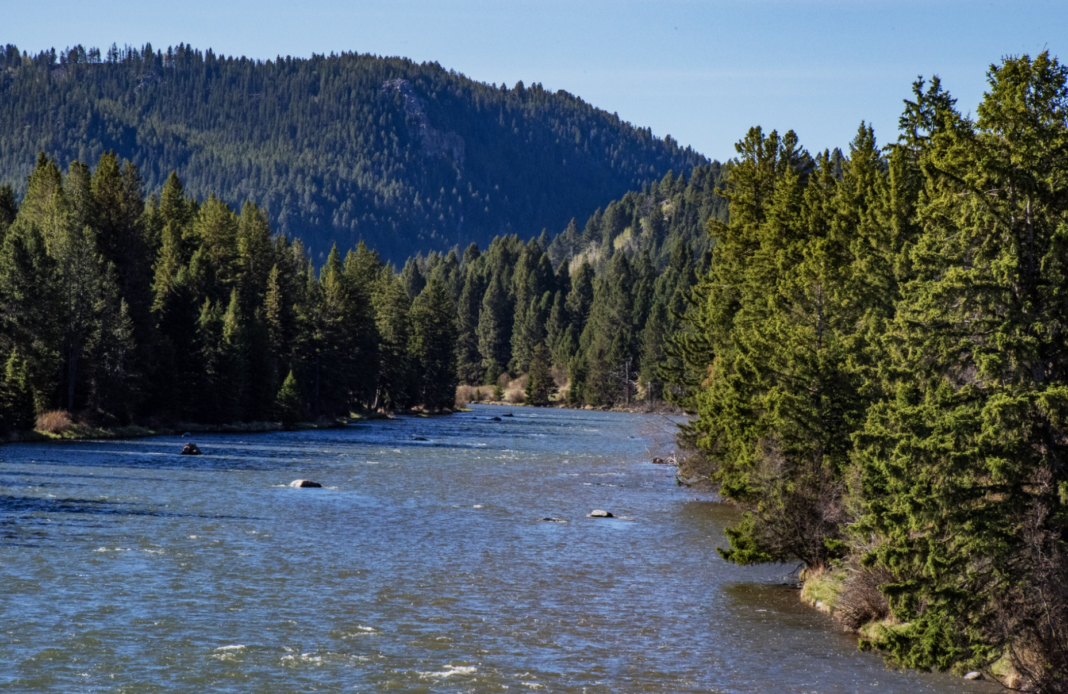
There are only two times a year that much attention is paid to the Boulder River: in August when there is barely a trickle to supply the ranchers down river with irrigation water, and in the spring when the same trickle can swell into a raging torrent that takes out bridges and anything else in its way and in years past kept the railroads constantly repairing torn out trestles and roadbeds.
To just what extent the ranchers of the Valley were willing to go to protect their water rights on the Boulder and Little Boulder rivers was shown as early as 1891, when it was learned that the Anaconda Company was planning a reservoir on the Nez Perce watershed to supply the mines and the city of Butte with water.
The watershed is at the headwaters of Nez Perce Creek, a tributary of Elk Park, and the headwaters of the Little Boulder, just over the rise, an area of about 35 square miles. The plans called for the erection of a solid masonry dam from bedrock to a point 40 feet above the surface level of the ground, which would make it about 1,000 feet long.
More than 200 acres would be submerged to an average of nearly 15 feet and estimated would contain 800,000,000 gallons of water in an artificial lake about 8,000 feet by 11,000 feet at an altitude of about 7500 feet.
The waters of the Little Boulder were to be gathered in a wooden flume about 1 and 1/4 miles long and led to the mouth of a tunnel 700 feet long, 200 feet of which had already been completed. The water was to be discharged into the natural channel of the main fork of Nez Perce Creek to the head of the proposed reservoir.
From the lower end of the reservoir, the water was to be taken into an iron pipe 18 inches in diameter which would pass through a second tunnel, 1500 feet in length (about 1000 feet of the tunnel was already completed) situated a short distance below the proposed reservoir and, from the mouth of which, the pipe would take the most direct and available line to the Continental Divide near Woodville, about 4.2 miles distant.
In January 1891, Edward Ryan issued a call to citizens and ranchmen to meet at Simpkins’ Hall to determine what course to pursue to protect themselves against the Anaconda Company’s usurpation of the water of the Little Boulder.
Mr. A. J. Macfarlane, engineer of the Anaconda Company, was present to explain his company’s position. He said that the Anaconda Company had bought the water rights of Mr. Trask and they did not intend to use the water in any other way than Mr. Trask had a right to.
He contended that little water which started from the head of the Little Boulder ever reached the Boulder Valley. The sentiment of the meeting was that Mr. Trask had only water right for the purpose of using it in a log flume for his own use and didn’t have a water right to sell.
Mr. Will Kennedy (The Age) moved that it be the consensus of the meeting that the head of the Little Boulder, or any other stream the waters of which water the Boulder Valley, shall not be diverted from their course.
The resolution was unanimously carried, and it was also agreed that a committee be appointed with full power to collect money, employ lawyers and anything else necessary to prevent the Anaconda Company from taking the water across the range. The committee was composed of Avery Belcher, A. C. Quaintance, Con Smith. Ben Wahle. Henry Nelson, Mr. Northrup and Will Kennedy.
Whether it was the threat of the lawsuit or the fact that the Anaconda Company failed to get the contract to supply Butte with water, the project was abandoned and they pulled all their equipment.
Again in 1902, the ranchers of the Valley were forced to “do battle” to protect the Boulder River, this time from contamination. When F. Augustus Heinze of the Montana Ore Purchasing Company of Butte secured the Basin & Bay concentrator at Basin, he enlarged its capacity and commenced reducing ores from the Butte mines, dumping the waste, or slimes, directly into the Boulder River.
It was first noticed downstream by the discoloration where the Boulder empties into the Jefferson. It was estimated based on the capacity of the concentrator, that as much as 900 tons of slimes were dumped into the river each day.
The water was polluted to such an extent that vegetation along the banks was destroyed and although unproven at the time, the ranchers believed that it made the water unfit for livestock or vegetation.
Mr. Edward Ryan and Mr. Beck Barteau called on Mr. Kidney, who was in charge of the works, and filed a protest. Later Mr. Kidney and Mrs. Robinson of the M.O.P. visited the Ryan ranch to talk the matter over.
They said that the construction of dams to hold the water for settling would cost a great amount of money and suggested that the water be allowed to run as it was during the remainder of the winter and that during the floods of the spring, the debris would be washed away.
Mr. Ryan argued that such a practice would be very harmful, for the spring rise would wash all the silt from the stream onto the meadows, as the sand is sometimes washed on the land – only to a greater degree and with more damage.
At a public meeting in Boulder, a committee consisting of Mr. Edward Ryan and Mr. Ben Wahle was appointed to take the matter up with Mr. Heinze. Another committee, Dan Merrill and John McCauley, was appointed to solicit funds from property owners with which to commence injunction proceedings if necessary.
Heinze built a dam of sorts, although some in the area complained that it did more damage than good, and damage to the water was sporadic. It was unknown why the pollution was more noticeable some days than others, and stranger still that on the day the officials of the concentrator inspected the stream that the water was running especially clear.
The winter of 1907-08 was one of extremely heavy snow for all of western Montana. For 29 days, almost continuous rain and snow made regular gulley-washers of all the streams.
Although some discomfort was experienced, no particular damage had been done up to the night of June 5, 1908, when Basin had been fighting the flood for a week. The settling dam there had caused the water to back up so that the flat was submerged, and many residences were under water to such an extent that the occupants had to leave in a hurry.
It was thought that this state of affairs could be remedied by dynamiting the dam, which was done about 9 o’clock in the evening. A telephone message was sent from Basin informing the people of Boulder what had been done and to prepare for high water. The crest of the flood reached here shortly before 1 a.m.
In the meantime, the fire alarm had been sounded and those apt to be damaged had been notified as quickly as possible. Couriers were dispatched, a la Paul Revere, down the Valley to notify the ranchers.
The sawmill operated by Wilson Kilburn at Galena Gulch was completely washed out, and all his lumber along with other debris piled up against the bridge across the Boulder River, creating a jam for a hundred yards, making an impenetrable dam.
This diverted the water from the channel directly into town, more than three feet deep in places. All day long the thunder of exploding powder was heard until the jam at the bridge had been disintegrated and the water finally back in its accustomed channel. By 6 o’clock in the evening the streets were resuming a nearly normal appearance, although there were deep washouts in many places, mute testimony to the fury of the rushing waters.
The residence of F.H. Benjamin in west Boulder was the most badly damaged. Water was pouring through the house higher than the window sills. His household furniture was ruined and, in addition, his outbuildings were demolished and his flock of 60 chickens drowned.
Cellars of residences and business houses filled with water, doing great damage to stock and goods. The Windsor had 13,000 cigars under water, as well as several barrels of whiskey, kegs of wine, etc. The Northern Pacific tracks between Boulder and Finn were completely under water and many of the bridges down the Valley were washed away.
The north approach to the bridge at the edge of Boulder washed out for 20 feet. Numerous smaller bridges, culverts, etc., were strewn along the banks of the Boulder to its confluence with the Jefferson. Boulder was without mail service from June 4 to 11. On that day a train was run through from Helena, bringing in mail from all directions. Mail that ordinarily came via Butte, was routed from Butte to Logan, to Helena, and then to Boulder.
Floodwaters seemed to be general throughout the western part of the state. The only method of travel out of Great Falls was by stage. The Oregon Short Line had a break south of Silver Bow and the NP had a washout on the divide east of Butte.
A cloudburst in Silver Bow Canyon west of Butte tied up the Butte, Anaconda, and Pacific RR. Service between Spokane and Missoula was closed because of a washout of several miles of track near Sand Point. The water was three feet deep at Craig, and the Madison River overflowed at Twin Bridges.
County Health Officer Dr. Leighton warned that property owners make a thorough cleanup; much water had seeped into wells, making it necessary to pump them out as a precaution against typhoid fever.