
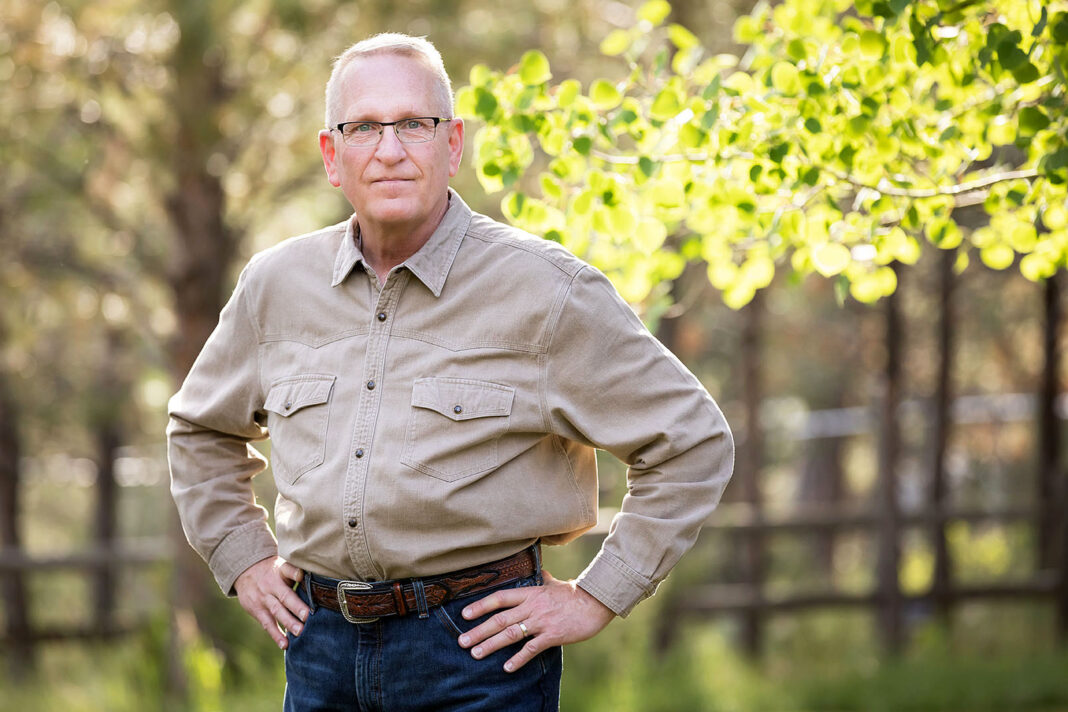
Montana has not had a Republican governor since 2005. In the June 2 primaries, three candidates will vie for the chance to change that — among them Attorney General and Clancy resident Tim Fox.
Fox has been the state’s top law enforcement officer since 2013, when he succeeded now Governor Steve Bullock. He has pursued a broad agenda with startlingly bipartisan support in the legislature, introducing legislation to curb substance abuse and stiffen penalties for drunk driving; remove barriers to prosecution of sexual assault cases; impose restrictions on prescriptions of opioid medications; and create a missing indigenous persons task force.
The Harden native, 62, faces an uphill battle in the Republican primary against U.S. Rep. Greg Gianforte, who has raised three times as much in campaign donations, according to the Associated Press, citing campaign filings with the state Commissioner of Political Practices. State Sen. Al Olszewski, R-Kalispell, also is running.
Fox spoke with The Monitor on March 13, just as the coronavirus crisis was taking hold in Montana. The interview was edited for length and clarity.
You grew up in Hardin, where your family had a car dealership, a farm equipment distributorship and a gas station. How did your childhood help shape your world view?
Growing up in Hardin was somewhat idyllic. It was a close-knit community where families watched out for other families’ kids. There was the Big Horn River for fishing, the mountains nearby for camping. And growing up on edge of two Native American reservations was a big part of my life.
I had a paper route; I would ride my Stingray around town, trying to build out my route and get customers, so I had PR and marketing experience early on. There were life lessons — like it’s snowing outside, but you took the job so you had to do the route.
My parents were depression-era people. They had been through a lot, and they didn’t have much growing up, but they were very smart and were hard workers. Dad was a professional violinist and a founder of Billings Symphony. We knew how to read music, how to make music, and we gained a deep appreciation for the arts. I can’t imagine growing up any other way.
You went to the University of Montana to study geology, and you worked in oil and gas for a time. Then you enlisted in the Marines but got turned out for medical reasons. That’s when you decided to study law and public policy. Why?
It made sense to me that I might work for government at some point. But actually, the first time I remember talking about a future in politics was after law school, when I moved to Billings. A friend was running for the state legislature and he asked me to help out — and a number of people suggested I run myself. With a young family then, the timing was bad, and politics didn’t come onto my radar again until 2007, when the attorney general job came open.
I just finished my Master’s in Public Administration two years ago. I had got everything done except a little coursework and my thesis. So I enrolled for summer session in 2018 — and then found out I had cancer. I finished two weeks late, because I was very sick at one point with the chemotherapy. But I actually walked across [at the graduation ceremony] in May of 2019. I felt grateful I was able to finish, and it was an emotional time. I thought: I’m going to gown up and get my diploma.
At the Montana Board of Oil and Gas Conservation, you were hired to develop a regulatory program. How did that and your work at Department of Environmental Quality inform your view of environmental issues?
Yes, I developed the Board’s first regulatory program from the ground up. That industry had gone unregulated with regard to environmental protection for a long time. That changed in the 1970s and 80s; the work we did stands today, and I’m very proud of it. And at DEQ, I helped prosecute the state’s first environmental quality case.
I’m one of those people who feels if there’s a law, you’ve got to comply with it. So, I hold people accountable, whether it’s the environment or anything else. But I also feel that in many cases, there’s a way forward, whether it’s mining or drilling or logging, where you can be environmentally sensitive but [also advance economic interests]. The folks who drive the narrative that it has to be one way or another, that’s a false narrative. But I also believe there are places where we shouldn’t go – where we shouldn’t drill, we shouldn’t mine. Those are special places that should be managed that way for future generations. Your bipartisan approach has been impressive: 49 of the 51 bills you’ve introduced over eight years as attorney general have passed. But the two that failed were both in the last session. Is that the canary in the coal mine, in terms of the future of bipartisanship?
I’ve prided myself on listening and trying to find core problems and then building coalitions, bringing people together, helping them to see the vision and believe in it, and then getting it done. We’ve done very well not just with legislation, but with big coalitions on human trafficking and substance use disorders. Of those 51 bills, roughly half were carried by Democrats and half by Republicans, at my request. That’s my style of governance and leadership, and it’s been very effective. But yes, we live in a hyper-partisan age. In my 62 years, this is as bad as I’ve seen it, particularly on national level.
How would bi-partisanship translate to the governor’s office?
That chapter is yet to be written. But when I became attorney general, I was the first Republican elected to that office in 24 years. Some people viewed that as an opportunity to turn things upside down, and we didn’t do that; that would have been an abuse of authority. There were a number of efforts to take down open primaries, with Republicans primarily behind them, but my job was to defend the law. A lot of my Republican friends say, why did you defend those laws? Well it’s the attorney general’s job. There is a code of ethics that comes with the office, and I have my own personal ethics. So if people sit down and think about those situations, they should see a certain character and ethic there. That’s the kind of leader I want to be. I suspect I’d be confronted with bills that most Republicans have voted for and would expect me to sign. But I’m no one’s lapdog. I do the right things for the right reasons.
Funding has been cut to mental health services in the state. You’ve noted specifically the cut to the Children’s Mental Health Bureau. Would you re-fund that?
One thing we’d have to confront is prioritizing the budget. I know there are efficiencies and cost cuts to government that could be made. But there are core roles for government to be engaged in, and one is protecting those who are disenfranchised, disabled, or otherwise unable to help themselves. When Governor Bullock made the decision to cut mental health services across the state, it was the wrong thing to do. Many community-based mental health services went away, and it will be difficult to bring those back, even if you fund them. We are hugely underserving the part of the population in mental health crisis. If I can find the wherewithal without raising taxes to shuffle the resources in our budget to more fully fund community mental health services, we will do that.
You’ve given a lot of attention to substance abuse. What can the governor do to address that challenge?
The number one driver of the substance abuse crisis in Montana is methamphetamine, a particularly dangerous drug because of the physiological and psychological effects it has on people. Almost 100% of it comes from Mexico. Until we slow that down or stop it, we have to have all-of-the-above approach. That’s what we’ve been trying to do with the Aid Montana Project, which I would continue working on as governor: It includes prevention and education; early intervention through programs such as treatment courts, veterans courts and family courts; law enforcement; and more treatment options, short and long term. We’ve got our hands full. I see it as the number one crisis in our state.