
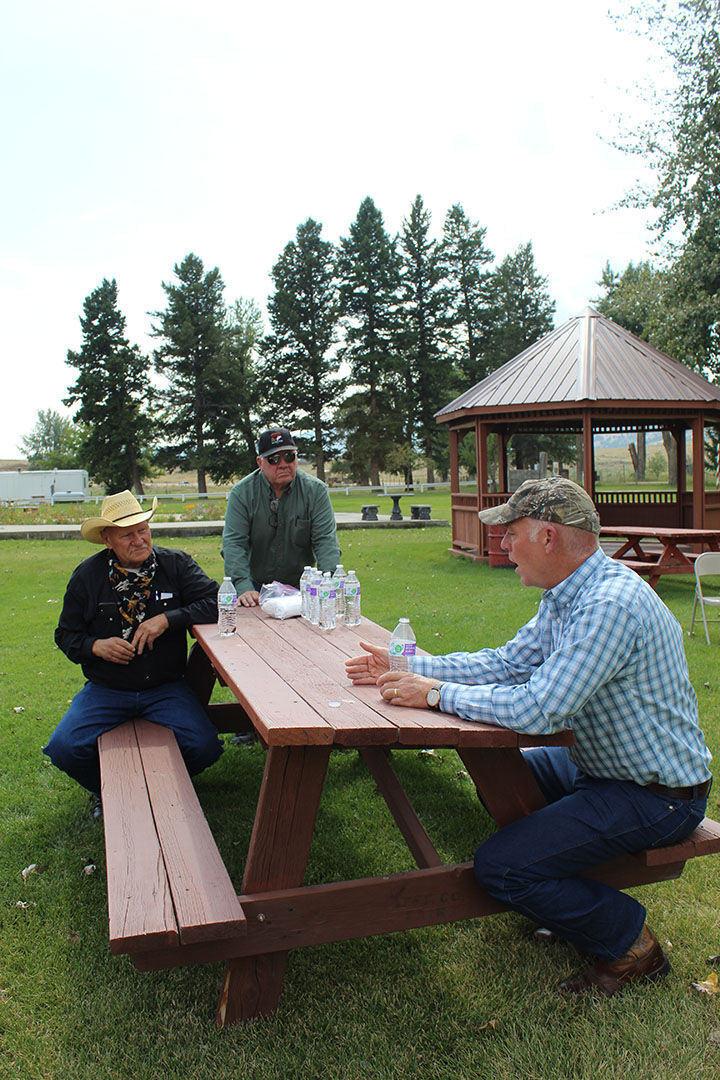
COVID-19 dominated the conversation Thursday when U.S. Representative Greg Gianforte attended an informal outdoor sit-down Thursday at the Jefferson County Fairgrounds.
Gianforte, a Republican running for governor against Lt. Gov. Mike Cooney, said he believes in “personal responsibility,” and not mandates when it comes to managing the pandemic in Montana.
“We’ve created an economic pandemic,” said Gianforte about the impact of shutdowns and other measures being used to contain the spread of the virus.
It’s important to focus on keeping the most vulnerable safe, take input from public health officials, but balance that with other concerns, he said.
“I trust Montanans to take the necessary precautions to protect their health and that of their loved ones,” he said.
Gianforte was joined by Jefferson County Commissioners Leonard Wortman, Cory Kirsch and Bob Mullen, Boulder Mayor Rusty Giulio, as well as a handful of local residents and business owners.
When Gianforte asked what was on their minds, Wortman said he wanted the COVID-19 pandemic “shut down.”
Gianforte said he didn’t believe any additional government appropriations were necessary, except, perhaps, enhanced access to liability insurance for businesses.
The Congressman said he voted for the CARES Act because there was an expiration date, adding that if the government shuts down the economy, there is some obligation on its part to assist in reopening.
Gianforte said he was pleased that Jefferson County decided to proceed with its rodeo, albeit a scaled-down version, as some rodeo cancelations have caused economic hardship in other Montana localities.
Jefferson County Public Health Supervising Nurse Pam Hanna was also on hand to provide an update on the COVID-19 situation in the county. The reopening of schools was one of her biggest concerns.
“We’re bringing 2,000 people together who weren’t together,” she said.
Gianforte asked about the progress of various local initiatives, such as broadband, since he visited last year.
Giulio said the city took $50,000 from the Boulder Development Fund, and along with the assistance of a local contractor, ran fiber to the downtown area. By offering free internet, it incentivized several internet carriers to also offer service, said Giulio.
“It created competition and gave everyone a choice,” he said.
Gianforte said that one silver lining that has come out of COVID-19 is that it’s shown a lot of younger Montanans, who have moved out-of-state for jobs, that they can return home and work remotely.
As long as they have housing and the internet, they can work, said Gianforte.
Gianforte also touched on his support for eliminating the disparity in beef pricing, as well as pushing for better labeling.
“I think consumers want to know where their beef comes from,” he said, adding that a “Product of the U.S.” label should mean the animal was born, raised and slaughtered in the United States.
The longer term solution is to create more meat processing opportunities in Montana, said Gianforte, adding that if he’s elected governor, his office can make sure that regulations don’t get in the way of that effort.
As Montana’s only congressman, Gianforte supported the renegotiated United States-Mexico-Canada Agreement, which was ratified by all three countries in March. He is also an advocate of reinstating the Country-of-Origin Labeling (COOL) for pork and beef. Gianforte, along with U.S. Senator Steve Danes, called for an investigation last year on market manipulation after a fire in a Kansas meat processing plant, which resulted in a decline in prices for producers but an increase in profits for meat packers.
Gianforte also asked about the progress on the former Montana Development Center property — and possible reuses for the facility. The state is in the process of transferring the roughly 32 acre property to Jefferson County.
Wortman said the county was working with St. James Hospital for a pain management clinic, as well as three community colleges about educational programs for veterans.
Gianforte asked about offering space for entrepreneurs and Wortman said a feasibility study is in the works.
As for the state assisting with mitigating some of the structural issues of the state buildings, such as asbestos removal, Gianforte said the campus was ripe for a public-private partnership and, if elected governor, he would work with the community to find a strategy to move forward.
Tom Harrington, project coordinator for the Jefferson Local Development Corporation, had estimated that removing the asbestos and lead paint from one of the administrative buildings, dating back to the 1890s, could cost upwards of $700,000.