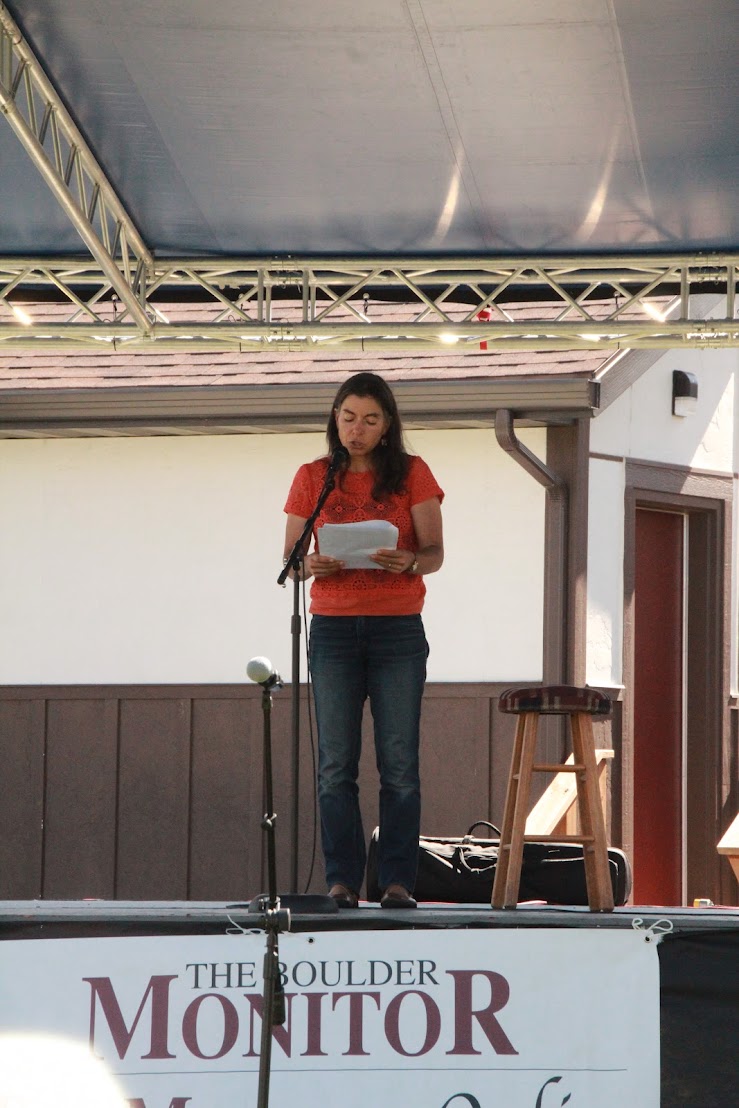
On Sept. 10, The Monitor hosted the inaugural Boulder Ideas Festival — an afternoon-long event at Veterans Park featuring innovators and thought leaders from across Jefferson County. Here are excerpts from the seven speakers’ presentations, edited for length and clarity.
MJ WILLIAMS: Jazz trombonist and vocalist
One of the most important features of music, and of community life, is listening — being able to hear other people, other sounds, the sounds of nature. What I discovered as a youngish person is, it’s a practice: You don’t just learn how to listen; you have to expose yourself to the practice of really trying to listen.
When that happens in music, it’s an exciting thing. In an ensemble, you’re playing with two or five or 15 other people. What you’re doing is a double activity, listening to yourself and also the other players around you, and that creates another universe. When I’m playing with other people, I’m always listening to what they’re doing, and that’s a guide for me to take the music in a different direction, make a swerve or a curve.
Jazz is my milieu. But I’ve come to a point where I’m able to let the form go and just listen, and that information I’m getting as a listener comes from everywhere – from nature, from mechanical noises outside my window, from thinking my own brain. That’s an opportunity to just relax and not worry about form, not be judgmental about the noise I’m making, but to step into a universe of unformed ideas.
We’re living in a time when we need to do that more. We need to be more open thinkers, and less judgmental. That is also a practice. I’ve had some bitter lessons in my community about not being a good enough listener, not hearing what was happening in the room. I always turn back to music and that reifies that point of view.
JOHN ADAMS: Founder and executive director, Montana Free Press
I just came back from rafting the Colorado River. We spent 16 days and 17 nights, which was a long time to spend with 16 people, most of whom I did not know. For two weeks, these 16 people were a community, a society, if you will, floating down the river, depending on each other for our survival. No joke: If you’ve been down the Colorado River, you know this is a daunting endeavor.
I was thinking about this book that every one of our boats had: The Guide to the Colorado River and the Grand Canyon, 8th edition. This piece of literature was our lifeline for 16 days. Navigating rapids, identifying suitable campsites, spotting potential dangers. We relied on this piece of information; we all knew it was something we could trust. We agreed that the facts in this book would help us get down the river.
That provided a pretty good metaphor for the importance of trustworthy journalism in our society. When we have a source of information that we all agree provides value that helps us navigate collectively, and that we can all trust as factual, we can avoid the dangers and pitfalls, experience exciting things that we didn’t know existed before, and tap into cultures we hadn’t experienced.
Local news operations are trusted because the community knows who they are, they know they’re experts, they know the people to talk to get the answers to questions the community needs. In Montana, we’re still the kind of community that if we come together around facts we all trust, collectively we can make decisions that move us forward and get us safely down the river.
STEVIE CROISANT: Founder, We Are Her
Montana reports that 37% of women and 35% of men have experienced physical or sexual violence in their lifetime. But we do not have a robust ecosystem for survivors. We treat domestic violence as a problem that happens over days or weeks. The question: How can we help survivors months, or decades, after they’ve left an abusive relationship?
I started asking that question in 2016. At the age of 24 I found myself in debt, isolated from family and friends, diagnosed with PTSD and with no resources to help me. My adulthood had just started, but it felt like my life was over. That’s why I started We Are Her.
Healing is hard. There’s no manual on how to heal, no secret formula. When I first started healing, I thought that going to a therapist was the definition of being healed. But the hard work of healing is exactly that. There’s a lot of grief that comes with being a survivor. There have been days or weeks when my excitement of life has been replaced by fear. Most days, I feel drained.
Healing is different for everyone. The only thing survivors share is that there’s ebb and flow, and it’s more about the journey than the destination. Over the years of struggling with grief, the re-traumatization of the court process, and trying to set healthy boundaries, the three pillars of community care, trauma recovery education and sharing my story still feel relevant.
Survivors are trying to heal and deserve love and patience. Every survivor has taken a different path: There’s no perfect way to heal, and no right or wrong way. We’re all just doing the best we can. At the end of the day, survivors get to define what healing means to them, and get to make the messy mistakes along the way.
LISA ERNST: Ceramic artist
There was a really cool idea at a ceramics conference in 1992. An anthropologist showed a slide of the oldest human, Lucy. What was so special about this skeleton, he observed, was that it had opposable thumbs. Thumbs made it possible for humanity to move forward in huge ways. We could become detached from ordinary tasks, which allowed us to contemplate the future. That future is where creativity lies. You can think about the next step, and the step after that: What if I did it this way?
So human beings are pretty lucky to have thumbs.
My formula for being an artist has to do with a few things. The first is fascination: You have to be fascinated by something. And you have to cultivate the skills and the understanding of the material you’re going to use. What is clay? Clay is mostly silica; it’s found nearly everywhere. It’s the most studied material on the planet. That’s this inert, lumpy stuff I’m working with here.
But you also have to have an element of fearlessness. What you’re putting out there is really personal, really close to you; you’re compelled to do it, but you’re also making yourself vulnerable.
All along the way, there are little pitfalls. You can have a platter that you take it out of the kiln, and there’s a crack in it; you didn’t see it until the end. There’s a lot of loss and failure in this process, and you have to let that go. The practice makes you confident; the practice brings you back to center.
Clay is forgiving in that way. If I make a mistake, I can work the clay back up into a ball and reuse it. I never mind failing. I never mind having to practice.
VAIA ERRETT: Writer
e talk about land, we talk about land use. Especially in formalized settings. But this framework fixes our pattern of language around the values that build economies, sustain livelihoods, or enhance our quality of life, and these become the things we seek to protect.
When it comes to fire, one dominating pattern defines our talk: Fire is catastrophe. We must control fire. But this overshadows deeper ways of understanding fire.
I believe in the power of data and quantifying it to inform understanding. I believe in sound science and analysis. I believe in chronicles of human experience. We must continue our pathways of conversation about land as a resource. They are important. They are necessary to how we shape our future on this landscape.
But I also believe in metaphor. And maybe how we shape our language about fire can influence how we shape that broader landscape, where we don’t define everything that happens. Not everything. We never did, and we never can.
If we can clear a space for language when we talk about land — outside of the traditional platforms of engagement — then when we do disperse back into these familiar, more fixed grids of conversation, we carry this flexibility with us. We can come to the table and we’ve been tuned by language.
So that when I speak up at a public meeting and say, “Burn is an ecology, not a scar. Burn is a stage the land needs,” then maybe that language can help to inform and unlock a more resilient response to fire, or land use, or the ways we understand and engage with each other.
MIKE KORN: Folklorist and conservationist
nce I came back to Montana nearly 50 years ago. First, I was director of the Montana Folklife Project. We documented ranchers, native people, traditional musicians, miners, hunters, and painted a picture of the diverse elements that make up the patchwork quilt that’s Montana.
Then I moved into conservation with Fish, Wildlife and Parks. I worked with many of the folks I had worked with previously, now acting on behalf of conservation projects, public access, and enforcing the state’s games laws.
What I came to find is that the cultural work and the conversation work reflected one another. Our lives are framed by the natural landscape and in turn defined by the cultures we brought with us or developed to adapt to the land. How we articulate that is a narrative.
Montana is stories: Accounts of when the land belonged to God and how people both indigenous and immigrant originated here or came here and the things they brought with them, and the ways they learned to live on. Whether coyote stories, Salish legends, cattle drives, miners in Butte, grandmothers’ lefse recipes, old-time fiddle tunes or generations of hunting stories, they’re all narratives.
Today, we’re confused over cultural values that at times conflict with one another. We celebrate our individualism and outdoor savvy, and the majestic scenery that frames our lives, while at the same time falling back on the original reasons for the “settlement” or colonialization of the West: manifest destiny and the exploitation of its natural resources.
Whether it be Butte, the coal seams of Rosebud Creek, the dryland farms of the Golden Triangle or the tall timbers of the Northwest, development has always been a part of a tense balance, even more so today. An important view of this place we call home is understanding the intertwining of culture and the magnificent landscapes that surround us and how we can reconcile those two things.
ELIZABETH PULLMAN: Civic entrepreneur
In 2018, I went to work for an HVAC company in Bozeman. The pay was great, and my boss wanted me to leave work at the door at 5 p.m. Then COVID hit. I worked from home and got reacquainted with the important things in my life. I had lived in Whitehall for almost 20 years, and now I was really seeing it again for the first time. Seeing what it was and what it could be.
And I realized I missed feeling like I was doing something important, something that made a difference.
So I bought the Whitehall Ledger. By teaming the Ledger up with the events of the Chamber, where I’m president, our events have grown bigger and have a wider range of participants. Around the same time, Gold Junction Presents, the Whitehall-based non-profit working to bring arts and cultural activities to the area, was incorporated. We began thinking big but starting small. We had a preliminary architect’s report done which conceived of bringing the Star Theater back to its original glory days while bringing a technological edge.
The project costs $2.9 million, but that’s not what we’re going to focus on. You may have heard about the free movie series, Shakespeare in the Park, the classical music series, Screams Come True, and more. We’re giving Whitehall and surrounding communities something to do and at the same time producing respectable economic impact with the support of the Chamber and the coverage provided by the Ledger – synergy in action.
We know this isn’t an overnight project. It’s probably 10, maybe 15, possibly 20 years in the future. My motto is “be realistic, be persistent, share responsibilities, be humble, know your roots and care.” These are secrets to being a good human being, a human being who cares about their roots, their community, and the legacy they leave behind. I’m proud to say my roots are firmly planted in Whitehall.