
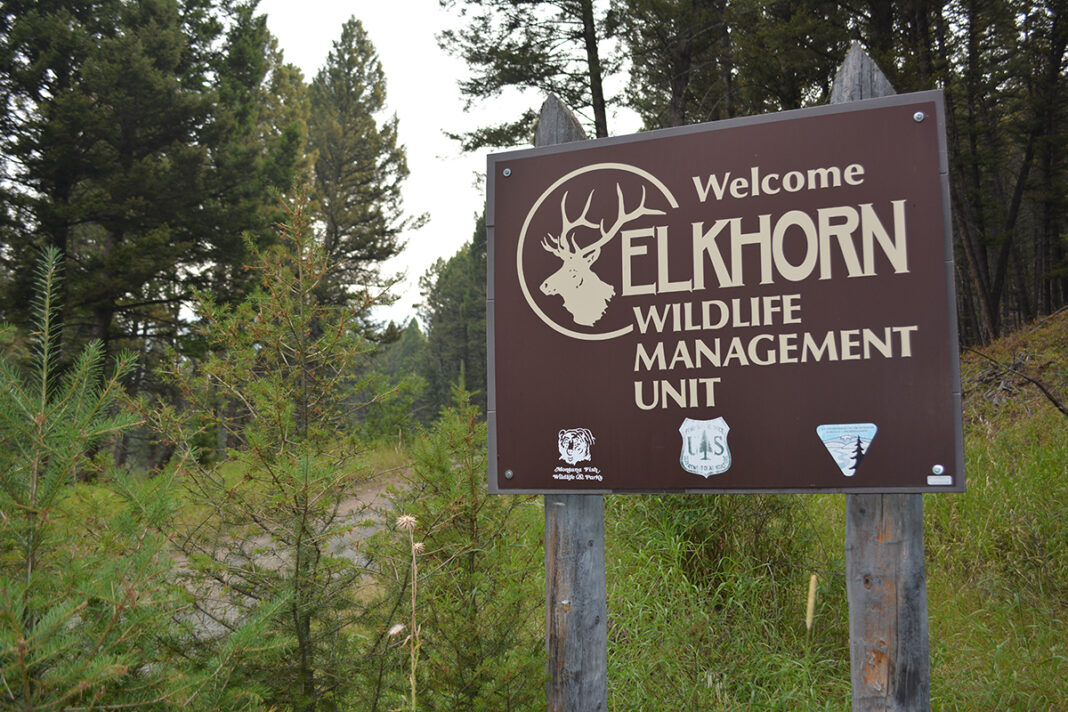
This is the final part of a three-part story on the Elkhorn Working Group (EWG), a citizen advisory body that recommends land use strategies to the public agencies managing the Elkhorn Range. First convened in 2001 to overcome controversy over elk and livestock management, the EWG has evolved their intent as emerging pressures threaten core wildlife and habitat values of the range’s unique Wildlife Management Unit (WMU) and challenge the cultural continuity of surrounding communities.
Part III explores the challenges of agency commitment to the WMU’s core values and the process of EWG consensus and continuity, bridging natural and cultural conservation to approach success.
Underlying the uniqueness of the Elkhorn Wildlife Management Unit (WMU) is the obstacle it presents: No federal law establishes the WMU. Since its inception in 1986 it survives administratively as a management prototype. Driven by public support stressing wildlife values over other uses, it was born as an alternative to wilderness. The WMU’s wildlife priority directs management only by being embedded in a series of Forest Plans which can be influenced by changing priorities and political winds.
“The Elkhorns Management Unit was never formally legislated so it operates under the discretion of the Forest Supervisor as to how it is managed,” says EWG vice-chair Mike Korn.
The Forest Service’s commitment to uphold the original intent of the WMU is critical, say EWG members, to fending off management degradation. Pressures for multiple-use, modern recreation, and access, both nationally and locally, intensify an overriding complication: In the hands of the HLCNF Supervisor, what is the priority of the WMU?
“The WMU is carried forward in the Final Draft Revised Forest Plan and shows the value of the work of the Forest Service, the public agencies, the Elkhorn Working Group, and the public that we serve,” says Bill Avey, HCLNF Forest Supervisor. “The concept established in the 1986 plan carries to the current plan, with the importance that the Forest Service recognizes for the wildlife and landscape of the WMU.”
The EWG continues to press for more explicit internal reference and guidelines that translate into implementation. This protects the WMU, especially its core.
Core values, adds Korn, have long been supported by the Forest Service and other managing agencies of the Elkhorns despite a passing of the reins. He credits George Weldon, HLCNF Townsend District Ranger when the EWG first formed, for turning down the volume on original conflict over elk and livestock management. Weldon worked to convince the Forest Service of funding and other supportive commitments vital to management of the Elkhorns.
Korn also names former EWG agency advisors Jodie Canfield, Elkhorn Coordinator with the HLCNF from 1991 until 2005, and Tom Carlsen, FWP Wildlife Biologist for the Elkhorns through the 1990s until 2012, as guiding lights. Their deep dedication to the Elkhorns landscape and comprehensive understanding of policies defined their exceptional advocacy for the priority of the WMU.
“They stepped up in a big way,” says Korn, who applauds continued commitment from agency representatives at the EWG table.
Essential elements
“People have personalities,” says David Brown, charter member and immediate past chair of the EWG. “They come with things that are important to them. If we can understand that, we can move forward.”
Brown unfolds a dynamic but thoughtful process for weighing viewpoints within the EWG.
“I’ll take this stick away. I’ll give you this one but I need these values for this consensus…. You need to be honest with yourself as an individual, how you can contribute to the good of the whole. Not with an agenda or how you can collaborate on that agenda. Everyone’s point of view is important, but not everyone’s point of view is valid. How can you understand, and respond? This task is adaptive,” he said.
The group arrives at decision by consensus, not by vote. They drafted early meeting criteria still used today to test decisions for acceptability. Reconciliation approaches breakthrough, explains charter member and past chair Brud Smith. “If you had your choice you wouldn’t do it this way. But this is better than no solution at all. It may not ever be the best solution. It’s progress.”
“It’s a self-leavening process,” says Brown of the time required for informed, spirited debate to drive progress. “It’s a revelation for some. Some people can’t live in that environment. People come and go based on their ability to manage that kind of setting.”
Progress over time, says vice-chair Korn, relies on relationships, and key relationships need key people. An open process to bring in new members allows the group to reflect on current perspectives while embracing veteran knowledge.
“To have success,” says long-standing member Ron Marcoux, “you have to constantly analyze yourselves as a group.”
“We work hard to get diversity,” says Brown, who has pushed for youth and new leadership to “pass the glory around a little bit.” To that end, he encouraged current chair Joe Cohenour to follow him into the position early in 2019.
A call for members in November 2019 resulted in five appointees. According to Korn, recruits were evaluated to encourage a younger cross-section familiar with the WMU and its managing agencies. Of additional value was an informed grasp of the unforeseen impacts of modern recreation and development that have arisen. Mentorship pairings of new members with veterans merge a continuity of knowledge with fresh and relevant perspective to provide depth of understanding.
“The value of the recommendation will only be as good as the credibility of the group,” says Marcoux. “The value of the group is not getting involved politically one way or another, but to work through issues, look at options, be objective about it.”
“The group has no power other than the power of citizen voice,” says Korn. Brown adds that members “represent the communities and don’t stand on a single, contentious platform.”
Marcoux tempers success with perspective. “Don’t feel bad if you’re not accomplishing everything that there is. You’re at least shedding some light in the darkness.”
Bridging natural and cultural conservation
“We’re all moving in the same direction,” says Korn. “I see value in that both as a community and as a resource. If we don’t also look at the Elkhorns as a cultural resource, we’re going to look at the reason we started and perhaps see it’s long gone. Natural and cultural conservation go hand in hand.”
The unique wildlife priority of the WMU roots conservation at the core of culture and its values cherished locally, historically, consistently, passionately. From native American inhabitance, grown on ranching, grazing, hunting, and recreating in primitive settings, communities around the Elkhorns lend voice to an influence that gains power, like anything, with time.
Are intensifying threats inevitable?
“Probably,” Korn says. “But maybe we can slow them down a little bit. By maintaining the core of what we are trying to do and perpetuating it into the future. Maintaining why this place was set aside – maintaining the Elkhorns for the important resource it is. We can, if we fall back on our common values and go from there. The Elkhorn Working Group can provide a means of dealing with emerging issues. The feds are accountable to everyone in the U.S. We can have some influence on how that’s done. The EWG is a means of doing it in a real constructive way.”
He smiles, cocks his head. “But, it ain’t easy.”
Current members of the Elkhorn Working Group
•David Brown is a charter member of the EWG, original chair of the group, and subsequent chair serving again until early 2019. Brown is now a full-time rancher in the Helena Valley after a 40-year career as a commercial ag lender.
•Mike Korn is current vice-chair of the EWG. Since the EWG’s inception, Korn first served as agency representative for FWP (Helena Area Coordinator then Deputy Chief of Law Enforcement) before becoming a voting member in 2016.
•Ron Marcoux attended early EWG meetings as a representative for the Rocky Mountain Elk Foundation before becoming a voting member, and before that, he was the Deputy Director of FWP in the 1980s when the Elkhorn WMU was designated.
•Brud Smith is a charter member of the EWG and past chair. A rancher in the Boulder Valley, he is also a grazing permit holder whose family has ranched in the Boulder Valley since the 1860s.
•Adam Grove is Townsend District Wildlife Biologist for FWP who has served as agency advisor to the EWG since 2014.
•Ryan Fetherston was appointed in March 2020. He grew up exploring the Elkhorns and works as a teacher at Clancy Elementary School.
•Bret Lian was appointed in March 2020. He grew up in Clancy, playing and exploring in the Elkhorns, and is interested in public lands management.
•Bill Avey is Forest Supervisor for the Helena-Lewis and Clark National Forest.