
There is a circle of life aspect to a 4-H show, sweet, sad and true. Young farmers buy their animals each autumn or spring. They spend months caring for their cattle, hogs, sheep and other livestock — feeding them daily or more often, training and exercising, grooming. And hoping they’ll peak at the right moment in late August.
Then, finally and suddenly, it’s fair week, and the Boulder Outlaws, the local 4-H outpost here, dig in. Kids check their animals in on Wednesday — and for the next four or five days, they pretty much live in the animal barn, farmers and livestock forming an intimate and purposeful commune.
Hogs, cattle, lambs and goats are shown in the ring outside the barn on Thursday, then rabbits and poultry in their cages on Friday. Those are the public displays, and they can be both thrilling and nerve wracking for participants. Control your animal, and keep your eyes on the judge. The animals don’t know they’re on display, so they may or may do what’s wanted.
But the real action, and the real work, is back in the barn.
Hope Nelson is spraying her goat’s hooves with polish, bringing them to a black sheen for good presentation. Hope says showing “definitely is a learning curve,” but this is not her first rodeo, you might say; after years of 4-H, “she knows what she’s doing,” a judge remarked later as he awarded Nelson’s goat best-in-show.
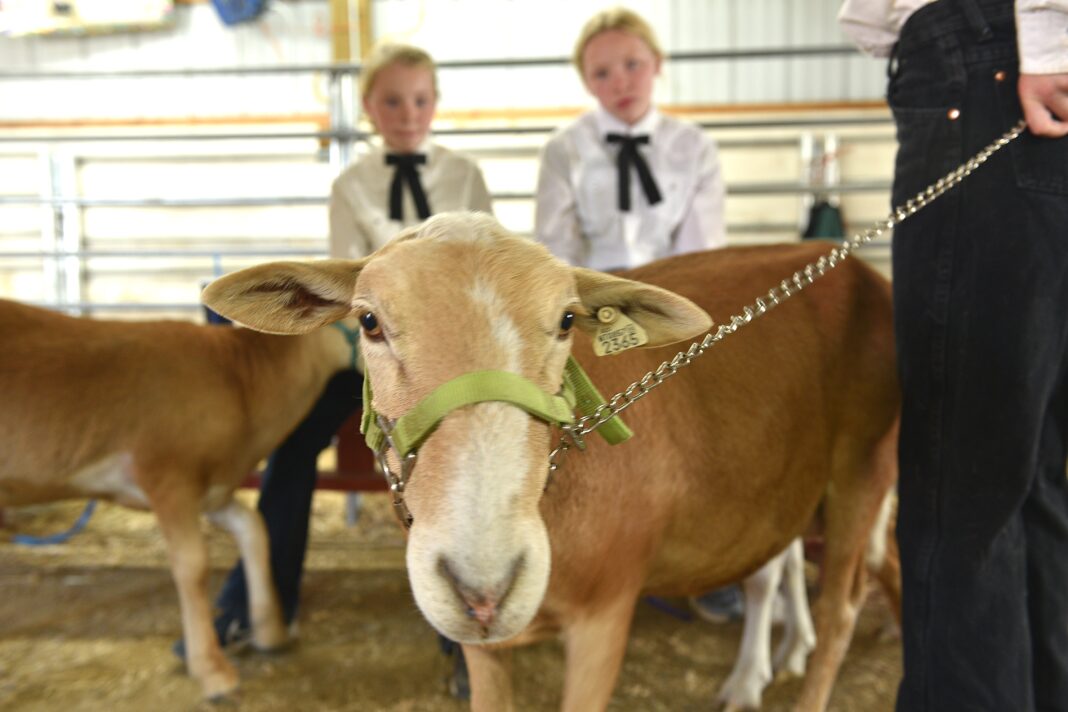
Piper Dawson brushes her Katahdin ewe, Sunny, and its triplets, Frank, Franny and Francis. She’s showing them as a breeding group — she bought Sunny last year, and bred the ewe with the ram she already owned. Piper is just 13, but well on her way to building a small flock. The breeding, “I’m still figuring it out, she says. She’s watched a lot of instructional videos on YouTube.
Hadley Becker is spritzing her hog, Bonnie. “I spray her a lot,” she says, because pigs don’t sweat, and there’s no mud in the barn to cool off in. At 300 pounds, Bonnie is the heaviest hog in the barn. Why? “Because I feed her a lot,” Hadley explains.
The next day, like most of her 4-H peers, Hadley will put her animal up for auction. “Yeah, it’s hard,” she says. “We have a bond. I’m really hoping the buyer is a pig breeder, so she doesn’t go to market.”
Yeah, this is the thing, a tough 4-H lesson. You can fall in love with your animal, but in the end, it’s an animal. It lives and dies, arrives and departs. And you start over.
The auction is where rubber meets road, and where months of work pay off — or maybe don’t. The economics are uncertain: A 4-H farmer might invest $100 to $700 for a young hog, then several hundred dollars more on feed. Cattle are riskier: Marlee Sarchet bought her Gelbvieh steer, Curly, for $1,700, and spent another $800 on feed over nine months. She’s not guaranteed to earn it back. That’s another part of the 4-H education — real-life market economics.
It’s back into the ring, farmers tricked out in the Outlaws show uniform of jeans, fitted white shirts, and western bow ties. They take their animals a lap or two around — or, with the hogs, which take direction only anecdotally, some approximation.
This is a hometown crowd, full of friends and family and folks who mostly appreciate the work that’s gone into all this. Many animals will see at a premium to market, a reward for the toil and sweat; a couple of bidders will instruct the auctioneer to “sell it again,” meaning the 4-H-er collects more or less double.
In the end, Curly sells for $3,250 to L&P Grocery. The steer will be trucked to a processor the following Monday, along with two bovine companions. Hope Nelson’s grand champion, a Black Angus named Stetson, goes for $3,500 to the Windsor Bar.
Among the hogs, Wyatt Nordlinder’s grand champion sells for $3,500 to Rusty Giulio. And Hadley Becker’s pig, Bonnie? She’s bought by Jackson Enterprises for $3,100. Her fate is unknown.
And that’s it; months of work is nearly done. Animals that aren’t auctioned will be collected on Sunday. Then, it’s time for school, for sports and friends and chores and maybe a few months off before the 4-Hers buy animals again for next year. Before they start over.