
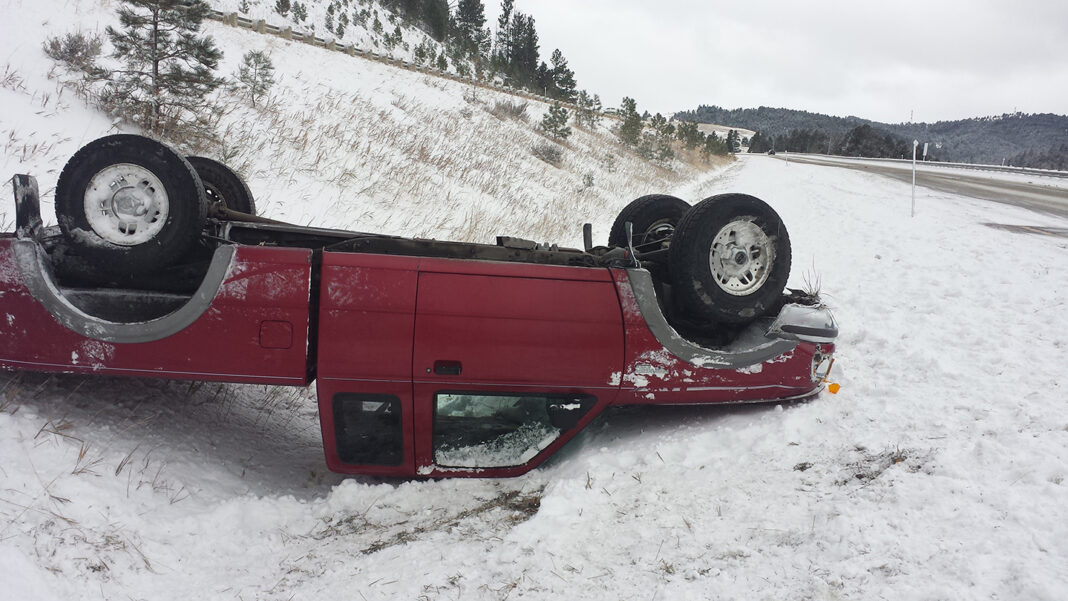
Jefferson City Volunteer Fire Chief Bud Siderits believes he’s picked up on a pattern.
Siderits has noted a number of rollover accidents since 2010 involving vehicles driving along I-15 — with the majority occurring southbound near the Jefferson City interchange.
The most recent was in June and resulted in a fatality.
The Montana Highway Patrol has recorded eight rollovers in the past 10 years between mile markers 175-176 on I-15 at Jefferson City.
The frequency of the rollovers prompted Siderits to write a letter to the Montana Department of Transportation in June to see if there is something about the highway itself that is contributing to the accidents.
The Montana Department of Transportation did not indicate if that was an unusually high number of rollovers by press time.
When the Monitor asked about the letter, the Montana Department of Transportation stated that its safety program will review Siderits’ request to look into why these types of accidents are happening at this location. Siderits said he also received a call from the MDOT in response to his letter.
In each of the eight rollover accidents, the MDOT data indicates either that the driver was driving too fast for the conditions at the time — such as rain, ice, frost or snow — or that the driver was operating the vehicle in an erratic, reckless, negligent or aggressive manner.
Since 2010, there have been more than 250 rollovers alone on I-15 in Jefferson County. Other interchange areas with a larger number of rollovers, according to the spreadsheet provided by the Montana Highway Patrol, include Basin and Woodville, with eight and seven, respectively.
Weather conditions for the more than 250 rollovers were all over the map — from dry to snow and slush, daylight to dark. However, in the majority of those incidents, according to a Monitor analysis, the driver was listed as having been driving too fast for the road conditions or driving in an erratic reckless, negligent or aggressive manner. Of those, there were six fatalities, including the one this year at Jefferson City.
Basin Fire Chief Brian Gasch wasn’t surprised to hear the number of rollovers near Basin, and along the stretch of highway between mile markers 155-157.
“There is an extreme number of call outs for accidents” along that stretch, he said.
Gasch said the curve at mile marker 155 is especially tricky and thinks the reduced speed there — 55 mph — is still too fast.
The area also includes seven bridge decks and those ice up in the winter, said Gasch.
For drivers doing 80 mph along those curves, Gasch compares it to NASCAR.
“You’re doing Mario Andretti stuff,” he said, adding that the number of accidents dropped when the speed limit was reduced from 80 to 70 mph just south of Boulder to Elk Park.
Overall, the Montana Highway Patrol lists 67 crashes, including the rollovers, over a 12-year period on the two mile stretch of road near the Jefferson City interchange.
That is about 5.5 crashes a year, and half of those were animal accidents, according to Dave Colamaria, data control technician with the Montana Highway Patrol.
That translates into about two to three non-animal crashes per year in that stretch, said Colamaria.
“As a state, we average over 23,000 crashes per year, but it is hard to say what is a lot or a little for any particular section. Quite a few of the non-animal crashes seem to indicate driving too fast or erratically, particularly in poor weather/road conditions,” said Colamaria.
Siderits has also noted the number of animal crashes around Jefferson City, particularly near the curves headed toward Boulder Hill.
Siderits thinks the interstate gives drivers a false sense of security — and says that perhaps the speed limit, which is currently 80 mph, might need to be reduced. He also suggested some signage warning motorists to slow down as they approach the Jefferson City interchange.
Jefferson VFD President Dave Cooper also thinks the speed limit is an issue. He prepared a chart showing that since 2011, 75 percent of the departments interstate calls were for traffic incidents. Of those, 58 percent were around Boulder Hill.
Montana increased its speed limit from 75 to 80 mph in 2015.
With the speed limit increase, Cooper estimates that people nudge that up a bit to 85 mph.
And according to Cooper’s chart, that’s when the incidents began to increase, particularly between October and March.
“We can’t necessarily avoid weather, but there are things we can do,” said Cooper, suggesting possible fixes like treating that stretch of road for ice and making better use of variable signage.
Then again, that stretch of road doesn’t need to be 80 mph during that time of year, he said.
“It’s an accident waiting to happen,” said Cooper.
The Montana Department of Transportation uses crash data, among other measures, for setting speed limits, according to Traffic and Safety Engineer Gabe Priebe.
However, general speed limits are set by statute and special (reduced) speed zones are established by the Montana Transportation Commission based on engineering studies; and these studies involve gathering and analyzing speed data, crash data and citation data as well as host of other variables. MDT will conduct an engineering study for a special speed zone based on a request from the local government, according to Priebe.
In addition to crash data, the MDOT also uses a benefit cost ratio to prioritize projects funded through the Highway Safety Improvement Program — and are awarded through a competitive program, according to Priebe.
HSIP projects may result in an array of improvements — from signage and pavement markings to straightening a curve, according to Priebe.
Meanwhile, Siderits thinks that rollovers must be particularly traumatic for the driver and the occupants of a vehicle — hence his added concern.
“It is significant,” said Siderits.