
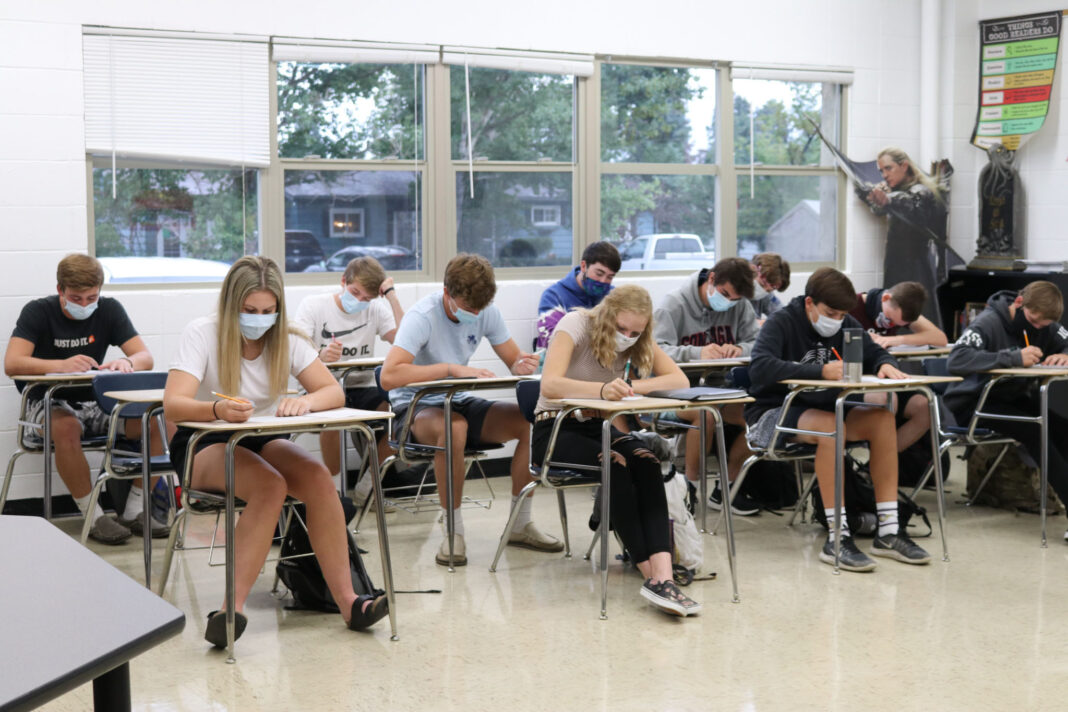
Students are back to boarding big yellow school buses and heading back to the classroom — most of them, anyway.
Relatively few Jefferson County parents and students opted for remote learning this fall despite the ongoing threat of the COVID-19 pandemic going into a new academic year.
About 9% of Jefferson High School’s students opted to participate in remote learning this fall — 26 students out of a in-school population of 270, said Principal Mike Moodry.
Boulder Elementary has 25 out of 165 students, or roughly 15%, chose remote learning, while Clancy had and Montana City have 32 and 34 remote learners, respectively.
This time, school administrators, teachers and parents had the summer to adjust to school on a screen — as opposed to last March when swiftly enacted stay-at-home orders abruptly put an end to in-person classes and the switch to unfamiliar digital platforms was anything but smooth.
Also this fall, those who are learning remotely made the choice to do so.
At Jefferson High School, remote students join the in-person class via digital platforms such as Teams or Google Meet, said Moodry.
What’s changed since the spring is that the learning is conducted in a synchronized fashion, rather than asynchronous — meaning that the remote students are learning along with their in-person classmates in real time, said Moodry.
With this format, the remote students can raise their hand and communicate with the teacher and other students as the lessons progress, said Moodry.
Biology and business teacher Dawn Smartnick said she has a few remote learners in her classes this year.
Juggling the in-person and remote students is a challenge, probably one of the biggest in her career, she said.
“I strive to provide the same educational opportunities for both learners, but I am somewhat limited with my remote learners, especially with hands-on learning experiences, field trips, etc. My hope is that we can all reach the same educational goals at the end of the first quarter and beyond,” said Smartnick in an email.
What is helpful is that the remote students are required to “join” the classroom virtually in real time, which, unlike in the spring, allows Smartnick to shut off her computer at home before 10 p.m.
That was one complaint voiced by teachers and parents last spring — because all students were either online learning at different times or getting instruction through paper packets — the school day seemed to expand beyond the typical set hours.
During the first week, Smartnick said she also tended to help the 20-plus students who were physically in the classroom and had to remember she had students online too.
“This is a unique learning experience, and with time, I am hoping to have this all working like a well-oiled machine,” she said.
Moodry said the remote learning option has added some extra work for teachers, but there has also been time set aside during the week for one-on-one enrichment time for teachers to meet with their online students, he said.
Boulder Elementary School has dedicated two teachers to work exclusively with the remote students, said Superintendent and Principal Maria Pace. The school has also purchased Chromebooks to make sure those students have the necessary technology to participate. The remote teachers are using a variety of platforms, such as Google Meet, Zoom and Seesaw, the latter a good tool for engaging students, said Pace.
Over the summer, the teachers developed the “BES Remote Learning Plan,” that outlines expectations and resources for parents, she said. The school is also using a remote learning “play book” suite of tools through Corwin, a company that offers educational resources.
The parents of remote students at Boulder Elementary signed on for an initial nine weeks. Students are required to log in and the teachers take attendance, said Pace.
The students are encouraged to attend all classes, complete all assignments and parents are asked to create a distraction free area in their home for school time and participate in the learning process, said Pace.
The school has designated Rochelle Hesford as the family engagement coordinator to help parents and students in this process — a position funded by the literacy grant. Hesford is also serving as the school’s COVID-19 tracker.
“Now we understand a little bit more about it and have had more opportunity to do some research and gain insight,” said Pace about how the remote learning format has changed since the spring.
At Montana City School remote students in grades K-5 will be clustered with the same teacher, who is being assisted by instructional coaches, who are certified teachers, according to Curriculum Director and 3-5 Principal Cori Trudeau.
The entire school day will not be conducted online, however, as teachers will have afternoon office hours specifically set aside for remote students, according to Trudeau.
Students in grades 6-8 will log in simultaneously along with their in-person classmates, according to Trudeau.
Clancy plans to use Google Meet along with its Google Classroom program and will also follow a simultaneous learning environment.
In the end, teaching remotely is still new, said Moodry.
Teachers are classically trained to be in front of a classroom with students physically there with them, and school buildings were not designed for online learning, he said.
The high school is working to make sure the bandwidth is adequate and so far, it’s been working, said Moodry, adding that teachers and students are being trained to use the various devices and platforms for remote learning.
“We’ll make sure it ’s the best we can possibly do,” he said.
Reporter Bridget Weigel contributed to this report.