
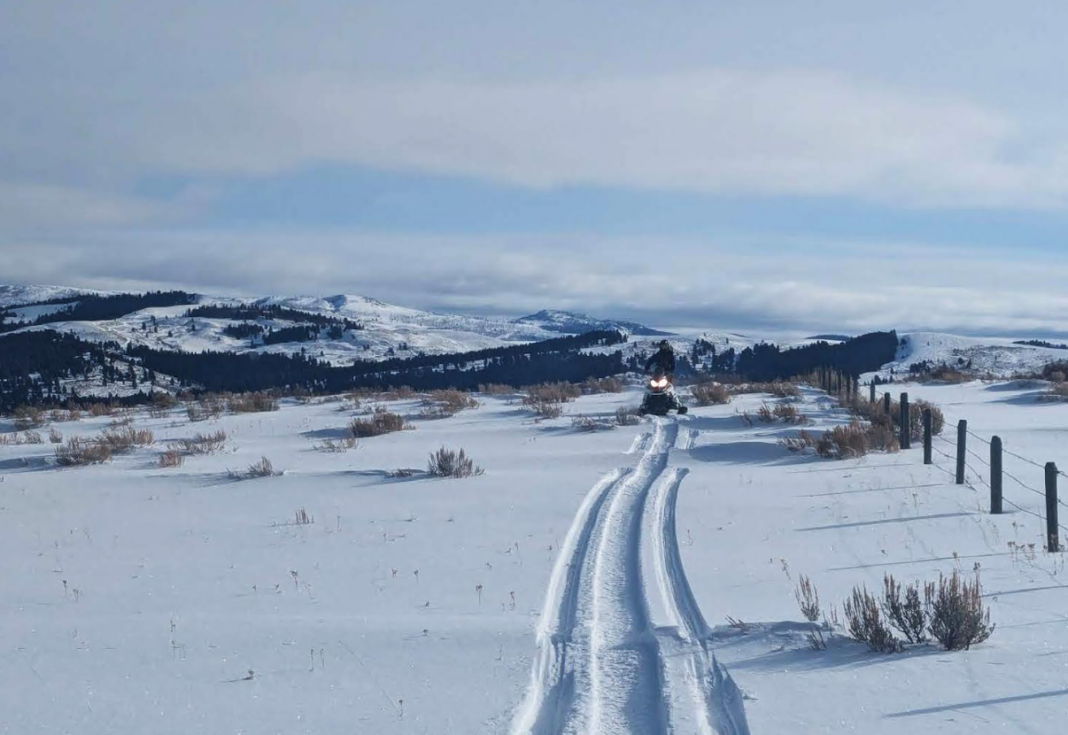
As this balmy winter rolls on, local fears of a dry summer may be gaining steam after the federal government declared Jefferson County a drought disaster area and released troubling precipitation data.
Maura Casey, Great Falls-based warning coordination meteorologist with the National Weather Service, last week ranked the county at D1 drought, the least intense of four levels. Local streamflows running are a bit high, but due to potentially worrying early melt.
“It looks good right now, but the expected loss of snowpack down the line is not expected to be beneficial,” she told the Local Emergency Planning Committee meeting, adding that higher elevations mostly remained at 75-100% of median.
“It’s the valleys and foothills where we’ve been suffering most,” Casey said, looking ahead to more warm days and more melt. “At 6800 feet we’re near record lows in terms of snowpack.”
Indeed, lower elevation totals – responsible for much of the spring and summer runoff – have begun to elicit broader concern.
“Mid elevation snowpack is falling behind and low elevation snowpack is noticeably absent,” Florence Miller, U.S. Department of Agriculture Natural Resources Conservation Service hydrologist, said of Montana’s winter precipitation in a Feb. 5 statement.
Miller cited below-average precipitation in Boulder as compared to the 1991-2020 median. “Monthly precipitation in the Boulder Subbasin was only 62% of median for January,” she said, adding that the basin typically reaches peak snow-water equivalent in mid-to-late April. “We’re only halfway through the winter and the snowpack story could change in the coming months.”
The key question, as spring looms, may be how much of the Upper Missouri Basin’s snowmelt comes from higher elevations, given that medium and lower elevations represent a much greater area. A Utah lab has found that just 5-15 percent of that state’s annual snowpack water comes from higher elevations – meaning around 90% of its runoff comes from mid to lower elevations.
Michael Downey, Montana’s drought program coordinator, questioned that figure and its applicability here. “I was very suspicious of that number from Utah if only because it’s something that’s really difficult to put an accurate number to,” he said. “There are so many variables that go into that number, and they are likely to differ between years.”
Jefferson County faced an even drier winter two years ago, when mid-January snowpack was 30-60% of the median and most stations reported record or near-record lows. That year’s drought ultimately cost Montana’s agricultural producers more than half a billion dollars, or 10% of total output, according to the American Farm Bureau.
This may explain why area ranchers are starting to feel the heat, particularly after the USDA designated Jefferson County a primary natural disaster area due to drought. “This weather right now is really stressful,” Boulder Valley rancher Darby Smith said in an interview. “We don’t know what this summer is gonna look like. It’s probably not gonna be great.”
February is too early to talk of fire risk, but Casey, the NWS meteorologist, expressed concern about drying fine fuels and reduced snowpack. Helena-Lewis & Clark National Forest Supervisor Emily Platt acknowledged that poor winter/spring precipitation tends to impact wildfire season.
“The dryness is definitely one factor that affects how quickly fires burn, how quickly they spread,” she said in an interview last week, adding that she had not begun to consider seasonal fire restrictions.
“We try to only do that when it’s necessary because we like people to be able to have campfires,” said Platt, expressing further concern about the forest itself.
“Drought conditions,” she said, “will make trees more prone to insect mortality…more susceptible to some kind of disturbance.”