
The arrival of COVID-19 vaccines has marked the beginning of the end of the pandemic, and EMTs in Jefferson County are at the forefront of helping get those administered.
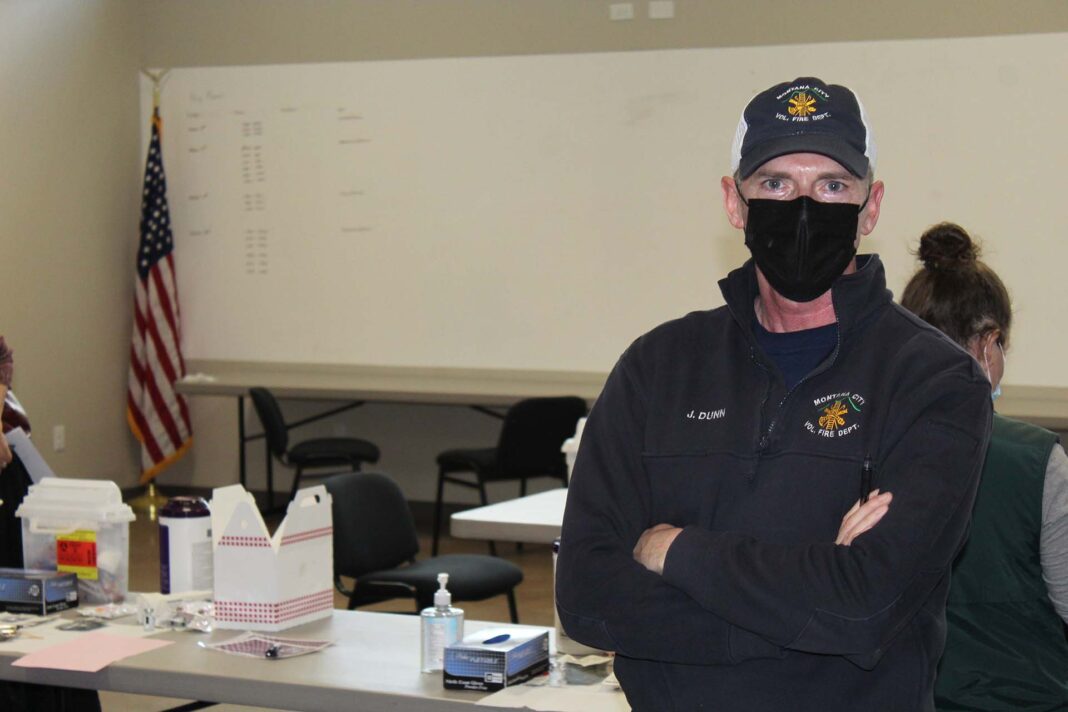
Joseph Dunn and Larry Alheim are firefighters and EMTs with the Montana City Volunteer Fire Department. They have been providing support to the Jefferson County Public Health Department as it conducts weekly vaccination clinics at the firehouse.
EMTs Dunn and Alheim are the last to be featured in The Boulder Monitor’s series on those working the front lines of the pandemic. The feature series has highlighted what it has been like for those working directly with the public over the past year, despite the risk, and has included school bus drivers, grocery store workers, school support staff, librarians, firefighters, postal workers and those in the food service industry.
Dunn and Alheim, as well as those with Boulder Ambulance, have been on hand during the clinics to monitor individuals after they have received their shots. Those having received a vaccination are asked to remain on site for about 15 minutes to make sure there isn’t an immediate adverse reaction. If there is, the EMTs are on hand to help.
This works well for Alheim, who describes himself as having the “gift of gab.”
“I enjoy talking to people,” he said, and he does just that, chatting up the residents he serves before and after they receive their vaccinations.
It’s good to see people getting their shots — and the service being available in the northern end of the county, he said.
Alheim stepped away from responding to medical calls when the pandemic hit because he was at a higher risk for the virus. He got it anyway — despite all precautions — and fortunately it wasn’t a severe case. And since he’s also been vaccinated, Alheim returned to running medical calls in January.
“I am invincible,” he joked.
The biggest change is that all responders try to minimize contact with patients on calls, said Alheim. Whereas in the past five EMTs would go inside a residence, now it is two, with the remainder waiting outside getting ready for transport. Alheim said it hasn’t slowed down the response time, just changed how it’s done.
Dunn is an EMT, as well as an emergency room nurse at St. Pete’s in Helena.
Dunn hasn’t noticed a change in the number of calls — that is, folks hesitant to call an ambulance because of the virus. The team is alerted if a call may be a suspected COVID-19 case so they can suit up with the appropriate PPE, or personal protective equipment.
What Dunn has noticed the most is that COVID-19 is not the flu.
The progress of the flu is predictable, COVID-19 is not, said Dunn.
With COVID-19 cases, the EMTs have made multiple visits to the same house, and many are what are called “long-haulers,” those whose recovery is slower.
The difference between the flu and COVID-19 is “enough that we take note of it,” he said.
Despite his work as an EMT, an emergency room nurse, as well as teaching at Helena College, Dunn has managed to avoid contracting the virus, although he has now been fully vaccinated. Dunn credits his avoidance of COVID-19 to wearing a mask, appropriate PPE, hand washing and social distancing when able.
“It’s prudent to wear masks,” he said. What’s been particularly hard for Dunn is the amount of misinformation, distrust and politicalization that has developed around pandemic. He’s been in the medical field for 25 years, has worked through prior epidemics such as the swine flu, but has never seen anything like it.
“It becomes exhausting,” he said of trying to combat the misinformation and anxiety expressed by some of those he comes into contact with in his work.
Dunn looks forward to going out to coffee again with friends and colleagues. The pandemic has really cut into his social life, he said.
The social isolation has been the hardest to deal with, said Dunn.
His workin the emergency room, as well as an EMT, is stressful, and he misses being able to decompress with co-workers. It’s also been hard to work while wearing full PPE, said Dunn.
Alheim wants to stop hearing the phrase, “the new normal.” For some reason, it just irks him.
He also wants to return to the East Coast, where his entire family, except his own, lives within a 100 mile radius in central New York state. It’s been more than three years since he’s been back for the family’s annual gathering on Cape Cod.
“I’d really like to get back to that,” he said.
The plan so far?
The family is going this summer, said Alheim.