
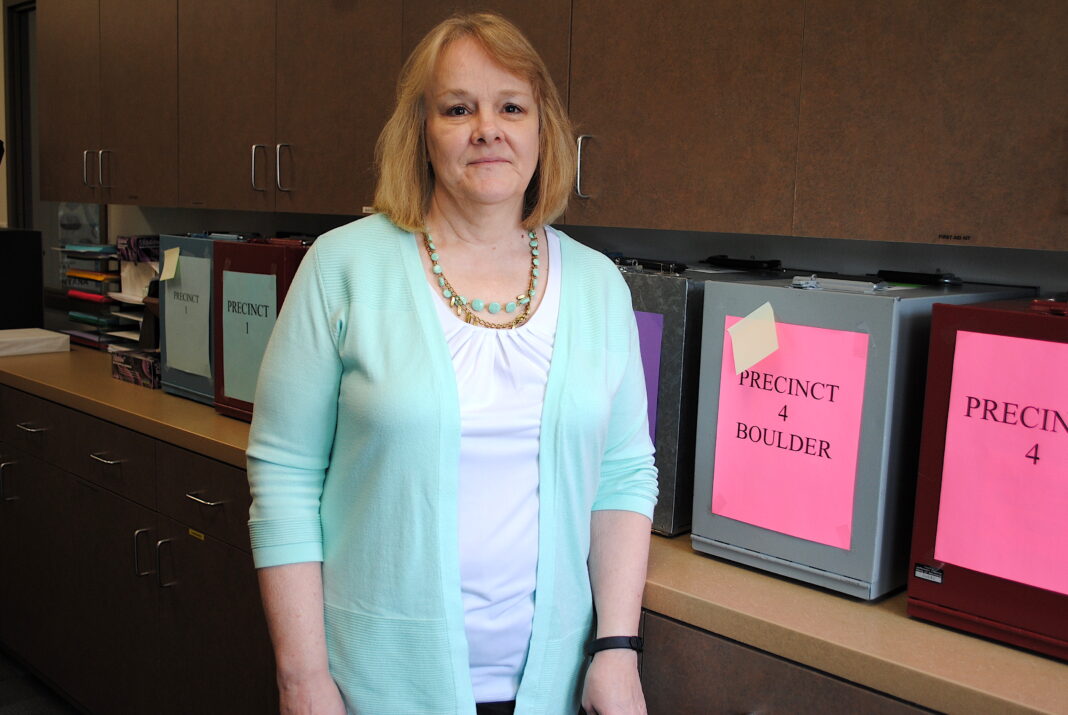
Jefferson County Election Administrator Bonnie Ramey wrote this “point-counterpoint” in response to questions from residents concerning the decision to hold a mail ballot election in November. She addresses oft-heard comments and concerns about mail ballots versus voting in person at the polls.
Concern: There’s no difference between standing in a line at a polling place than standing in a line at a store.
Lines at stores are not hours long. The longer a person carrying the virus is in one place, the more exposure they present to others and the greater the likelihood of continuing the transmission of the virus.
If voting is being compared to shopping, an appropriate comparison would be Black Friday. Also, voters are assigned to a polling place and must vote there. Customers can choose any store they prefer based on proximity and crowding.
The CDC provides guidance for many sectors. For election officials, one of their guiding principles is, “…any other feasible option for reducing the number of voters who congregate indoors in polling locations at the same time.” Another suggestion they provide is, “Where available in your jurisdiction, offer alternative voting methods that minimize direct contact and reduce crowd size at polling locations.” And to, “Consider offering alternatives to in-person voting if allowed in the jurisdiction.” In Montana, the alternative available under the law is our time-tested vote by mail with an in-person voting option.
Concern: Mail ballots and absentee ballots are not the same thing.
They are very much the same thing. The only difference is the chapter of Title 13 of Montana Code Annotated the election is being conducted under. Title 13, Chapter 13, Part 2 is specific to how electors who are absent from a polling place may vote. Chapter 19 of this title is specific to the conduct of a mail ballot (i.e. all-mail) election. Each of these chapters cross references to the other, thus showing that the procedures for one are the same as the other – both in issuing and accepting ballots.
In a polling place election, absentee ballots are mailed to active and provisionally registered voters who request an absentee ballot. In a mail ballot election, ballots are mailed to active and provisionally registered voters. When you register to vote in Montana, you must provide a verifiable ID number or copy of ID. If the number is not verified, you are provisionally registered, and your ballot can only be counted if you provide verifiable ID first. In other words, you must first register to vote with verifiable ID to have a ballot sent to you. Otherwise, the processes for issuing and receipting absentee and mail ballots are the same. Every ballot issued, and every ballot returned is tracked. The same signature verification process is used.
Concern: Dead people get mail ballots.
Voter rolls are constantly maintained. The Montana Department of Health and Human Services provides quarterly updates to county election offices. The county’s death list is also used to crosscheck voters prior to ballots being issued. If a ballot is sent to a deceased voter, more times than not we receive it back with notations that the voter has passed away. All signatures on affirmation envelopes are checked against the exhibits in the voters’ records. If the signature is forged, it will most likely be rejected as a “signature mismatch” and would not be counted.
Concern: People move and somebody else votes their ballot.
Voter rolls in Jefferson County are checked annually against the National Change of Address (NCOA) registry and sent confirmation mailings to ensure that ballots are sent to the correct address. All signatures on affirmation envelopes are checked against the exhibits in the voters’ records. If the signature is forged, it will most likely be rejected as a “signature mismatch” and would not be counted.
In all-mail elections, every person gets a ballot regardless of if they’re registered or not.
The election office uses voter rolls for all purposes and has no other database from which to draw recipients of election materials. In all-mail elections, only ACTIVE registered voters are sent a ballot. Inactive voters are not sent ballots in all-mail elections. Voters become inactive due to not responding to confirmation mailings as a result of either not voting in a federal general election or a mail ballot being returned to the election office as “undeliverable”.
Mail ballot elections actually aid in maintaining accurate voter rolls because of the laws related to undeliverable ballots.
Concern: The Postal Service cannot handle this much mail.
The USPS is very much equipped to handle the task as they did in June and have done in all other elections. The volume of election mail will be less than the volume of mail sent between Thanksgiving andChristmas.
We have very close relationships with the five postmasters in the county. In all elections, we partner with each other to ensure that ballots are sent correctly and received timely. There is detailed coordination to ensure that election mail is properly flagged and processed.
Annette Weisenbach, Mailing Standards Specialist, USPS Dakotas District, had the following to say in response to county election administrator’s concerns:
“The Postal Service receives no tax dollars for operating expenses and relies on the sale of postage, products and services to fund its operations. Further, the Postal Service’s financial condition is not going to impact our ability to process and deliver election and political mail.”
Voters and election officials can rest assured that the U.S. Postal Service remains fully committed to fulfilling its role in the electoral process when policymakers choose to use our services in administering elections. The Postal Service can fully handle and deliver the anticipated increase in Election Mail volume and is continuing to coordinate with state and local election officials through November. Election officials and voters are being asked to be mindful of the Postal Service’s established delivery standards and consider how the mail actually works, so that voters have adequate time to request, receive, complete and send their mail-in ballots. The Postal Service will continue to do everything in its power to efficiently handle and deliver Election Mail, including ballots, in a manner consistent with the proven processes and procedures that we have relied on for years.
Concern: Mail ballot elections are not how voters typically vote.
Generally, the only elections that are conducted by poll/absentee are federal/statewide elections. The majority of elections conducted in Montana are conducted by mail ballot and do not have polling places available. These include countywide, municipal, school, and special district elections. In all elections, voters may vote in-person at the county election office for 30-days prior to the election and cast their ballot.
Even when polls are open, most people vote by mail.
Concern: Mail ballot elections are more susceptible to fraud.
Mail/absentee ballots have fraud prevention features that polling place ballots do not. Specifically, when a ballot is returned in the mail or in a return envelope at a place of deposit, the signature contained on the envelope is compared to the signatures on file for that voter before the ballot can be accepted and counted. This level of scrutiny is an aspect of security that polling place elections do not have. While a voter at a polling place will sign the register when receiving a ballot, there is no comparison of this signature to any other exhibit of that voter’s signature.
Concern: This is against the Constitution.
Nothing in the US Constitution or the Constitution of the State of Montana prevents elections from occurring by mail. Article IV of Montana’s Constitution is specific to allowing absentee voting and requires the Legislature to provide laws for the administration of elections, such as mail-ballot elections.
Concern: Ballot boxes can be stolen in a mail ballot election.
Ballot boxes are not left unattended and will be staffed by at least two election officials at all times.
Concern: Mail is stolen and the ballots are harvested and voted.
Signature verification is the cornerstone of accepting mail/absentee ballots. All signatures on affirmation envelopes are checked against the exhibits in the voters’ records. If the signature is forged, it will most likely be rejected as a “signature mismatch” and would not be counted.
Concern: Election officials can change votes and fill in ovals on unvoted contests of ballot returned by mail.
The process of opening secrecy envelopes is monitored and observable by the public.
Concern: Election officials do not have adequate training required to conduct a mail ballot election.
This is a headline we are seeing nationally, but is not relevant to Montana’s elections. While it may apply in some states, Montana has laws governing mail ballot elections and election officials with years of experience in conducting these types of elections.
Polling place elections and the laws that govern them require a great deal more training and understanding by election officials. The chance of an election official making an error that could cause potential harm to a voter is greater in a polling place election than it is in a mail ballot election.
By the numbers
As of Oct. 2 in Jefferson County:
• Registered voters: 9,148
• Active + provisional voters: 8,414
• Absentee voters: 6,308
• 74.97% of active and provisional voters are absentee
• 68.95% of all registered voters are absentee
Just the facts
With the exception of elections for federal/statewide offices, all elections in Jefferson County are conducted by mail ballot, with an accessible, in-person voting option.
Montana has robust, time-tested laws that govern mail ballot elections.
Jefferson County has developed processes for conducting elections by mail ballot.
There is no evidence that mail ballot elections are more susceptible to fraud and tampering. Any evidence of voter or election fraud should be reported to the election office, the police, the county attorney’s office, or the commissioner of political practices so it can be investigated. As with any crime, details help with investigation.
Election processes are open to public observation.
In all elections, voters may vote in-person at the county election office for 30-days prior to the election and cast their ballot.
— Bonnie Ramey, Jefferson County Election Administrator