
This warm, dry winter is one for the record books. While it has been nice for those of us who have to work outdoors, it may be wreaking havoc on our watersheds and flora.
What might this dry warm weather mean for the survivability of our plants? There has been a great deal of local news coverage on this weather, including in The Monitor.
I thought I’d add to the discussion with some myth-busting, a bit of forecasting and a few solutions. And I should clarify that the below generally applies to all woody plants, meaning trees and shrubs. Let’s start by busting some myths:
Myth 1: watering trees in fall/winter could interrupt their dormancy period.
Think about it: if this were true it would mean any heavy rain in the fall or winter would “awaken” trees too early, leading to mass fatalities in forests and neighborhoods.
Thankfully, this is not the reality. Plants cue their dormancy cycles upon the temperature and the photo-period, not upon the soil’s moisture level. Trees transpire (lose moisture) in winter, especially evergreen trees. They need to have adequate moisture reserves in their roots and in the soil. Without these reserves, some of the small fibrous roots die, which usually translates into some canopy die off, typically the most recent growth.
Myth 2: Deep watering is the only way to give trees adequate water.
Plants, especially trees, are able to do “hydraulic redistribution”. This means that trees move moisture around the root zone to where it is needed. Sometimes they even release moisture back into the soil. Deep watering may encourage roots to go deeper searching for that moisture. But the best practice is watering from the surface, or just below the surface.
Myth 3: Trees “sleep” in winter, so we don’t need to worry about them until spring.
This is also false. Not only do trees transpire in winter, there’s also root growth that can occur in just above freezing soil conditions. With these recent high February temperatures, we’re nearing the point at which root growth and bud break, signaling the start of the spring growing season, occur.
Root growth generally occurs when soil temperatures reach about 40 degrees Fahrenheit, while bud break occurs when air temperatures approach 60 degrees. If bud break occurs followed by extended freezing temperatures, we will likely see some frost damage and die back. So we do need to pay some attention to trees in winter.
Now on to some predictions. Many areas of the state are seeing their plants begin to break dormancy. Fortunately, I have seen limited signs of trees breaking dormancy, and it has been mostly the aspens and other poplars. I’m closely watching plants in Helena and Whitehall because they are typically a week or two ahead of those in the Boulder area.
If we have another week of 50-degree days followed by an extended freeze in late February or March, we’ll see winter injury, decline and even death for some trees. I also predict that the plants most affected by this will be those surrounded by rock, concrete or asphalt.
These hard surfaces trap heat, increasing soil temperature and trapping heat around the roots. Plants with bare, exposed soil around them will also be affected. Flowers and fruit buds are the most sensitive parts, so we may see reduced flower and fruit production this year.
We may also see on some plants, tip die back (newest branch growth dies) and growth occurring from auxiliary or epicormic buds. What can we do to help our plants make it through this critical time?
-
Water – on days above 40 degrees, drag out the hose and give your plants a good soaking.
-
Mulch – if your plants are not already mulched, add at least a couple inches of wood mulch around them. This helps retain moisture and keeps the soil temperature cooler.
-
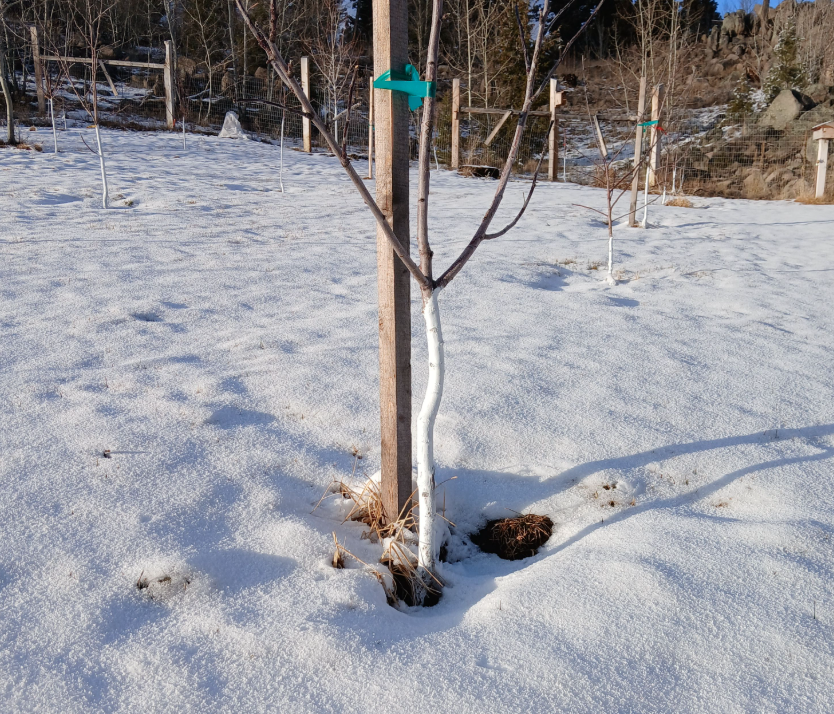
Protect tree trunks – use white tree trunk guards or paint young tree trunks up to the first scaffold branches. This helps reflect sunlight on warm sunny days. Hessian or burlap can be wrapped around tree trunks as well.
Native species and plants that have adapted to our climate will all have a difficult time given our current and forecasted warm temperatures and limited moisture. In the past, the snow cover has protected many of our plants, but with no snow cover, our plants are going to need as much help as we can give them.
If these warm temperatures continue into spring, rising gradually, our plants should be fine. But continued sharp temperature fluctuations or an extended cold period could lead to tip die back and tree death.
One silver lining is that the next couple of months offer a unique opportunity to see which plants are able to tolerate extremes. Those will be the best candidates for increased future planting, as our weather patterns become increasingly varied and extreme.
If you have plant questions, don’t hesitate to reach out to me at bsarchet@gmail.com.
Brent Sarchet, a certified International Society of Arboriculture (ISA) arborist and crop advisor, runs Finn Creek Farm near Boulder with his wife Andrea.