
Driving a school bus has generally been considered a challenging job with its mix of a large group of children in a narrow, confined space, staying safe with ever changing road and traffic conditions and a schedule that asks drivers to basically work a split shift everyday.
The pandemic has added another layer to the challenge — one that Jefferson County school bus drivers have met head-on without a lot of fanfare. So far, they’ve managed to keep themselves and their riders safe.
The Boulder Monitor is highlighting those who have been on the front lines of the pandemic since it arrived in Montana, now nearly a year ago. In addition to bus drivers, in the weeks ahead we’ll feature librarians, grocery workers, school support staff and more.
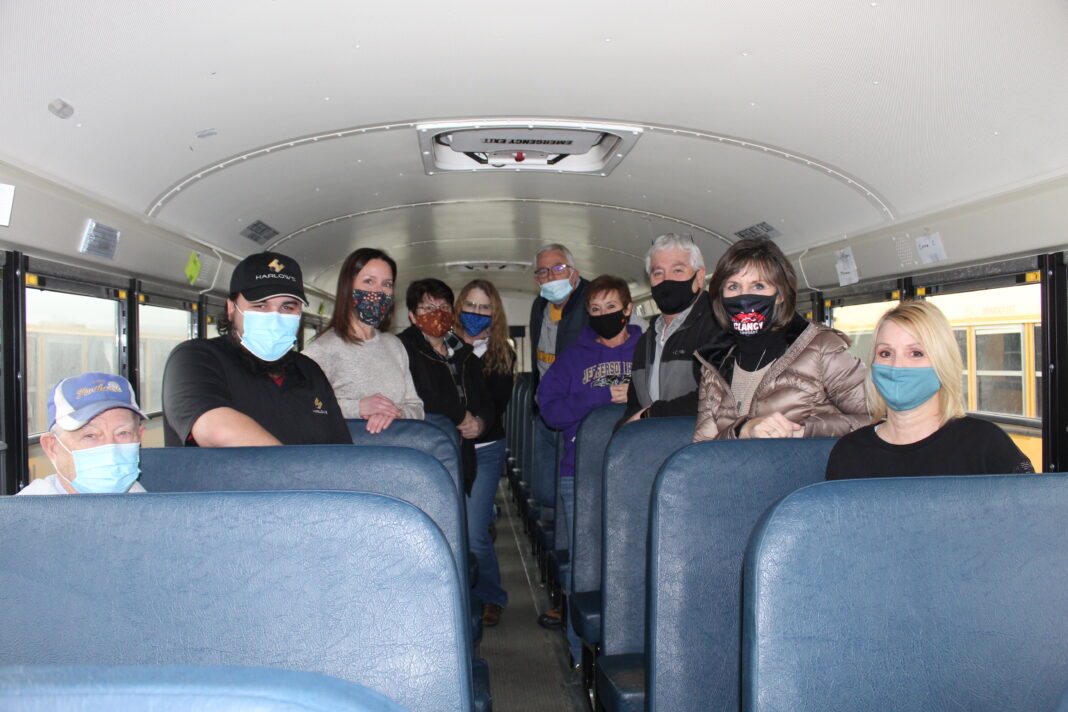
This week, the Monitor talks to bus drivers with Harlow’s, the transportation company that serves Jefferson County schools, about their work, the challenges brought on by the pandemic and what they miss most about the job since COVID-19 became a daily threat.
Drivers were idled last spring when the state shut down the schools, although they continued to be paid. By fall, the plan was to re-open for in-person learning, but that presented new challenges for how to manage COVID-19 on Harlow’s fleet of school buses.
Transportation manager Joe Canzona said some drivers decided not to return because they were nervous about driving a bus during a pandemic, while others took the opportunity to retire.
Finding school bus drivers is a tough sell in a “normal” year, but last fall, Harlow’s really increased its effort, said Canzona, who also stepped in to drive several routes to fill the gap.
Meanwhile, Harlow’s Joy Ratigan out of Seattle “pounded the streets” and used social media to recruit — and it worked, said Canzona.
Harlow’s in Boulder generally gets one or two responses from a recruiting push, but this year there were about 10, with three to five completing the process, said Canzona.
“Even with COVID,” he said, adding that more folks seemed to be looking for side work or part-time jobs to fill gaps of their own.
This year Canzona’s crew includes a group as diverse as retirees to parents of young children. He credits his drivers with keeping the buses running.
“They have made a lot of sacrifices and pulled a lot of extra hours to help keep these schools running and students safe and still getting the education they need. I truly feel that we’ve achieved the impossible this year. With an additional 14 routes a week between our four school districts, and on top of our 28 general routes a week and sports trips, we’ve added to our workload this year to help keep social distance standards. We managed to cover that with originally 11 bus drivers, not including myself and my mechanic. We have been able to hire three new drivers with two more potentially on the way, which in my four years of driving is unheard of for this department. I truly feel we have exceeded expectations for this school year, and the team we have here is to thank for that,” he said.
The drivers interviewed for the story said the biggest challenges under COVID have to do with wearing masks, enforcing seating charts, sanitizing and scheduling changes due to the need for fewer children per bus to reduce exposure.
Most of all, the bus drivers were less concerned about the impact of the pandemic on themselves, but rather the strain it has put on their young riders and they long for the time when their kids can be kids again.
Larry Ferguson switched to a new route this year, it being his second year as a driver. Ferguson does one of the Montana City routes, and because of COVID-19, he’s had to learn to recognize his riders with half their faces covered with a mask.
“It’s been very hard,” he said, adding that with the younger children, it’s also difficult to understand them through a mask.
Jim Connole used to be a substitute driver, but when shortages arose due to the pandemic, he took over a double route in Clancy along Lump Gulch Road and the Frontage Road. The double route came about as a way to limit the number of children on the bus, as COVID-19 protocols call for one child per seat, unless they are siblings.
Because Connole had been a substitute driver, he didn’t really know his kids either. Connole has also had to learn to recognize his riders despite the masks. While he can’t see all their facial features, Connole said that’s O.K.
“The great thing about it is that they don’t get to see mine either,” he joked.
Ferguson has learned to recognize his riders by their eyes, hair, height and where they sit due to the seating chart.
“It didn’t take too long,” he said.
Jinny Jandron has been driving the same Jefferson City route for five years. As a result, she already knew most of her kids, although there are always a few new ones.
For her, the masks are not so much an impetus in getting to recognize her riders, rather, it’s causing a lack of connection.
Gone is the ability to see their smiles and full facial expressions — as well as hers.
Jandron said she used to communicate through her facial expressions in the big mirror above her seat. But wearing a mask has changed that. Before she could give a stern look and say their name loudly. With a mask, it’s harder to hear each other, forcing the way she communicates to change.
“I have to yell a lot louder with the mask,” she said.
Ferguson said the younger children don’t understand the need for a mask, they often don’t fit correctly and many don’t keep them on.
But it usually just takes a reminder to remedy the situation.
“They’re good kids. They want to do what’s right,” he said.
Enforcing the seating chart can sometimes be a challenge, said the drivers.
Kids naturally want to be together, to freely mingle and talk, said Connole.
They still want to get close, but now it’s his responsibility to keep them separate, he said.
Jandron said that sometimes the kids ask to move, but she has to remind them of the rules.
The seating charts are designed to make contact tracing easier, she said.
For Jandron, the staggered dismissal schedule at Clancy — also designed to reduce exposure, means she has kids on the bus in the afternoon for a longer period of time. Before the pandemic, it took eight minutes to get the kids loaded and on the road.
Now it takes 25 minutes, she said.
“That has been kind of a challenge all the way around,” said Jandron.
Jandron said the kids are tired, have had to wear a mask all day and simply want to go home, and she has to work to keep them calm during the lengthened waiting time.
“I would like for the children for things to go back, so they can be kids and not have adult worries. They don’t understand all of it,” she said. For her, it’s constricted an already tight personal schedule, as she operates her own photography business, as well as raising three children while her husband is deployed.
At the end of the day, the drivers are required to sanitize their buses. The drivers spray the seats and areas with disinfectant, using sprays, wipes or a battery-powered sprayer. If a child happens to sit in a different seat than he or she sat in the morning, that seat has to be cleaned midday, said Jandron.
Connole estimates the cleaning protocol adds another 10-15 minutes to the day.
Despite the extra work, Jandron thinks the cleaning protocol is one pandemic practice that should remain once it is over.
Ferguson, Connole and Jandron were not concerned about their own health while driving a bus during a pandemic. Cannole is concerned he may bring it home to his wife, who has health problems, and Jandron worried at first about giving it to her children, but that has passed.
Ferguson said he used to catch more bugs before COVID-19, such as colds. Before the pandemic, more kids came to school while sick and now they stay home, he said.
But, “this is the first year I got a flu shot,” he said.
Connole also got a flu shot, and because of his age, 78, he received his first COVID-19 vaccine on Jan. 14. His second is due Feb. 10.
Despite all the changes with cleaning, seating and the ever present face mask, the drivers were most concerned about the children who ride their buses and long for a return to some sort of normal.
Ferguson looks forward to being able to “ditch the mask and go to (sports) games again.”
Connole wants to see his riders be able to socialize and talk freely.
“I want the kids back to being able to be kids again,” he said.
Most of all, Jandron wants the masks to come off.
“I know a lot of people and children who would like that,” she said.