
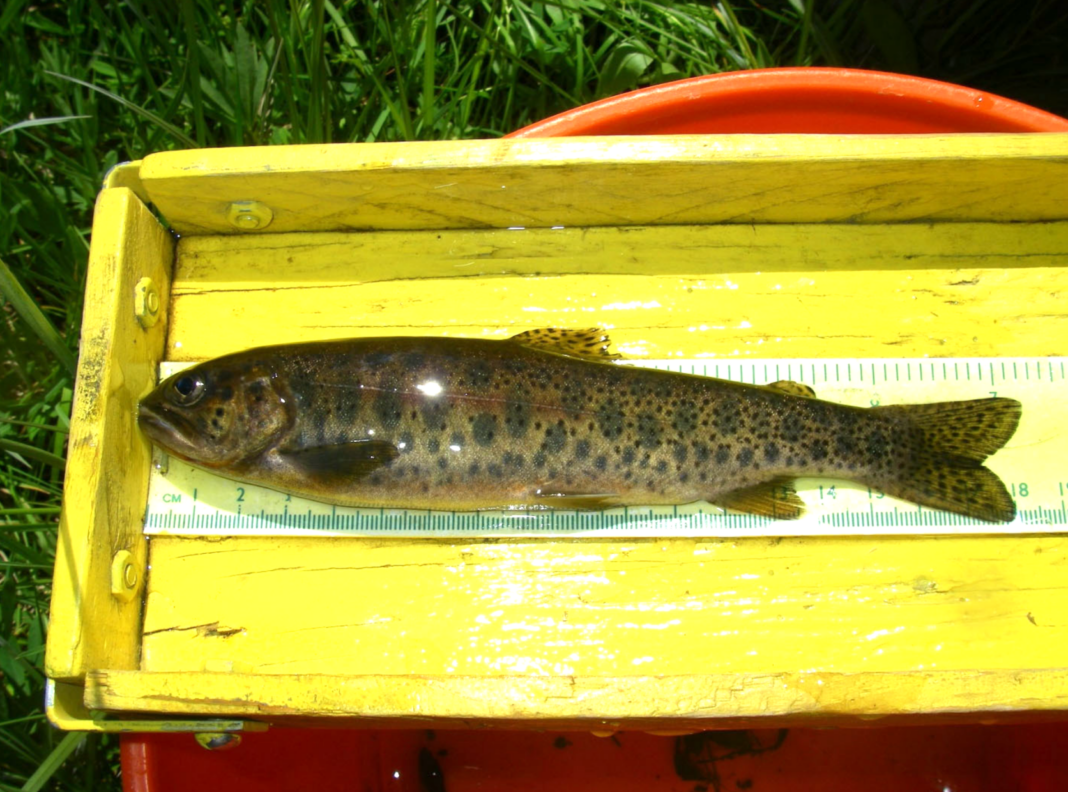
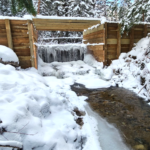
In the headwaters of Dutchman Creek, amid remote boulder fields and pine forest three miles east of Jefferson City, a handful of West Slope Cutthroat trout have made their home. They are small creatures, mostly about hand-sized, and striking, bearing the distinctive red-orange splash under their jaws and speckles at their tails of Montana’s state fish.
The way things are going, by the estimate of the state Fish, Wildlife & Parks Department (FWP), they’ll be gone within five years.
That’s why the state has fixed on Dutchman Creek for the next phase of its decades-long effort to preserve the West Slope Cutthroat in the Elkhorn Mountains. On Feb. 16, it released a draft environmental assessment for its plan to restore the trout in 3.5 miles of stream; it will hold a public hearing Feb. 29.
The project has little to do with recreation; most of the targeted area of Dutchman Creek is hard to get to and will only rarely be visited by fishers. “Our goal isn’t to improve the angling experience,” says Ron Spoon, an FWP biologist who has been working with trout in the Elkhorns for over 30 years, and who authored the latest assessment. “It’s to improve the genetics.”
The genetics here are problematic. The numbers of Western Cutthroat have declined precipitously in Montana since the early 1900s, when the state introduced non-native Rainbow, Brown and Brook species to artificially expand the supply of trout for recreational fishing. In the Upper Missouri River Basin, which includes the Elkhorns, Western Cutthroat once occupied approximately 1,634 miles of streams, according to FWP; today, their range is scattered in pockets across about 115 miles of waterways, and 65% of those populations are at risk.
The fish in Dutchman Creek, one of just four genetically pure populations of Western Cutthroat in the Elkhorns, are among those. Until around 1999, according to the FWP environmental assessment, the Western Cutthroat apparently were isolated by a section of water that ran under a boulder field. Since then, however, Brook trout have appeared above that barrier in increasing numbers. Nobody knows how or why, exactly – but it’s a problem.
“Brook trout can repopulate like crazy,” said Mike Korn, who once supervised FWP’s work in the Helena area and is now a member of the Elkhorn Working Group, a collaborative citizen body that advises on wildlife and livestock management of the area. Brook trout are voracious feeders, and they breed and hatch earlier in the season and in greater numbers, which means that their young establish themselves faster in a stream than do Cutthroat.
In the last 25 years, according to FWP, the number of Cutthroat in Dutchman Creek have sharply declined. Monitors counted 49.5 Cutthroat per 100 meters in 1999, and just 1.5 in 2022 — amounting to about 40 fish in total. Brook trout expanded from 2.5 per 100 meters in 2005 to 52 in 2022.
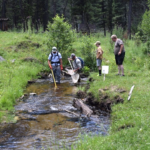
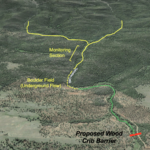
The plan for Dutchman Creek follows a strategy that FWP has refined over 25 years. Since 2021, teams have used electrofishing — basically, stunning fish with electric shocks — to capture most of the remaining Cutthroat, transporting them to safety in South Fork Sixteenmile Creek in Broadwater County. This spring, workers will construct a wooden fish passage barrier, at a cost of about $50,000, about one mile downstream of the Forest Service land boundary.
In the autumn, and through 2025, workers plan to kill Brook trout in the stream section, using a piscicide called rotenone; they will limit potential impact downstream by applying potassium permanganate to break down the rotenone. Beginning in 2026, the genetically unaltered West Slope Cutthroat will be reintroduced into the stream above the barrier — in small batches over time, to promote genetic resiliency.
FWP says that previous iterations of this approach have succeeded: “We know it works every time,” Spoon says. Populations of West Slope Cutthroat reintroduced after the removal of rival non-native trout have persisted for over 15 years, and counting. Beginning with the restoration of Cutthroat in Staubach Creek, near Winston, says Korn, “the fish here have been brought back to very viable populations.”
Early concerns about the use of piscicides have mostly eased. A presentation in 2017 by Bradley B. Shepard, a Montana State University researcher and consultant, showed that rotenone killed the tadpoles of spotted frogs, but not frogs in other stages — and tadpoles were abundant in treated areas a year later. Similarly, populations of caddisflies and stoneflies declined after the application of rotenone, but recovered within three years.
Multiple studies indicate that mammals are not affected by rotenone at the concentration used to kill fish. A 1994 paper by the California Department of Fish and Game reported that a 22-pound dog “would have to drink 7.915 gallons of treated lake water within 24 hours, or eat 660,000 pounds of rotenone-killed fish, to receive a lethal dose.”
Spoon says he expects Dutchman Creek’s population of Cutthroat eventually to return to the levels of 20 years ago, amounting to perhaps 500 fish. The 3.5 mile stretch will bring the project to a total of 22 miles in the Elkhorns, above the target FWP established a quarter-century ago (which it no longer officially uses).
The restoration isn’t a cure-all for the West Slope Cutthroat. Because the resulting populations will be below 2,500 fish, Spoon says, they probably can’t achieve the genetic diversity that’s needed to achieve permanent sustainability. The conundrum FWP faces is that barricading the fish into a stream’s headwaters, as it will do on Dutchman Creek, ensures that they can’t be crowded out by non-native species — but it also guarantees their ultimate decline.
“They have to be isolated,” Spoon says. “We didn’t like thinking that way, but that’s the only way they survive.”
Montana Fish, Wildlife & Parks will hold a public meeting to discuss the Dutchman Creek project on Feb. 29, 6-8 p.m., at Montana Wild, 2668 Broadwater Ave. in Helena.