
Local national forest fire management officers are planning for the possibility of a Montana wildfire season with fewer resources as the effort to prevent the further spread of COVID-19 continues, according to Jefferson County Disaster and Emergency Services Coordinator Doug Dodge.
“There are a lot of variables when it comes to what it will look like,” Dodge said. “We always want to plan for eventualities and that is certainly one of them.”
In a non-pandemic year, resources, including firefighters and fire equipment, are brought to Montana from other states and regions to suppress large wildfires, but this year, bringing resources from other states in the typical manner, poses the risk of spreading COVID-19.
Dodge said he has been in communication with fire management officers in both the Beaverhead-Deerlodge and Helena-Lewis and Clark national forests on how the wildfire season may have to be approached differently this year, from the federal to county level, in order to mitigate the risk of COVID-19.
“It’s just a matter of being prepared,” Dodge said, “crossing all of our t’s and dotting all of our i’s before the fire season is here.”
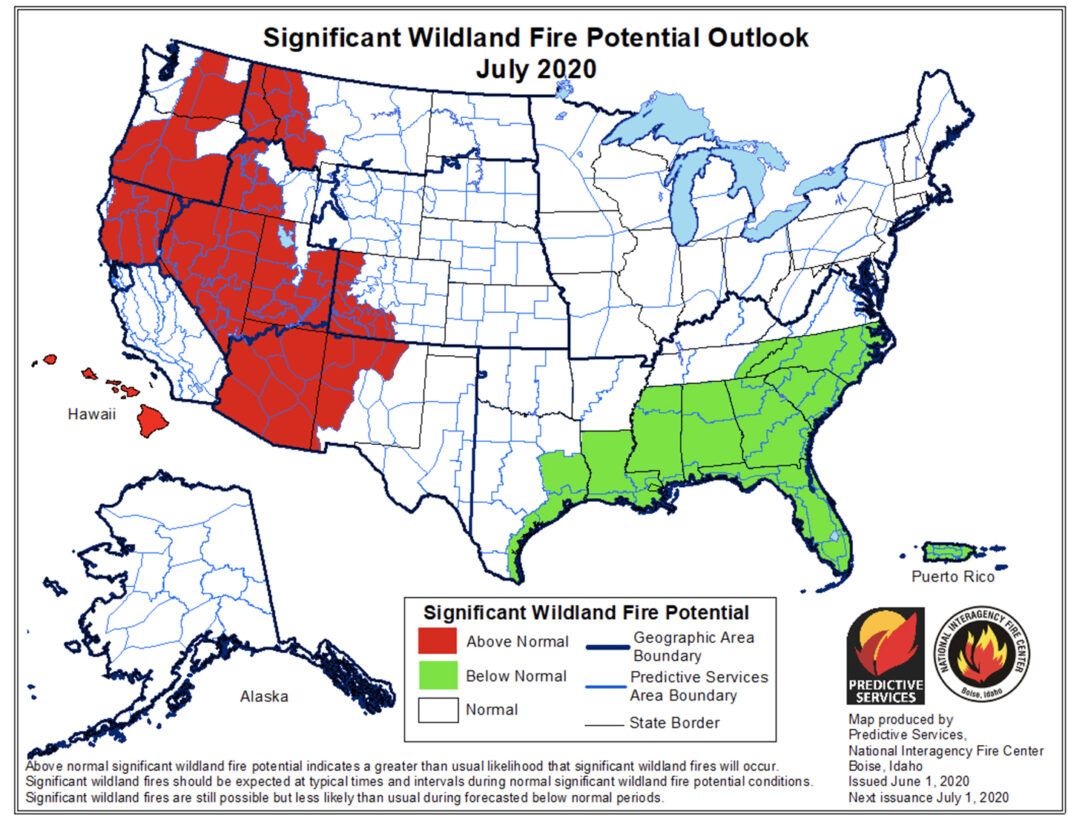
This summer, there is an above normal significant fire potential due to predicted above-average dry conditions, expected in July and August across northern Idaho and western Montana, according to a June 1 report of the National Significant Wildland Fire Potential Outlook. Jefferson County sits on the edge of the red portion that illustrates above normal significant fire potential in Western Montana, according to the map,
According to Global Forest Watch Fires, from June 5, 2019 through June 4, 2020, which encompasses the 2019 wildfire season, Lewis and Clark County ranked third in wildfire alerts by county in Montana with 423 fire alerts and Jefferson County ranked fourth with 389 fire alerts.
Kevin Smith, Butte Ranger District Fire Management Officer, said that he believes fire season will change, slightly. To start, moving resources like fire equipment and firefighters between our state and others to fight fires is going to have to be closely monitored to not spread COVID-19, or “cross-pollinate,” between states, Smith said.
The state, meanwhile, has lifted the 14-day quarantine for out-of-state visitors.
However, he said that although equipment and resources may be difficult to get in, they will also be difficult to get out. Resources usually sent to other states or regions fighting different fires will remain here for use.
“We may have more of our own toys in the sandbox versus other years where stuff was made readily available to go out,” Smith said.
Additionally, he said large fire camps will not exist this summer due to COVID-19. Instead of thousands of firefighters in a “tent city,” they will separate fire divisions into smaller camps to enforce social distancing. Lastly, Smith expects public briefings to be held differently due to social distancing as well.
But ultimately, there is no direct message on what may change, according to Smith. They are cognizant of COVID-19 and are planning for possible incidents where typical operations may be affected.
“There was no hard fast (information), on how it’s (COVID-19) going to change things,” Smith said.
Smith mentioned there are things to learn from fire agencies in other states. He received a handout from Florida with some “bullets” on how each area within the fire district made some adjustments.
Among others, the “lessons learned” consisted of no sit-down restaurants for feeding firefighters, but instead all meals should be individually boxed, face-to-face interaction can be moved online including electronic signatures for administrative documents and recorded messages for public/operational briefings.
And lastly, all vehicles should be kept sanitized and firefighters should not enter other people’s vehicles, unless needed, Smith said.
Also, there are nine wildland fire response plans, developed by federal, state and other agencies for each of the nine geographic areas recognized by the National Interagency Fire Center, and those each provide information on how fire seasons across the nation will be approached differently. The Northern Rockies response plan, which encompasses Montana, includes the same points aforementioned by Smith, as well as others. Each will help fire agencies navigate COVID-19 guidelines and promote social distancing, while suppressing fires.
Due to the possible complications of COVID-19, communication between federal, state, and county fire agencies are going to be important this year, Smith said. Smith attended a meeting on June 3 and talked over communications with federal, state and county representatives, including Jefferson County.
The meeting reaffirmed that each and every fire department should be communicating early and often this summer with the possible complications due to COVID-19.
It was stressed during the meeting that it’s important for each district to respond to a fire if they are closest when they get a call rather than worry about whose jurisdiction it is.
Smith said both communication and response to fires are normal every year, but it needs to be clear this year how important each is considering the circumstances.
“Basically, don’t get hung up in the weeds when we get the call,” Smith said, “just respond to it and we will figure everything out.”
Ultimately, Smith said that he does not see fires getting out of control or not being attended to due to complications from COVID-19. He said they are still going to see smoke and they are still going to go to it. COVID-19 is what he called an “incident within an incident.”
“The fire is the incident and then COVID is something we address as an incident within an incident, like how do we manage the overall thing but still make sure we are complying and doing our best. We are following those guidelines,” Smith said.
For this summer, like most summers, Smith and the U.S. Forest Service wants to make sure people are putting out their fires. He would hate to see the national forests being closed down due to fire restrictions after everyone has been cooped up for two months, he said.
“The ole’ Smoky Bear put your campfire out kind of stuff is critical this year,” Smith said.