
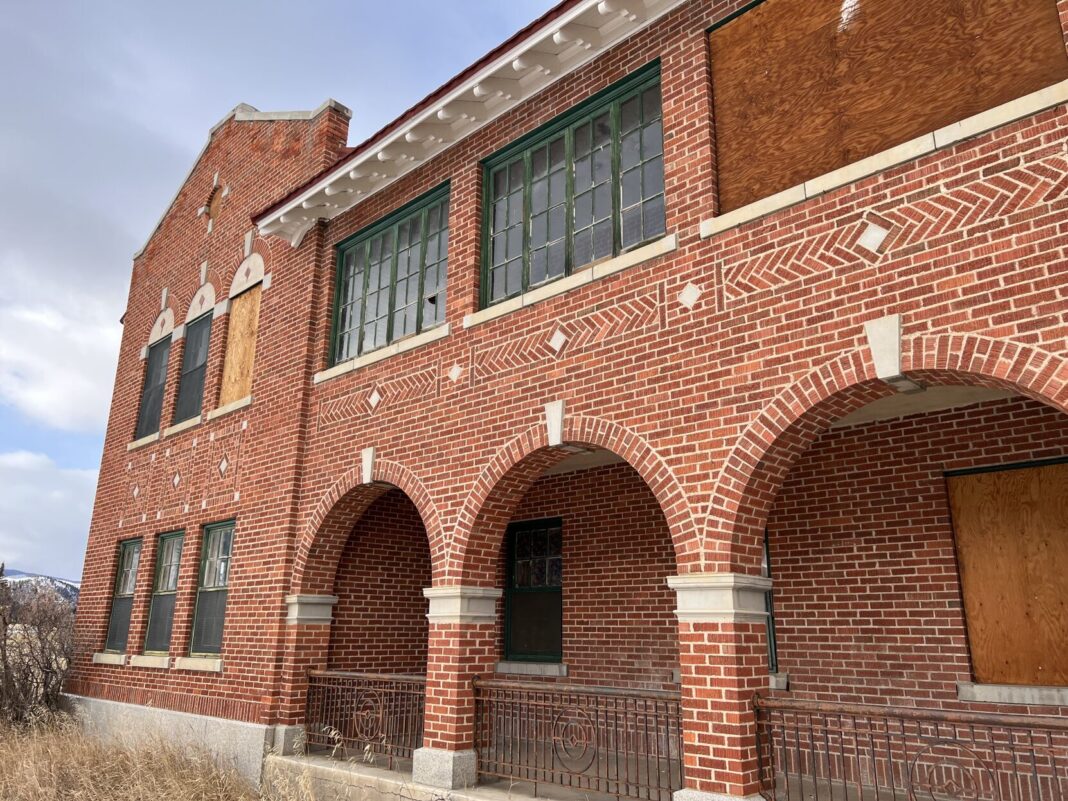
The Jefferson County Commission, facing a crucial deadline at the calendar year-end, is wrestling with funding options for the nearly two-year-long effort to restore and convert Cottage Five on the former Montana Developmental Center’s south campus into a new public health facility.
Jefferson Local Development Corp. project coordinator Leah Lewis, who has been responsible for the restoration’s grantseeking and planning, told the Commission at its Dec. 17 meeting that she will present the project to the Montana State Legislature Appropriations sub-committee sometime between Jan. 15 and Jan. 17, hoping to reverse a decision earlier this month by the Montana Department of Commerce not to award the county a $500,000 historic preservation grant.
In the meantime, the County is applying for, or awaiting decisions on, another roughly $2 million in grants that will help fund the $3.1 million total cost of the Cottage Five project. Due to the uncertainty of those pending grant awards, the Commission said it would likely move the $188,000 of American Rescue Plan Act (ARPA) State and Local Fiscal Recovery Funds (SLFRF) reserved for the project to the county’s general fund before year’s end.
“Our plan is to put it into the general fund by Dec. 31,” said Jefferson County Commissioner Bob Mullen at the meeting.
“We could’ve thrown it all into the general fund to begin with,” replied Jefferson County Commission Chair Cory Kirsch. “We’ve been trying to follow the ARPA guidelines anyway
because we don’t want to be audited, if they change their mind at some point. But when all of this [original 2021 funding guidance] came out, some short time after they said that anybody receiving less than $12 million can just shift it to their general fund.”
The Commission’s tentative plan for the ARPA funding is based on only partially correct information.
Nationwide, ARPA grant recipients must “obligate” distributed funds by Dec. 31, or else return them to the federal government. This past July, the U.S. Department of Treasury issued an advisory that ARPA dollars would only be considered “obligated” if they are committed through a formal contract, invested, or otherwise dedicated by the deadline.
Under ARPA guidelines, counties can claim up to $10 million of their ARPA allocation as “lost revenue.” This allows for ARPA dollars to be placed within a county’s general fund and used to provide regular services. Counties receiving less than $10 million can do this regardless of actual revenue losses or needing to utilize the Treasury Department’s revenue loss formula, which aims to more carefully quantify the COVID-19 pandemic’s economic impact on any particular county. A less stringent revenue loss measurement requirement lightens the reporting burden placed on smaller counties, and allows them to more simply allocate their full ARPA allocation to their general funds, as Mullen and Kirsch suggested.
However, according to the National League of Cities, local governments were required to commit to using their remaining ARPA allowances in such a manner by April 30, 2023, which Jefferson County did not do.
Also, according to the National Association of Counties (NAC), “moving SLFRF dollars to a general fund as revenue loss, but not further establishing an obligation with those funds by Dec. 31, 2024” does not fulfill Treasury Department obligation requirements.
Jefferson County plans to fulfill the requirement by signing a memorandum of understanding (MOU) with the county’s Public Health Department. The county says the MOU would allow it to retain the money without having to officially commit dollars to Cottage Five, though the funding ultimately would need to be applied to public health-related expenditures.
It is uncertain, though, whether or not the MOU would, in fact, fulfill the Treasury Department’s obligation requirements, as they exclude, according to NAC, any “written or oral intention to enter a contract” as sufficiently binding.
Importantly, the $188,000 in ARPA funding was also being used to fulfill the match requirement attached to the $500,000 historic preservation grant sought by Lewis. While that funding could still be used to initiate some of the necessary work, such as removing heavy, non-toxic furniture or miscellaneous landscaping, that would preempt any hazardous material abatement effort, moving it to the general fund now places the project’s most immediately promising grant application, and the effort as a whole, at risk.
“A perceived lack of commitment from the County is one of the things we got dinged on in our application,” said Lewis, after speaking with state Commerce Department officials about the county’s grant application on Dec. 12. “If we had an update that some preparation had started, that we had contracted money and actually went into this building to prepare for abatement, that would show real forward motion.”
The Cottage Five restoration was ranked 26th of 63 submitted grant applications by the Commerce Department. This year, the top 17 projects received funding and shared an award pool of roughly $6 million. Last year, Commerce awarded funding to 44 projects from a pool of more than $10 million. Should the State determine there is sufficient funding to match last year’s disbursement, the Cottage Five effort is ranked within that funding threshold.
But existing project rank is only a secondary consideration when awarding funds, and Lewis is concerned that projects ranked far beneath the Cottage Five restoration may receive funding instead should they demonstrate more meaningful progress since submitting their initial applications. “For Cottage Five, we really just need to keep pushing grants,” said Lewis in an interview. “If I can get one of these big ones, and a few little ones, we’ll be fine. There are a lot of grants we qualify for, a few we’re waiting on. But we’re actually pretty close, and, ideally, we’ll have the funding together to do most of the work at once.”
Lewis has also submitted an application for the first cycle of the Mountains & Plains Environmental Justice Grant (MAP EJ) program, which could award more than $300,000 to the Cottage Five restoration effort. Lewis will then submit an additional application during MAP EJ’s second cycle in the spring of 2025, which could award an additional $270,000. An application has also been submitted for an $800,000 Environmental Protection Agency clean-up grant. She plans to pursue an additional historic preservation grant of up to $100,000, and a grant of up to $100,000 from the Treacy Foundation, and will continue to explore potentially utilizing federal state historic tax credits, which, though riddled with complicated reporting and procedural requirements, could support more than $600,000 in project expenses.
While Lewis is pursuing an abundance of funding options, Jefferson County’s willingness to commit to meaningful financial support is, seemingly, dwindling. Commissioner Mullen spoke out against any guarantee that the project will receive dollars from its Local Assistance and Tribal Consistency Fund , which could provide as much as $800,000 to construction of a new public health facility.
“I’m not sure we can guarantee that money will be available, because that’s money the county needs to run itself,” said Mullen.
The Jefferson County Commission will make final determinations on remaining ARPA funding, including Cottage Five’s, at its final meeting of the year, Dec. 31.