
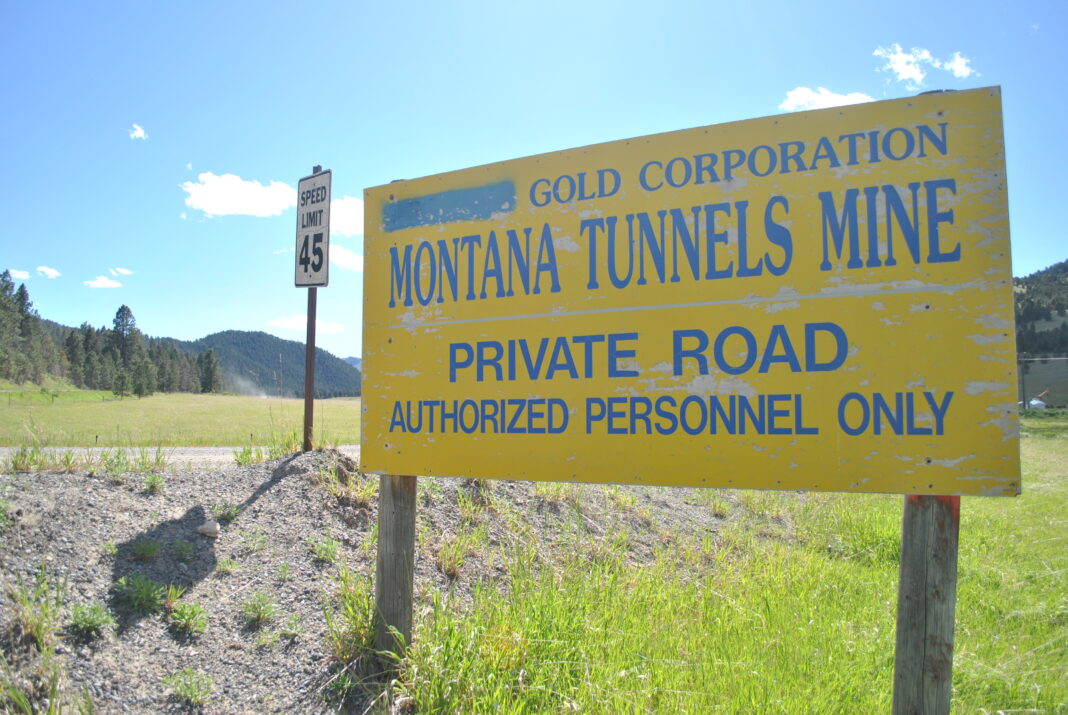
Montana Tunnels Mining Inc.’s labyrinthine journey through the bankruptcy system may not be over just yet.
On Oct. 22, Jefferson County filed a motion with the U.S. Bankruptcy Court of Montana asking it to reverse its decision last July to dismiss Montana Tunnels’ Chapter 11 case. And within hours, Judge Benjamin Hursch, who had issued the dismissal, agreed to consider the request.
The County hopes the court ultimately will convert Montana Tunnels’ case into a Chapter 7 liquidation, which could lead to a sale of the company’s long-shuttered gold mine outside Jefferson City. In that case, as a senior creditor, the County likely would be repaid the $3.1 million it is owed in unpaid metal mining taxes.
Meanwhile, the state Department of Environmental Quality (DEQ) has filed — but not yet served — a complaint with the District Court in Jefferson County aiming to block the transfer of the Tunnels mining property to a related company, Goldfields Funding Partners.
Montana Tunnels declared Chapter 11 bankruptcy in December, 2022, when it couldn’t pay the full amount of a state bond to ensure the reclamation of lands damaged by mining activities. The case was dismissed in July, after Tunnels failed to meet payments it agreed to under the Chapter 11 reorganization.
In its motion, the County argued that “with all due respect,” the dismissal was a mistake. In this context, “mistake” is a technical term described by federal Rules of Civil Procedure; it includes instances in legal proceedings of a “mistake, inadvertence, surprise, or excusable neglect,” or of fraud, misrepresentation or misconduct.
In the case of Montana Tunnels, the County observed that CEO Patrick Imeson misrepresented in a court hearing his company’s intention or ability to pay what it owed another creditor, LD Construction. Montana Tunnels has not repaid LD, which since has itself sought bankruptcy protection, and, the County’s motion argued, “the Debtor has no ability or intention to pay creditors.”
The County also tethered its argument to the pending transfer of a 625-acre parcel housing the Montana Tunnels mine pit and mill. In 2021, Goldfields Funding Partners, which also is controlled by Imeson, paid the county $5.1 million in taxes owed by Montana Tunnels, thereby acquiring a tax lien on the property. On Aug. 1 of this year, the redemption period for that lien ended, giving Goldfields the right to acquire the deed for the property.
The County said that the court seemed to have “mistakenly failed to consider the ramifications” of that transaction. “If Goldfields is successful in obtaining title to the mine and in extinguishing the County’s lien (and others), through the tax deed process…the County, like other creditors, will have no source for collection against the Debtor because it will effectively be without assets.”
In a status conference held Oct. 23, the County’s attorney, Martin S. King, explained that, given legal precedent, “there’s a good argument on the part of the holder of the tax deed that [the deed’s transfer] wipes out inferior liens.” In other words, the County would be unable to collect the unpaid metal mining taxes as well as $323,000 in unpaid property taxes for the 2022 through 2024 fiscal years.
In an interview with The Monitor, County Treasurer Terri Kunz said that she had resisted issuing the tax deed to Goldfields until it received those unpaid taxes. It is unclear, she said, how long the County is allowed to delay the issuance.
DEQ’s corresponding legal action was revealed during the status conference. Its complaint, filed in August, claims that Montana Tunnels failure to pay the full amount of the $41 million reclamation bond by law gave the state title to the underlying properties. DEQ’s suit therefore asks the court to block the issuance of a tax deed to Goldfields, and to award DEQ the title “so that DEQ may sell the properties at public or private sale to fund reclamation activities at the Montana Tunnels Mine.”
The DEQ legal action also asks the court to impose penalties on Montana Tunnels of $5000 a day both for not paying the full amount of the reclamation bond and for not reclaiming its property — fines that could total tens of millions of dollars. Since the action has not yet been served on the defendants, which include Montana Tunnels, Goldfields and Imeson, it is not effective. “DEQ is still considering all its options at this time,” the agency said in a statement.
Judge Hursch acknowledged at the status conference that the County’s motion “gave me pause.” His original decision to dismiss the case hung primarily on a narrow issue: In its Chapter 11 plan for reorganization, Montana Tunnels had specified that, if it were to default on payments to creditors, its case would be dismissed. But he seemed swayed by the County’s new argument that Imeson had misrepresented his company’s intentions to the court.
“This Court harbors grave concerns that it was affirmatively misled by Debtor at the hearing on dismissal or conversion,” Hursch wrote in his order on the County’s motion. “It is further alarmed at the prospect, that not only has Montana Tunnels made no efforts post dismissal to pay its creditors like LD Construction, the consequences of the Court’s reliance on this testimony may include issuance of a tax deed to an insider, as an alternative to payment of its taxes and other creditors, consistent with the testimony received.”
In his original decision, Hursch noted that, if Montana Tunnels did not pay what it owes, “creditors may exercise the full range of non-bankruptcy related remedies at their disposal.” But his Oct. 22 order, and his comments at the subsequent status conference, indicated a sense of urgency at the prospect that a transfer of the mine’s ownership could wipe Montana Tunnels’ debts clean.
At the conference, both Goldfields and Montana Tunnels agreed not to press for the issuance of a tax deed until the County’s motion was resolved. Montana Tunnels has until Nov. 5 to respond to the motion.