

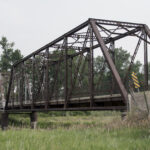


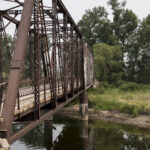
Jefferson, Gallatin and Broadwater counties have committed funds to replace Meridian Bridge, a 107-year-old single-lane truss bridge at the junction of the counties and whose load limit is currently 2 tons per axle—the lowest rating before a bridge is deemed impassible, according to Jefferson County Commissioner Cory Kirsch.
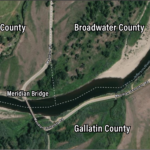
Meridian Bridge straddles the Jefferson River in the far southeast corner of Jefferson County, with its northern half in Jefferson County and its southern half in Gallatin County. The bridge is a few hundred feet from the southwest corner of Broadwater County. The bridge provides quick access to the town of Willow Creek—in Gallatin County—from U.S. Route 287 in Jefferson and Broadwater counties.
Due to the light load limit on the bridge, large agricultural trucks and emergency vehicles cannot cross the bridge, Kirsch said. A portion of Jefferson County receives emergency services from Willow Creek, he said. Several ranches and the Highlander Park subdivision are directly across the bridge from Willow Creek.
“It’s a pretty high priority thing for us to get it fixed,” Kirsch said, referring to the impeded access for emergency services.
Kathy Thompson, the bridge department manager at Stahly Engineering & Associates, added that the project is also a high priority because the bridge’s inability to carry agricultural vehicles is harmful to the surrounding economies that rely heavily on agriculture.
Replacing the bridge is estimated to cost about $2 million, half of which will be covered by a grant that Gallatin County received from the Treasure State Endowment Program in 2018, Kirsch said. The fund requires the counties to provide an equal match, according to Thompson. Therefore, the three counties with residents that most frequently use the bridge—Gallatin, Broadwater and Jefferson—will split the approximately $1 million in matching funds, Kirsch said.
Jefferson County will provide 37.5 percent—or at least $300,000, based on current estimates—of the match funds, Kirsch said; Broadwater County will pay 12.5 percent and Gallatin County will pay 50 percent. At their July 6 meeting, the Jefferson County commissioners formally committed to pay their share to replace the bridge.
“We’ve been in the planning process, and now it’s time to move forward and actually start the project. Funds need to be committed, and we’re going to hold up to our end of the bargain,” Kirsch said. He added that Gallatin, being a “huge county with lots of resources,” has led the project since the commissioners began discussing it in 2017.
However, Kirsch said that construction has been delayed until at least next year. Stahly Engineering has submitted a design and plan for the new bridge, which includes constructing a two-span bridge with precast concrete beams, Thompson said. Until the necessary permits are in place, however, the firm cannot solicit bids from contractors or begin construction, Thompson said.
Thompson said engineers are required to receive permits from the Army Corps of Engineers; Montana Department of Fish, Wildlife and Parks; and local floodplain administrators. She said they are still waiting on the permit from the Army Corps of Engineers because of the historical significance of the bridge.
Dating to 1914, Meridian Bridge allows Meridian Road to cross the Jefferson River. Though the road itself runs directly along the Jefferson-Broadwater county line as it heads south from Route 287, it veers west—fully into Jefferson County— just before the river, crosses the bridge into Gallatin County and then turns sharply back east, running along the river bank just outside of Broadwater County.
Kirsch said there’s a “funny hearsay story” about the peculiar layout of the road and bridge. He said that when the three counties set out to construct a bridge across the river near Willow Creek in the late 1800s, the bridge was meant to be right on the border between all three counties—in line with the road—and not just in Gallatin and Jefferson counties. But, according to local lore, he said, the Broadwater County commissioners got the Jefferson County commissioners drunk and convinced them to instead construct the bridge several hundred feet southwest of the original planned location so that it avoided Broadwater County, which could then avoid responsibility for maintaining it.
As colorful as the bridge’s alleged history may be, that history could prove burdensome to its eventual replacement. Replacement of the bridge must comply with processes outlined in the National Historic Preservation Act, which are designed to “mitigate the removal of the structure,” Thompson said. Currently, Stahly Engineering is working through this process with the Army Corps of Engineers and the Historic Preservation Office, she said.
“They want you to look at leaving the structure in place. That’s not really an option in this case,” Thompson said, citing the current state and limited functionality of the bridge.
The act also outlines efforts to preserve the bridge as best as possible, including taking historic photographs, posting informative placards at the construction site, and allowing others to adopt parts of the bridge if they want to, Thompson said.
Thompson said the dismantling of the bridge and the construction of its replacement would take approximately five months. She added that the bridge’s dismantling might be complicated, as several surrounding landowners have expressed interest in the pieces of the bridge. She said that this makes an already difficult process harder: Not only will workers have to prevent the pieces of the bridge from falling in the river, but they will also have to preserve the pieces so that they are in good condition.
Thompson added that construction has also been particularly difficult during pandemic related labor and materials shortages.
“Prices are up, and even if we had a contractor on-board today, there’s a delay in manufacturing of the concrete beams because they’re so backed up, just like everybody else,” she said, adding that, along with permits, materials availability could further delay construction.