


Connie had been ill for several months before he passed away in Whitehall on Tuesday, July 28, 1962. In his obituary, it is mentioned there were approximately 225 pieces of known artwork done by him and all that pertains to life in the West.
He most certainly did paint. And paint. It didn’t much matter to him what he painted on, either. Shingles, bits of board, actual canvas (if he could afford it), ceiling material and, as reported in a previous article, even plaster cut from a playroom wall in the Montana Training School.
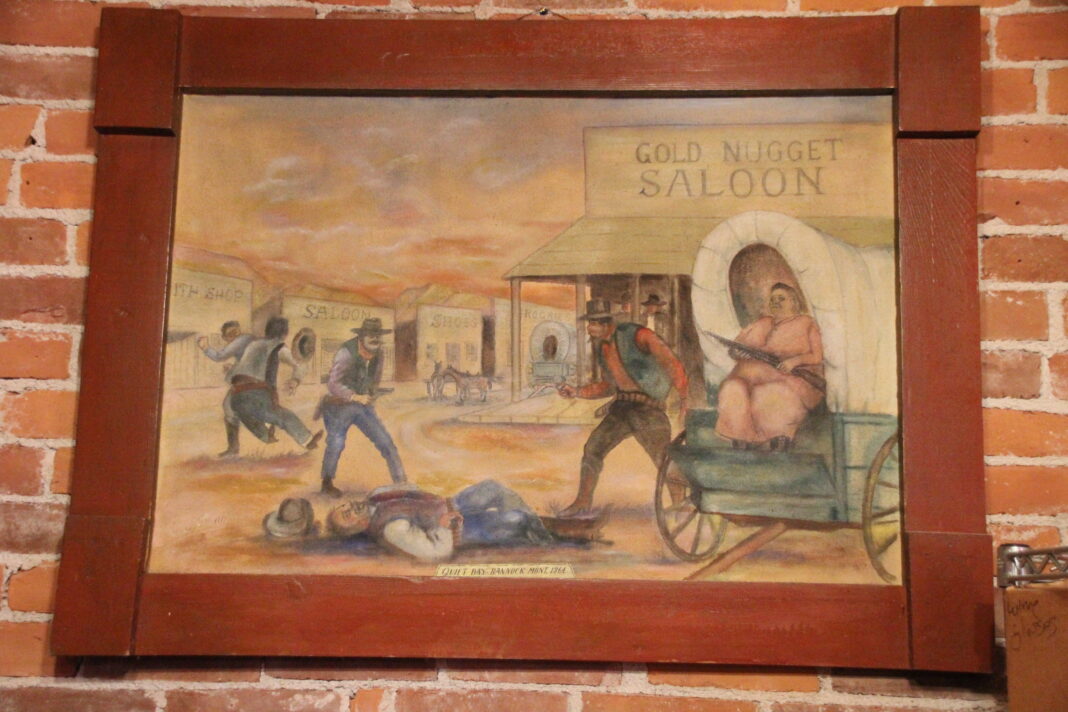
The depictions of some of the events in his works have raised eyebrows in recent years due to the subject matter, but for Connie, he was simply painting the West as he had known it since his birth in 1883.
Historically, Vigilante law was the only law protecting law abiding citizens and in the Vigilante’s understanding, the law was there to be strictly enforced. So when Clubfoot George Lane, Boone Helm, Hays Lyons and George Ives were caught stealing horses, and the law decreed the punishment to be hanging, that’s the punishment they got. It was administered immediately at the nearest tree.
There was no sentimentality about how harsh the punishment was. People’s livelihoods depended on the cattle they raised and their horses were essential for their transportation and farming chores. The little cash money they scraped together was very hard earned, so if stagecoach robbers stole it in a hold up, they were just as despicable as a rustler or horse thief. It was understood that if you jeopardized people’s lives or their means of survival and you were caught doing it, the punishment was clearly known, understood and immediate.
So when Connie Smith painted a cattle rustler about to be shot by a rancher who has caught in the act of rebranding one of the rancher’s cows, he was simply illustrating the way it was.
Connie’s style would best be called Western Primitive. He certainly was not on par with Charlie Russell or Remington, but considering he was completely self-taught, his paintings have a certain charm and also humor. There’s irony in several of them if you examine them closely.
In a very small painting of a wagon train being attacked by Indians (according to the semantics of the day, now Native Americans), the wagon master has been caught, knocked down and sat on top of by the chief. In apparent triumph, he holds up high the wagon master’s scalp, only to discover to his very big surprise, it’s not a scalp. It’s the wagon master’s toupee!
Then, looking closely in the background, you will see a pioneer woman, sunbonnet flying, who rather than hiding in fear during the attack, is in full chase after a fleeing brave.He’s tossed his tomahawk away in order to better his speed because she’s fearlessly hitting him on the top of his head with a broom!
In order to make a living, he painted interiors and exteriors of homes, the cowl of a private plane, walls of children’s playrooms, and sometimes his artwork even ended up as payment for his tab in the local bars, as he had a reputation for imbibing beyond his financial means.
He painted wildlife, landscapes, rugged individuals, dogs, miners gold panning, snowy cabins and scenes of everyday life, but bucking broncos were a favorite subject of his.
His reputation for painting colorful broncs made him sought after for murals and private commissions. He was known and respected for his works in his own time as a talented painter, but – as far as is known – most of his works have stayed in the area. Many of the pieces are with family members who have had them for decades. Records show that only a few were purchased and ended up in neighboring states.
After more than 60 years since his death, we are celebrating our local artist with a day proclaimed in his honor, Aug. 27. What remains of the full wall mural he painted on Hardware Hank’s will be restored during the weekend of the Jefferson County Fair. An exhibit of more than 20 pieces of his art, on loan from family and private owners, including a piece which was shipped from an owner in Arizona, will be on exhibit at the Fair and Rodeo this year.
At long last, Connie, we thank you for your contribution to Boulder’s history. Now it’s Connie’s moment in the sun.
Join in on celebrating Connie Smith
For all three days of the Fair, two dozen pieces of Connie’s artwork will be on exhibit in the Boiler Building, located behind the Carousel Building at the Jefferson County Fairgrounds.
As one of their first Main Street projects, the ReImagining Boulder group has commissioned the first full restoration since it was originally painted in 1947, of the remaining section of the “Lee Rider’s Copper Riveted Cowboy Overalls” bronco mural on the side of Hardware Hank.
The cost of restoration will be covered in part by grants from the Montana Foundation Committee, The Red Ants Pants Foundation and from private donations.
The work will be done by Billings artist Rilie Zumbrennen of the Rilie Tane Gallery. Rilie has painted murals in Missoula, Frenchtown and several in Billings. Painting will commence Aug. 25 through Aug. 27.
Zumbrennen will be painting the entire weekend and she welcomes the community observing as she works.. You can also enjoy the festivities on Second Ave at a bbq street event being held by The Windsor Bar on Aug. 27, starting at 2:00.
Share in the excitement of seeing part of Boulder’s history brought back to life. Help to celebrate our local artist’s legacy by being there!