
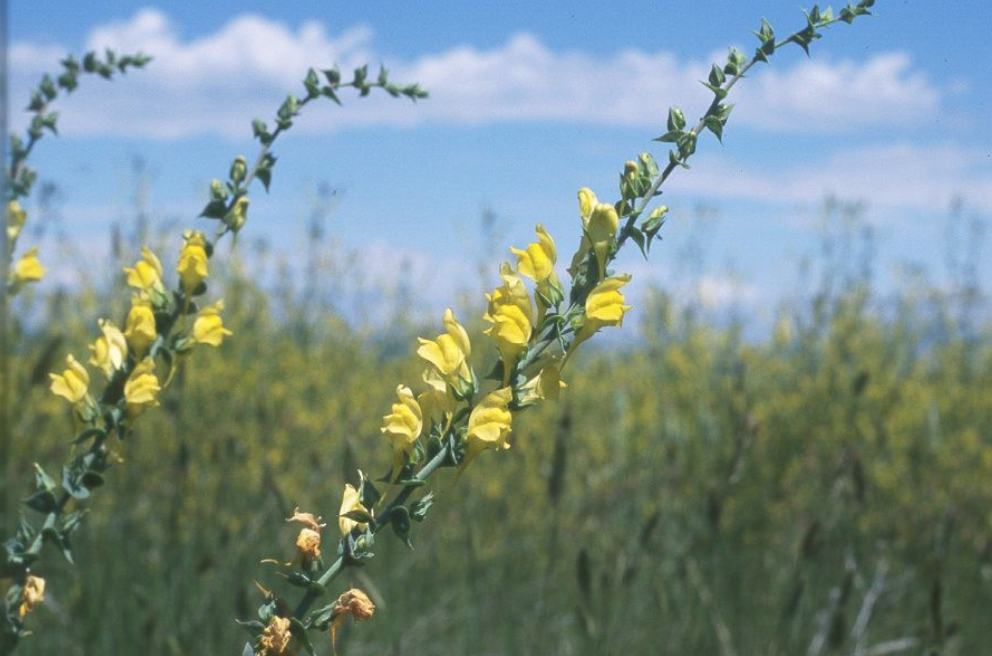
This time of year you might notice an infiltration of tall yellow flowers on your property. This Eurasian species arrived here in the early 1900s and has become quite the nuisance. Its thick, alternating leaves branch off of a thick stem that leads to snapdragon-like yellow flowers located towards the top of the plant.
You might have already guessed which noxious weed I am referring to: Dalmatian toadflax (Linaria dalmatica). This invasive plant thrives in cool, semiarid climates, and is known to cluster together. Dalmatian toadflax reproduces by seeds and by spreading its root system, which makes it very challenging to conquer, especially due to the fact that each flower produces 60-300 seeds.
Dalmatian toadflax is not to be confused with its similarly named relative, yellow toadflax (Linaria vulgaris). Yellow toadflax shares a similar snapdragon-like flower, but its alternating leaves are much thinner and longer, and much more frequent on the stem.
There are a few options for managing Dalmatian toadflax on your property. Pulling by hand can be feasible, depending on the size of the patch, and herbicide is an option. But there’s also an insect known as the Dalmatian toadflax stem mining weevil (Mecinus janthiniformis).
This weevil, a small, black insect with an elongated oval body shape and rostrum (snout), is an introduced insect species that specializes in Dalmatian toadflax. It dines solely on Dalmatian toadflax, and it will not damage any of our lovely native plant species. As its name implies, the weevils lay their eggs within the stem of the Dalmatian toadflax during the spring, and as the eggs hatch and the larvae grow, they consume the inside plant material of the stem all throughout the summer and fall. As the larvae turn into adults they survive the winter within the damaged stems and emerge in the spring to start the cycle again.
As spring is upon us, we are now able to see and collect this species from our weed insectary at the Whitehall Biological Weed Control Project, as well as from known infected patches in the area. With a light tap of the plant, these productive insects fall right into our release containers, allowing us to store them for up to a week until we are able to find patches of Dalmatian toadflax to release them on. In addition to their ravenous appetite for Dalmatian toadflax and their destructive method of oviposition (laying their eggs within the stem), these insects are strong flyers and can travel to new patches of Dalmatian toadflax once they’ve had their fill of an area. This allows us to release them strategically to maximize their yield.
Please reach out to us if you have large patches of Dalmatian toadflax on your property. We would be more than happy to visit and monitor your land to determine if you have Dalmatian toadflax stem mining weevils already, or if you could utilize some. These releases are completely free, though donations are always welcome.
Contact the Whitehall Project’s research intern Ava Balough during business hours at (703) 870-5696, or Project Director Todd Breitenfeldt (406) 498-5236.