
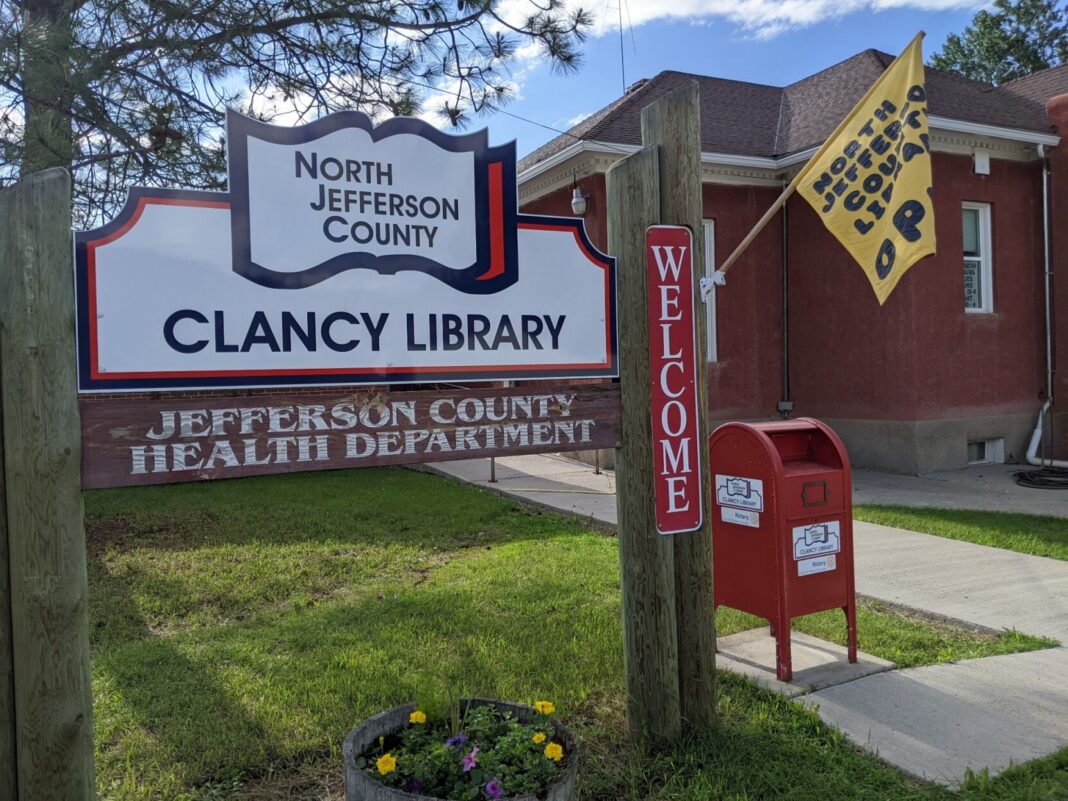
Clancy’s Old Red Schoolhouse is preparing to begin work later this year on a project to remove asbestos and other contaminants from its basement, potentially opening up for public use areas that have been closed for over a decade.
At a well-attended community meeting on Jan. 29, Melissa Wanamaker of Headwaters RC&D, the firm contracted to manage the project, told residents that work could begin in the next few weeks, after government approvals have been secured, and be completed in the spring.
The schoolhouse was originally built in 1898, and has seen several remodeling efforts over the years. In 1936, as part of a larger renovation, a basement gym was added to the building, with the space over the gym turned into another classroom — which now houses the Clancy branch of the North County Libraries.
That basement area was closed to the public about 10 years ago after unsafe levels of lead-based paint and asbestos were discovered by a state Department of Environmental Quality assessment. The boards of the library and the Jefferson County Museum, began exploring the possibility of cleaning up of the area a year ago.
Andy Wanta, of Weston Engineers in Helena, said that the project had attracted three qualified bid proposals, each with different scopes of work and corresponding costs. He and Wanamaker did not disclose the range of potential expenses for the project.
The most basic work involves either removing the lead paint by surface scraping, or “encapsulating” the surface with new, uncontaminated paint. Covering the old paint with newer, non-lead paint would seal off the dangerous surfaces. Scraping the paint off the surfaces would be more thorough, Wanta said, but also more labor intensive and therefore more costly. “Lead paint is only dangerous when it is consumed,” Wanta explained, “Not just by touching it.”
Drywall sections containing asbestos must also be removed, but replacing them may not be part of the project’s first phase. “There might be some unfinished-looking areas after this first phase,” Wanamaker told attendees. “A lot will depend on how much is raised for funding.” Wanta added that no further remodeling can be done until the dangerous asbestos has been removed. “You can’t work on anything because of the dust,” he said.
Funding is being sought from a variety of grants and low-interest loans available for these types of remediation projects. The Museum and Library boards also are seeking support from Jefferson County — perhaps, Wanamaker said, tapping into available ARPA funds. He and Wanamaker did not disclose the range of potential expenses for the project.
Wanamaker encouraged the boards to ask local residents for donations, since they would be getting the benefit of additional public indoor space. “I know some eight graders that would love to turn it into an arcade!” Wanamaker laughed. Library Director Carly Delsigne said that there had already been inquiries and interest in using the space as an additional meeting area.
Remediation efforts also hinges on approval from the State Historical Preservation Office (SHPO) to make changes to the building, which is a designated historical site. Any remodeling or modifications made to the structure must not endanger the historical value, Wanamaker said.
The project has already received approval from the federal Environmental Protection Agency, which stated there was no adverse impact expected from the proscribed work. “SHPO has 30 days to concur with the EPA’s letter of no adverse effect. Hopefully they will answer affirmatively and even early,” Wanamaker told The Monitor.
Wanamaker said she was encouraged by the public turnout for the discussion, and is excited to move the project forward. The museum and library boards granted Wanamaker permission to award contracts when the approvals have been received.
“I am hoping for an early spring clean up!” she said.