
There’s no exact science to finding a reliable source of clean water. Dowsing, a semi-common practice among 19th-century homesteaders, is largely guesswork, and the above-ground terrain gives few clues about what lies far below.
“None of us have X-ray vision and can tell what’s going on underground,” Joel Pilcher, an engineer for Great West Engineering, the main contractor for the Clancy water project, told The Monitor. “Until you drill it and test it, you don’t know what you’ve got.”
This helps explain why Clancy is still seeking a reliable drinking water supply a decade after the search began, and why the Clancy Water and Sewer District at its May 28 meeting voted unanimously to accelerate efforts to find a reliable water source for its 107 or so homes.
Since 2021, three test sites have been found to be either contaminated or lacking adequate flow, so the district has now tasked Great West and its partners with finding at least two promising potential test well drilling sites by its next meeting in late June.
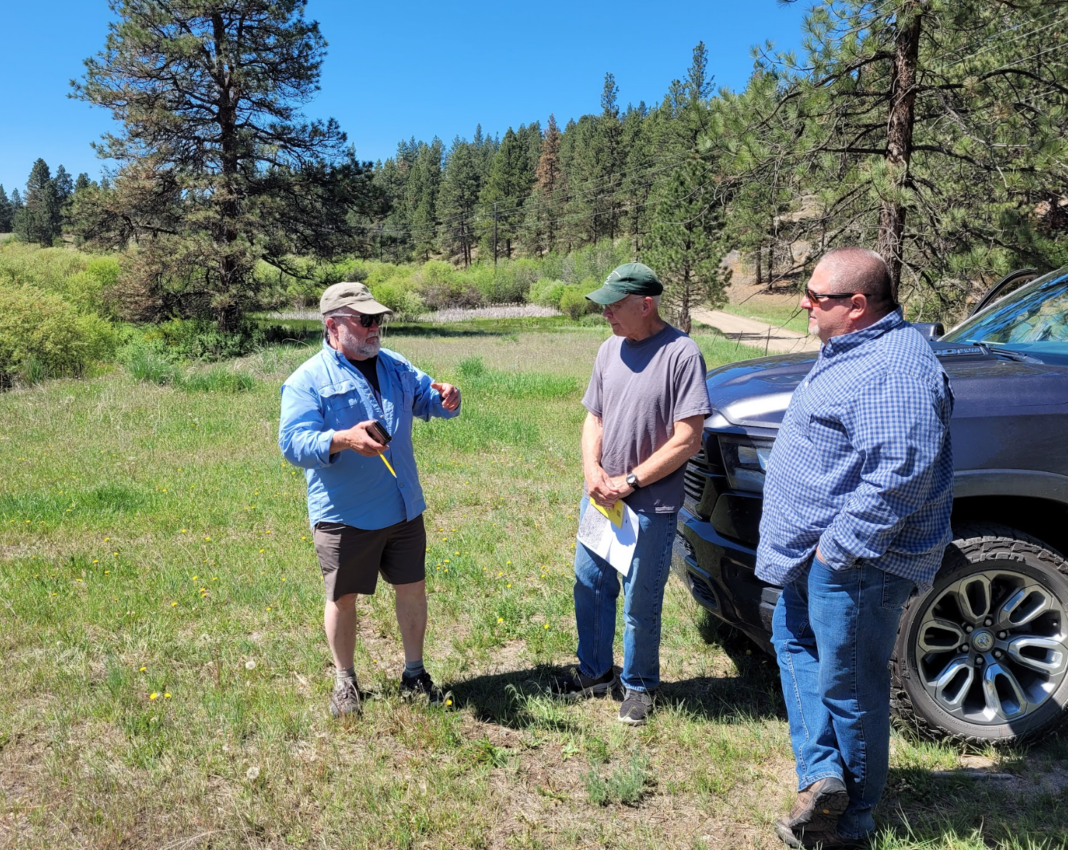
To fulfill that mission, Pilcher set out last Thursday with Clancy district board member Bill Hammer and Dave Donohue, a hydrologist from Helena-based HydroSolutions. Their first location, on cattle rancher Steve Marks’ property between Prickly Pear Creek and Red Cliff Estates’ drain fields, was an elevated mound caused by gold dredging more than a century ago.
Donohue thought the location might have water and noted that it was drilling equipment accessible. When on the hunt, he looks for geological formations and markings that might indicate the presence of water. Fractures in above-ground bedrock could hint at an aquifer. Reddish-colored rocks might be a result of oxidation. Or they might not.
“The reddishness could also just be feldspar deposits in the rocks,” he told The Monitor.
Next, the group checked out two other sites on land owned by Marks. The first was on Lump Gulch Road west of the Marks’ barn, and the other along Sunnyside Lane. Both seemed to have potential, yet any drilling would require the approval of Marks, who has cooperated with the district in the past while remaining reluctant to drill on his pastureland.
“He has always been helpful to us,” said Hammer, who worked for years with the state Department of Environmental Quality. “But he would rather we buy the land from him rather than leasing it or some other arrangement. That is certainly a possibility, as long as the price is right.”
Two miles south of the Clancy district boundary, the scouts visited a promising test well site on state-owned land. Donohue saw fissures in the over-hanging cliffs that suggested possible fracturing in the underlying bedrock, which might hide an aquifer. The nearby forest had recently been thinned for fire protection, leaving flat open areas for drilling rigs.
Pilcher pointed out that gaining drilling permits and approvals from the state would likely take months. A quick consultation of the map led to an alternative. The state-owned land bordered the property of longtime Clancy resident Keith Foley, who had recently told the district he planned to drill test wells this summer, believing his land held real promise.
Hammer pointed out that gaining permits and easements to drill on Foley’s land would likely be much easier than accessing the state land on the other side of the fence. In the end, the team decided to pursue all five options, rather than limit themselves.
Hammer would contact Foley, Pilcher would reach out to the state, and Donohue would talk to Marks. With any luck, the Clancy Water and Sewer District will start drilling and testing the water at one or more of these locations before the end of summer.