
For decades, Boulder residents have walked their dogs among the markers of the city cemetery. This simple pleasure — which turns out to be prohibited by the city —could now be at risk.
According to City Clerk Ellen Harne, this issue was brought to the committee’s attention several months ago when Harne discovered a City Council resolution written in 1952 that outlined rules for the cemetery. Among other things, the resolution prohibits dogs, refreshments including alcohol, and picnics in the cemetery.
Following this discovery, the Boulder Cemetery Committee convened on May 18 to draft a new resolution, keeping in mind the intent of their “forefathers,” as City Council and Cemetery Committee member Gyle Nix put it. In the committee’s draft, all animals, including dogs, are not permitted in the cemetery.
“The 1952 resolution was written by those that are interred there now,” said Nix, “and this is their legacy.”
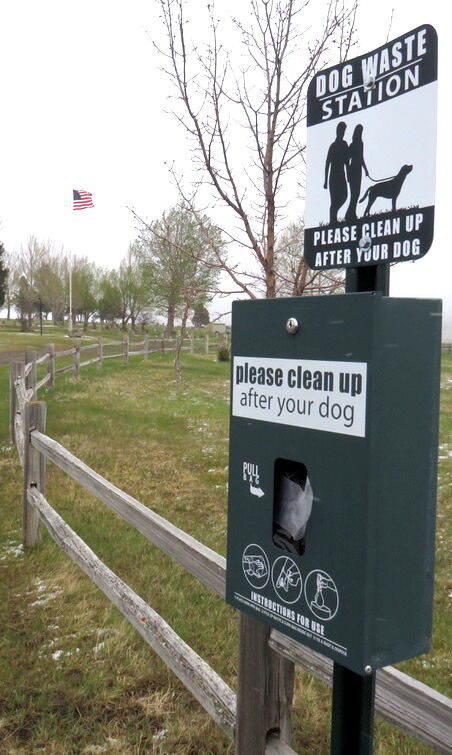
Cemetery Committee Secretary Patricia Lewis said that this issue has not only come to the committee’s attention due to the 1952 resolution, but also because some dog owners do not pick up after their dogs. In order to encourage owners to do so, said Lewis, the city agreed to put up dog waste stations in the cemetery. The movement to potentially ban dogs, she said, comes down to “irresponsible people” who still don’t pick up their dog’s waste.
Many grave plots are no longer maintained by their owners, said Nix, so responsibility falls on the city to clean and maintain those areas.
“We did a clean up [in the cemetery] last Saturday,” said cemetery committee chair Rhonda Craft. “Dog poo was found even on some headstones.”
Boulder resident Henry Elliott has been walking his dog at the cemetery for the past two years and expressed frustration about those who do not pick up after themselves. “It only takes one to mess it up for everybody,” he said.
The Animal Shelter and Care Committee’s Cheryl Haasakker says that while there are those who do not clean up after their dogs, the dog station is “well used” as she has to empty it one to two times per month. “For 50 years or so, residents have always walked their dogs up through there,” she said. “I would hope that the city would let it go.”
On June 21, said Nix, the City Council will hold a public hearing to gather the community’s opinions on the resolution and then decide whether to implement it.
“My fear is that we’ve just opened a can of worms,” said Lewis, “and that people will continue to walk their dogs and we do not have a police force that will police it.”
Nix agreed that this is a difficult policy to enforce, as even if the police were to drive by it would be hard to “catch people in the act.” He expressed hope that if the resolution passed to prohibit dogs from the park, members of the community will hold each other accountable out of “respect.”
He added that there is much more to the resolution than the “dog thing.”
“It is our job to protect, preserve, and promote the cemetery,” he said, “It is not a place for partying or for dogs — it is there to grieve and honor the dead, and there’s a whole lot of emotion involved with grief.”