
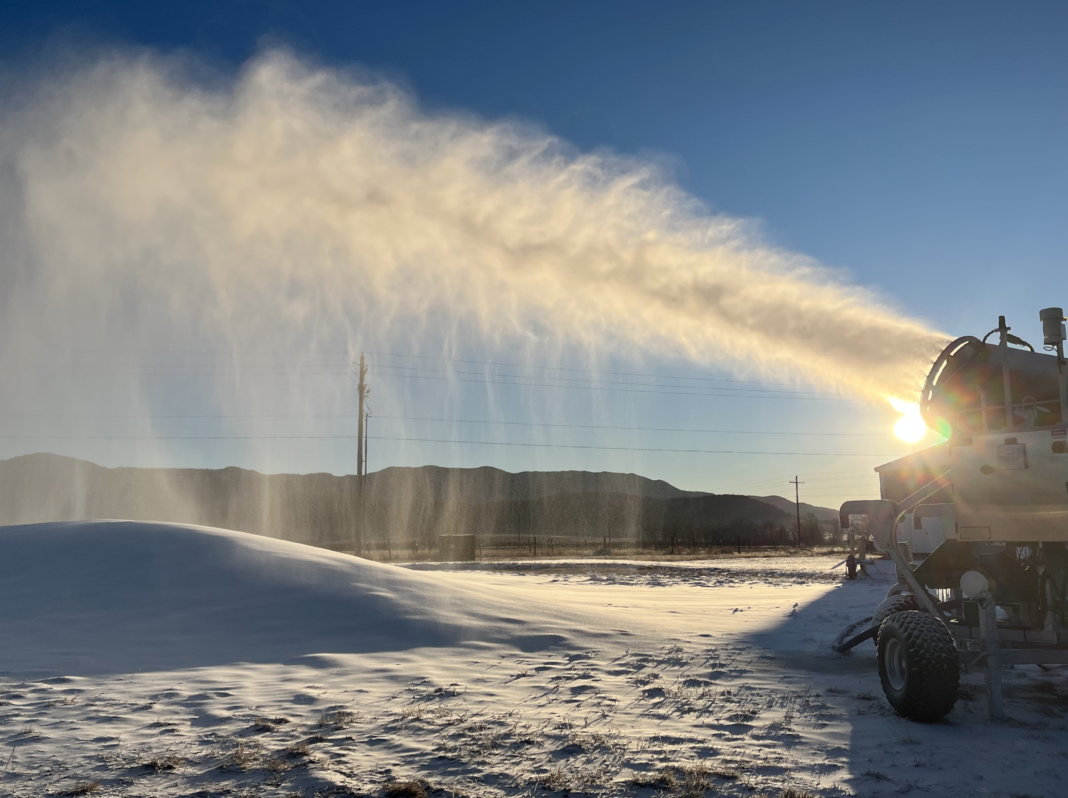
Boulder City Council voted unanimously at its Feb. 17 meeting to waive thousands of dollars in potential bulk water charges racked up by Skijoring the Big Rock, which last month used city water to make snow for the first time in its five-year history.
City Administrator Brian Bullock told the council that the Boulder Valley Skijoring Association’s borrowed SMI PoleCat snow machine used 428,000 gallons of water, which would incur a $4,280 charge at the city’s penny-per-gallon bulk rate.
The machine produced roughly 12,000 cubic feet of snow that volunteers trucked from Boulder’s wastewater treatment facility to the Jefferson County Fairgrounds for the Jan. 31-Feb 1 event. Rather than requesting a waiver, organizers told Bullock they were willing to pay for the water.
“I said, ‘Well, I can’t make that decision, but we could bring it to the City Council,’” he said.
Councilmember Drew Dawson opened the discussion by calling skijoring “a good public event” and moved to waive the usual fee. Councilmember Bear Taylor seconded the motion, giving community members a chance to weigh in. Eric Rykal, a member of the Boulder Kiwanis Club, made the case for the event’s economic impact.
“I haven’t seen Main Street in Boulder that busy in years,” he said, referring to the weekend visitors. “Skijoring is, I think, a great event to have in town. The Kiwanis put up a booth to sell food at, and we did great at that. You know, the amount of people that were in town, I think it’s well worth ensuring that it continues.”
Bullock echoed that sentiment.
“It’s almost like rodeo weekend, where it brings a lot of outside folks to Boulder to help boost the local economy,” he said in an interview. “Getting people into the area and letting them experience Boulder a little bit and see what we have to offer here is a good thing.”
The council also noted, albeit jokingly, a small silver lining to Boulder’s snowless winter: whatever snow remains at the treatment facility will find its way back to the aquifer.
For the Boulder Valley Skijoring Association, a 501(c)(3) organization, the waiver helps offset a tight budget. Organizer Melissa Ostrander said, including porta-potties, sound equipment, announcer, generator fuel, truck drivers and more, the event cost roughly $20,000 – even with community support.
With 1,600 spectators paying $5 each, the association brought in about $8,000 from parking fees – 20% of which went to the Boulder Outlaws, a 4-H group that managed parking.
That left the organization with roughly $6,400 from parking, plus additional fundraising and sponsorship revenue – but still not enough to cover the roughly $20,000 in total costs without dipping into savings built up over the years. Had the association been billed $4,280 more for water, it would have finished the weekend even deeper in the red.
“Our goal is to make enough money to keep putting the race on,” Ostrander said. “We don’t get a whole lot out of it other than bringing something good to the community.”
Looking ahead, Ostrander said she would like to purchase an SMI PoleCat snow machine – the same model donated by Discovery Ski Area this year – so the association could avoid seeking to borrow a snowmaker in future potential low-snow winters.
A new machine runs between $40,000 and $50,000, but Ostrander said it would save money in the long run. In years with natural snow, the association has hauled it in from surrounding towns using fleets of trucks – each trip costing around $400 in fuel alone.
In 2024, seven dump trucks made multiple round trips between Helena and Boulder to bring in roughly 325 tons of snow. “Hauling from Helena is so inefficient,” Ostrander said. “If we could find a main power source and hook up to a fire hydrant, there would be no question of us being able to do this year after year.”