
Officially, there are two mountain ranges in Jefferson County: the Elkhorns and the Boulder Mountains. According to the U.S. Board of Geographic Names, which only recognizes the aforementioned in our county, a range is “a single mass of hills or mountains.” Simple, and not particularly useful.
There’s also the concept of a subrange — smaller collections or offshoots of a larger range not distinct enough to be their own. What makes a mountain range and separates it from another is part relief, part geology, part adjacent barriers (such as a river), and part the circumstance of having someone officially name it. The Bull Mountains of Jefferson County have all of the former, but none of the latter.
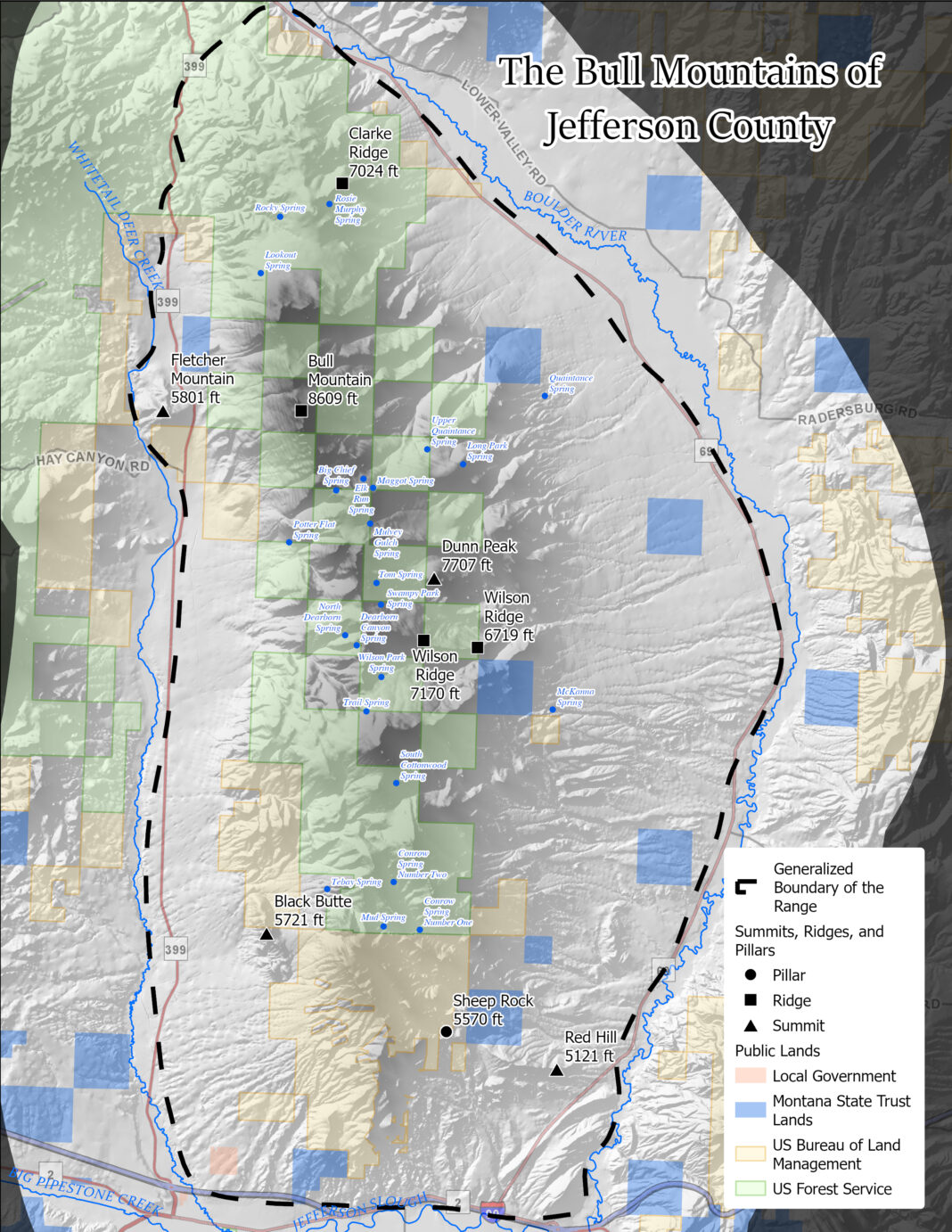
Rising nearly 4,000 feet above the valley floor, Bull Mountain is a gigantic mass of earth 8,600 feet in elevation just south of Boulder. The U.S. Geological Survey, classified it as a ridge and not a summit. Ridges and summits overlap in their definitions, and so characterizing that prominence as either figures just fine.
Bull Mountain proper is the northernmost peak in an unnamed pile of mountains running north-south for over 20 miles that colloquially are known as the Bull Mountains. I think the “s” at the end of the word “Mountain” matters, for it tells us we are looking at a range, and not a summit.
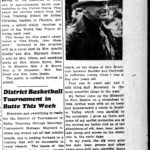
Then again, William T. Sweet, who was born in 1885 to Jefferson County pioneers in the Boulder Valley, wrote a 1956 Boulder Monitor article titled “61 Years on Bull Mountain,” and it seems that to him the entire string of hills from Bull Mountain proper all the way down to Cardwell was “Bull Mountain” — no “s” for plurality needed. So the Bull Mountains of Jefferson County — officially nameless — have a namesake within them.
There’s a process for naming geographic features in Montana – even mountain ranges, though it’d be fair to say that locals know they’re the Bull Mountains whether or not some bureaucrats have deemed it so. Further complicating things, just as there is another Boulder River in Montana, there is another Bull Mountains mountain range. Separating the Yellowstone and Musselshell Valleys north of Billings, the other Bulls run east-west for nearly 60 miles, but lack the stature of any our mountains locally.
Jefferson County’s Bull Mountains have a few named peaks and ridges, and even a pillar. They’re riddled with the remnants of mining and ranching, and even though much of the water that starts high on their flanks disappears into valley gravels, they have nearly two dozen named springs. Home to many a critter, ownership is a mixture of public and private, some of which is checkerboarded — a remnant of the land grants of yesteryear — and an issue for access today.
In his article referenced earlier, Mr. Sweet wrote of seeing hundreds of blue grouse at once in the range, of great elk and deer herds, and of bighorns on the slopes of Bull Mountain. Things have certainly changed, but when he wrote, “Given the chance, Bull Mountain will do its share to provide for our children and grandchildren…” he wasn’t wrong. Separating the two main valleys of southern Jefferson County, this massif of earth and history and possibility has been loved by folks who couldn’t have cared less about “official” names. What mattered to them, and what should matter to us, is that mountain ranges can love you back.