
(Second story in a series)
Chad Bullock has his eye on what he believes may be one of the last pieces of open land next to the city.
Bullock is in the process of developing 41 lots on about 40 acres near the Boulder cemetery in anticipation of building a residential housing development.
The Boulder resident believes the lack of housing is holding the city back when it comes to economic development.
“It’s stuck in a funk,” said Bullock. Bullock has not yet indicated a potential price point for the housing in the proposed development.
Housing in Boulder has long been a challenge. Compared to many places in Montana, affordable rentals or home purchases are in short supply. Barbara Miller, executive director for the Butte-based National Affordable Housing Network, and who has worked for years to help families buy affordable homes Boulder, sums up the city’s situation.
“It’s in desperate need and continues to be so,” she said.
As the Boulder Monitor continues to examine the lack of affordable housing in the city, this week it focuses on what Boulder has so far done to remedy the situation.
Boulder’s housing market is limited by its geography — constricted by public lands, rivers and an interstate. It’s also bound by economics — the loss of the Montana Development Center and its 250 jobs, as well as a decline in the mining industry.
As a result, the city currently offers little options for affordable housing that could accommodate both more commuters to Helena and Butte as well as employees for new businesses looking to locate here.
Boulder’s city government has begun to take on this challenge. It has crafted subdivision regulations and passed an annexation policy, both of which could ease the path for developers. And the emergence of projects like Bullock’s indicate that it is, in fact, possible to expand the community’s housing supply.
But it won’t be easy.
Affordable, or workforce, housing is defined as that which doesn’t consume more than 30% of an individual’s or family’s gross income, including utilities, according to the federal Department of Housing and Urban Development. The idea is that the 30% percent threshold allows for other expenses, although that percentage has crept upward since it was first established at 20% in the 1940s for federally subsidized housing, according to HUD.
This year, Boulder completed a three-year project, initiated by the closing of the Montana Development Center, to boost economic growth in the city, which includes measures to confront that gap.
As part of that project, the city created its first subdivision regulations. The regulations are designed to encourage development in the city and provide a level playing field for those who want to build houses, said City Council President Drew Dawson.
“Subdivision regulations, which are required by state law, provide for the orderly growth and development within a city and help to make it an even nicer place to live and to work. They allow the coordination of roads and public utilities. They lay out, by city ordinance, the requirements the all developers must follow to establish subdivisions with a city. If we do not have subdivision regulations, Boulder would have no method to allow developers to establish “subdivisions” within the city — a situation that is certainly not conducive to attracting developers or promoting organized and orderly development,” said Dawson.
The subdivision regulations outline details such as street design and how lots can be laid out, as well as providing a list of information that must be submitted as part of a development plan. The regulations include flowcharts and timelines for the review and approval process, giving developers an idea of what to expect from the city when they propose a project.
Along with the regulations, the city developed two other tools for addressing economic development and growth — the Downtown Master Plan and the Boulder Growth Policy.
The Downtown Master Plan focuses on the need to revitalize the downtown area for both residents and visitors, while the Growth Policy specifically lists housing as a key issue, with four main goals — developing a regulatory tool to allow for more mixed-use and multi-family housing through zoning; creating incentives for developers to construct affordable and seniors housing, such as density bonuses; supporting nonprofits in building affordable housing; encouraging homeowners to improve their properties with incentives and enforcement of regulations; and providing educational opportunities, tools and incentives to develop infill lots and other locations.
Earlier this year, Boulder passed its community decay, beautification and upkeep ordinance, which gives the city a legal framework with which to enforce violations regarding accumulated items, such as junk cars, and vegetation.
The city’s zoning ordinances are also being updated.
The city recently passed an annexation policy that will facilitate development outside city limits, as well as having contracted with Great West Engineering to assist developers with the subdivision approval process on an as-needed basis.
The annexation policy was designed to set criteria for extending the city’s boundaries, such as having to fall within the city’s future land use map as part of Boulder’s Growth Policy.
A development can have city utilities extended to the property once an annexation application has been submitted and approved by the City Council, according to the policy.
The annexation policy will benefit Bullock’s development, as a portion of it will need to be annexed into the city, paving the way for municipal utilities to be extended to the project.
Boulder Mayor Rusty Giulio is optimistic about Bullock’s new development.
“When we have (new) lots to sell, you’re going to be surprised what happens … they’re going to sell,” he said during a recent Planning Board discussion on how to address housing needs in the city.
The question is, when and how will those lots emerge? The city Planning Board has recently acknowledged that the housing shortage needs greater attention
During a discussion about housing at a recent Planning Board meeting, Jefferson County Planner LaDana Hintz suggested using “density bonuses” for senior housing, as well as alternatives such as mobile homes and tiny house villages. A density bonus is an incentive offered by a locality to developers to achieve a public policy goal, such as affordable housing. To increase senior housing, for example, the city might offer a density bonus in the form of reduced water and sewer connection fees.
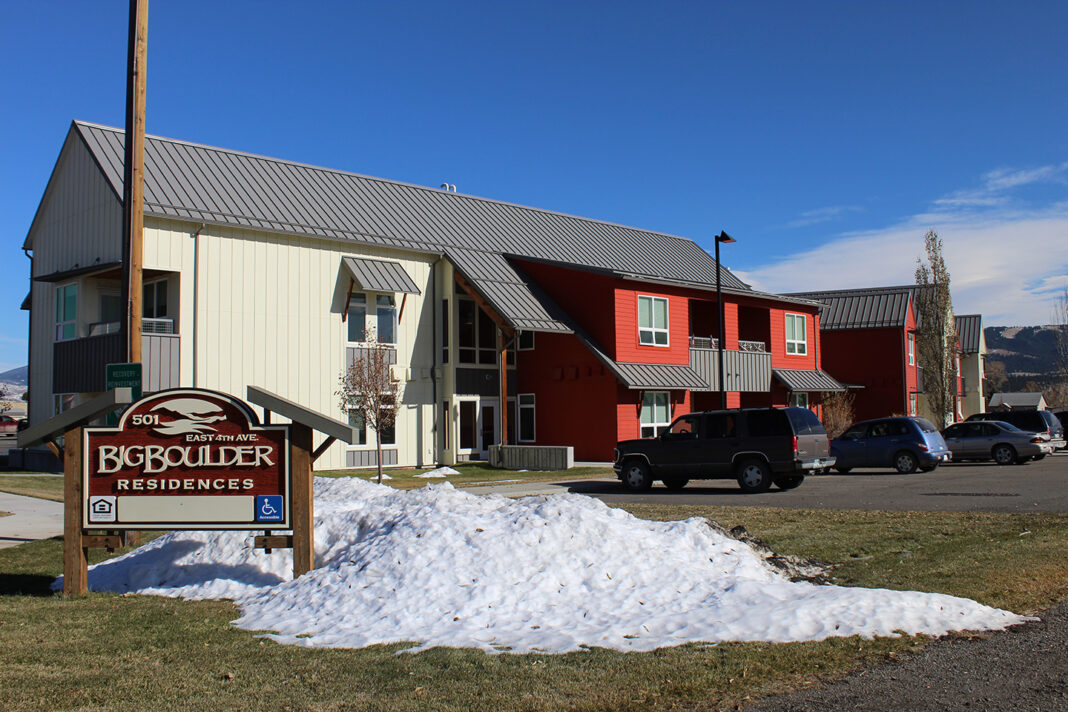
Boulder already has some multi-family units such as Big Boulder Residences on East 4th Avenue. Big Boulder offers 36 units available only to those who meet income qualifications.
The apartments are Section 8, and income caps for one individual considered low-income is $29,000, and for two people, it’s $33,150.
Rents are $663 for a one bedroom apartment and $770 for a two bedroom, and because they are Section 8, the tenant pays 30% of his or her adjusted gross income with the remainder subsidized by the federal Department of Housing and Urban Development. There is one more stipulation, said Property Manager Bobbie Sue Carothers. The tenant must qualify for at least $1 of a Section 8 rental subsidy.
However, there is a waiting list that varies from two months to two years, said Carothers.
Carothers said she regrets not being able to help those who fall just above the income threshold, as she has heard that finding affordable rental housing in the city is an issue.
It often boils down to who you know, as many folks rely on a word-of-mouth system in Boulder, said Brian Nathan, a recent transplant to the city from Great Falls. Nathan also experienced difficulty finding a rental unit.
There are other apartments scattered throughout the city, but those are also snapped up quickly — and often by word-of-mouth.
At a recent Planning Board meeting, Giulio pointed to mobile homes as being a viable and affordable option.
With the right type of unit, they can provide good housing, said Giulio.
In June 2016, a fire destroyed two mobile homes, damaged two others, and threatened several more in a Boulder trailer court — mostly due to the age of the structures, as well as their being located close together.
The fire led the City Council to draft an emergency ordinance that originally called for phasing out the pre-1976 mobile homes within five years. Those built before 1976 do not meet HUD standards.
The city’s action only highlighted what had already been a problem in Boulder — the lack of affordable housing — as many complained that the new ordinance, as originally proposed, would make them homeless. After a good deal of public outcry, the ordinance was revised.
The ordinance that was passed now bans mobile homes more than 20 years old from its date of manufacture and which do not meet HUD standards from entering the city. The ordinance also increased the separation between the structures to 30 feet or more.
Today, the city still allows mobile homes, also known as manufactured homes, but they must meet federal Housing and Urban Development standards (established in 1976), and be less than 20 years old. That would appear to preclude mobile homes that do not meet HUD standards, and were built prior to 2001, from coming into the city in 2021.
The National Affordable Housing Network has also built eight homes in Boulder, with plans to add two more. The work that the NAHN has done will be explored further in part three of the series.
The coronavirus pandemic may only be amplifying the problem. More folks from larger cities are buying up properties to pursue a rural lifestyle, abetted by technologies that allow them to work from anywhere, said Tom Harrington, project coordinator with the Jefferson Local Development Corporation.
These buyers can afford to make cash offers, which in turn, drives up prices, he said.
“It will make it even more difficult” to carve out land for affordable housing, he said.
Amber Conger is a Realtor with Windermere Real Estate in Helena, which serves Boulder and Jefferson County.
Conger said that while housing has historically been a consistent concern here, the recent trend of teleworkers seeking properties in rural areas, such as Jefferson County, as well as low interest rates, are driving inventory down even further.
Interest rates are currently around 3.8% for a fixed-rate 30-year mortgage. Two years ago it averaged about 4.5%, according to Lending Tree.
Today, the average home in Jefferson County goes under contract in 13 days, which is two weeks faster than this time last year, said Conger.
This is creating a good deal of competition and that sometimes means multiple offers being made on homes, she said.
Last month, there were around 43 houses for sale in Jefferson County, compared to 88 in January of 2017, she said.
The lack of housing inventory means buyers and realtors must be patient and flexible, said Conger.
Conger said buyers sometimes wait for a property that matches their criteria to come on the market, or they try expanding the area for which they are willing to look.
Harrington said it all comes back to the lack of available land — and those prices are rising.
“It’s not going away, it’s going to get worse,” said Harrington of the lack of affordable housing.