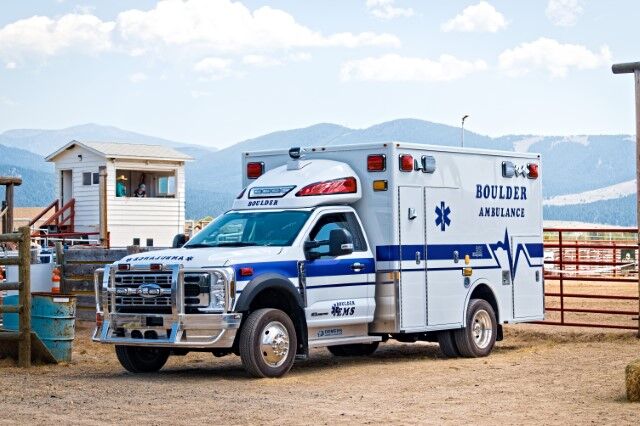
To balance its troubled emergency care budget, Boulder’s City Council on Monday approved a near-doubling of its rates for ambulance services, putting the cost in line with state averages.
“It’s been a long time since we’ve raised ambulance rates, and we’ve fallen significantly behind,” City Council President Drew Dawson said at the July 21 meeting, introducing the rate proposal. In fact, no one seems certain when the rates last changed; Boulder Ambulance Service Director Molly Carey said they haven’t budged since she joined the service 15 years ago.
In June, the City asked Pintler Billing Services, which now provides billing services to BAS, to survey charges at comparable ambulance services across Montana. The results were “pretty eye-opening,” Carey said.
Under its old pricing structure, BAS charged $600 for a basic life support emergency call and $750 for advanced life support – 55% and 60% the state averages of $1,252.27 and $1,368.51, respectively. (Most services charge less for non-emergency care; BAS has a unified rate.) The city charged $12 per mile for its vehicle, less than half the $25.02 state average.
The new rates, effective immediately, are $1,100 for a basic life support call, $1,300 for advanced life support, and $20 per mile. Fees for oxygen, defibrillation, intravenous therapy and other services have likewise gone up.
The change should help BAS’ dire financial situation. Last fiscal year, fee collections of $24,000 represented less than half the firm’s expenses of $50,000, according to City Clerk Rose Perna. BAS operates under an enterprise fund in the city budget, which means it must sustain itself with revenues from patient transport and other operational activities. Until the recent switch to Pintler, BAS’ collections had fallen behind, exacerbating its financial difficulties.
“The only way we’ve been surviving is we received CARES Act money a few years ago and we’ve been operating on those funds,” Dawson explained, referring to the Biden Administration’s 2020 Coronavirus Aid, Relief, and Economic Security Act.
The City expects the new rate structure and improved bill collection to increase BAS’ revenues to $46,000 in the new fiscal year, which may still be below expenses. “We’re going to have to adjust as we go,” Dawson noted. “We have a new billing company and a new rate structure, so we’ll have to monitor carefully.”