
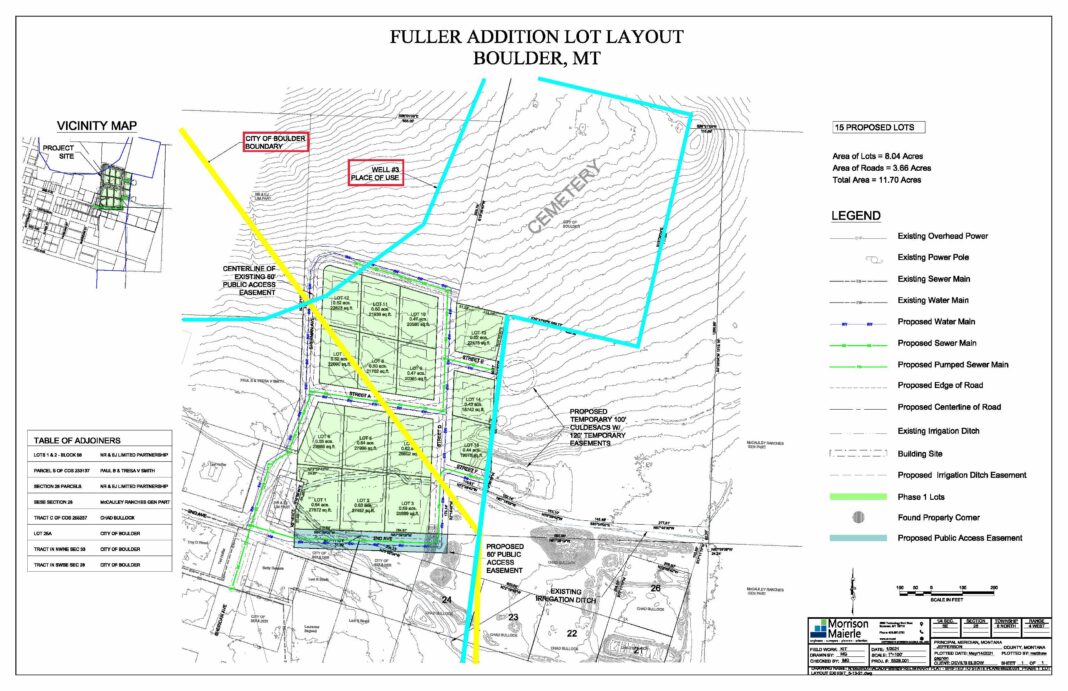
Facing a mostly mute crowd packed into City Hall on Monday night, the Boulder City Council unanimously approved the Fuller Subdivision at the east end of East Second Avenue.
The subdivision, comprised primarily of 15 lots across 11.3 acres southwest of the Boulder Cemetery, previously drew public comments in opposition of the proposal throughout public approval processes this summer and fall. But at Monday’s meeting, three people commented in support of the proposal and none voiced opposition.
The subdivision, proposed by Chad Bullock, sits partially on land that was annexed into the city this summer in a process that was at times contentious and drew many public comments opposing the project. Despite public opposition, the Planning Board, and ultimately the City Council, approved the annexation after finding that it met the city’s requirements.
On Oct. 4, the Boulder Planning Board, having found that the subdivision application met all city requirements, recommended that the City Council approve the subdivision. On Monday, the City Council did just that, by unanimous vote, including a stipulation that the development include a “no-build zone”—aimed at preserving rancher access—along a 15-foot easement for an irrigation ditch that runs through the property.
Before the vote, Jefferson High School Superintendent Tim Norbeck voiced support for the subdivision, saying that housing availability is “one of the first questions asked by new hires,” and that he has to be “straight-up with them” and tell them that Boulder has very little.
Jefferson County Commission Chairman Leonard Wortman said that “I think everybody is aware of the housing situation in Boulder area—there are no houses available,” and he encouraged the council to approve the subdivision, calling it “a great opportunity.”
Amber Giulio, a realtor, said that “we are struggling with a housing crisis in Boulder,” and that she is often unable to find homes for potential buyers looking in Boulder. She “highly” recommended the council approve the subdivision, hoping it would increase Boulder’s supply of homes.
Previous criticism of the subdivision included concerns of increased water usage, poor stormwater runoff, increased traffic on East Second Avenue and that the road was the only way in or out of the subdivision.
According to U.S. Census Bureau data, Boulder grew by 2% during the decade from 2010 to 2020, adding about two-dozen residents in 10 years.


