
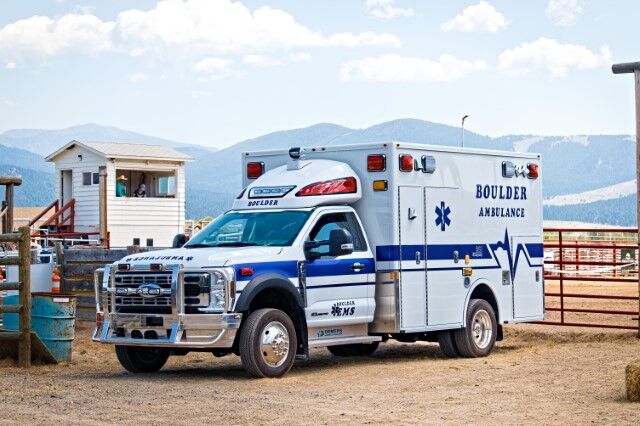
The Boulder Ambulance Service, from a barn on 2nd Avenue and with a roster of 11 dedicated volunteers, provides emergency medical services (EMS) to more than 2000 Jefferson County residents, as well any passing travelers that find themselves in need of an emergency response team. With a service area of more than 350 square miles, Boulder Ambulance operates across a vast territory, and often responds to calls in wilderness areas. In the face of environmental, financial, and staffing difficulties common to rural ambulance services across the United States, Boulder Ambulance, one of five operating in Jefferson County, is working towards improving incident response times and securing its long-term fiscal future.
“Some of the frustration voiced by the community comes from how long it takes for us to get an ambulance out to a call,” said Boulder Ambulance Service director Michelle St. George. “But we all have lives and jobs in the background of what we do here, and we do the very best we can.”
St. George, when not leading the Boulder Ambulance Service, works full-time as a Montana State juvenile probation officer, which requires frequent travel between Jefferson, Beaverhead, and Madison counties. Wherever she might be, when police dispatch requests an ambulance on-scene, St. George and the 10 other Boulder Ambulance volunteers simultaneously receive a notification through Active 911, an emergency response notification tool, and then determine who among them is capable of responding.
“When a call comes in, a lot of the time I’m out the door before my husband realizes I’m gone,” said Boulder Ambulance EMT Amanda Cochrain. The Boulder Ambulance Service, largely through successful grant-seeking, received a new 2024 model ambulance last month, which it hopes will positively contribute to the service’s consistency and quality.
Each response requires at least two people; a driver and an emergency medical technician (EMT). The time it takes an ambulance crew to begin moving towards an emergency from when they are notified is called the “chute time”, and, according to a 2023 report issued by the Montana Department of Public Health and Human Services (DPHHS), Montana’s volunteer ambulances services have chute times nearly four times longer than ambulance services with paid employees. While on-site times, or the time an ambulance team spends preparing and loading a patient for transport, are comparable between volunteer and paid services, total call time for volunteer ambulance services is roughly 2.3 times longer, state-wide. The Boulder Ambulance Service does not collect consistent data on response times, though it did respond to more than 120 recorded dispatch requests in 2023. Since the closure of Eagle Ambulance in 2022, based in Montana City, Boulder Ambulance is anticipating an increase in the number of dispatch requests over the coming years.
“As a volunteer service, we need to find people with flexible schedules, supportive families, and employers who understand the value of volunteer work,” said St. George. “We’ll be getting busier with Eagle (Ambulance) gone, and we’re doing everything we can to get ready. Just three more volunteers would bring us to 14 total, and allow us to create a more consistent schedule and lower our response times. We haven’t really lost anyone, but it’s hard to find new people.”
According to a 2021 survey conducted by the U.S. Census Bureau and Americorps, formal volunteering, which is volunteer work facilitated through an organization, in the United States is down seven percent since 2019. With now only 23.2 percent of Americans participating in formal volunteering, this is the lowest recorded rate in nearly three decades. As ambulance services require volunteer EMTs to first complete a 120 hour certification course, and with other positions also requiring significant medical and continuing education commitments, the pool of potential ambulance volunteers is even more strained.
“Volunteerism is at an absolute all-time low!” said Three Forks Area Ambulance Service Treasurer Barbara Mutter. “But, once you’re trained, I don’t care if you’re here for five years or five minutes! We’re willing to welcome everyone because what we’re doing is so important, and the stakes are so dire.” Mutter has deployed creative solutions to finding and retaining new volunteers that may be replicable in Boulder.
Mutter managed to bring her total roster from seven to 15 volunteers in less than a year by creating sleeping quarters within her ambulance barn, which she furnished in a single day through soliciting furniture donations on Facebook, and by opening up recruitment to those living outside of her service area. She directly targeted pre-med and medical students in Bozeman by offering them a simple deal: agree to two mandatory eight hour shifts a month in exchange for direct experience.
“The faster you can intercept a patient, the better the outcome: always. Expanding the volunteer pool has really improved things for us; we just needed to think outside the box a bit,” said Mutter. While the Boulder Ambulance Service does not presently have the ability to create sleep facilities in its ambulance barn, due to a lack of utilities access and available space, the City of Boulder, as stated in its 2019 Capital Improvements Plan (CIP), is considering constructing a new emergency medical services facility to be used jointly by the ambulance and fire services. The new facility could potentially accommodate out-of-area volunteers and expand the Boulder Ambulance Service’s volunteer roster.
“We have a lot of hope for a new barn, and to create a sleep space,” said St. George. “But right now our barn’s toilet is literally a hole, with water from the fire department. We’re a bit stuck! We’ll host another EMT course in Feb. 2025, so hopefully we’ll get some more volunteers from that. But until then, we just have to stay positive and focused.”
“In terms of the long-term stability of the ambulance service, there is some work to be done,” said Boulder City Council President Drew Dawson, who himself served as Boulder Ambulance Service director for many years. Dawson was also the National Highway Traffic Safety Administration’s Director of Emergency Medical Services, where he oversaw the National EMS Advisory Council, the Federal Interagency Committee on Emergency Services, and the National 911 program.
“As I look around the state, and the nation for that matter, rural ambulance services need to think creatively to find ways of staying viable, and that has to involve community support. Staffing plans for a 24-hour ambulance service might just need to include budgeting for 24-hour ambulance staff. The challenges of running a rural ambulance service are similar across Montana, and we’re going to need a commitment from the community to improve the situation here.”
Beyond donations and grant-seeking, the Boulder Ambulance Service presently operates under an enterprise fund, which is replenished exclusively from revenues generated from transporting patients and other operational activities, such as educational offerings, like CPR classes, or special event coverage. As the ambulance service can only receive payment in its regular, daily work for directly transporting a patient to a medical facility, and that, according to DPHHS, only 65 percent of calls result in a patient transfer, ambulance services often have trouble generating consistent sources of funding. Even when they do conduct a transfer, they can struggle to collect payment from patients and insurance companies. Boulder Ambulance presently has roughly $11,000 in its operational account, and, according to Boulder city officials, as much as $60,000 in outstanding collections. While struggles with financial security and collection are common among rural ambulance services, some, such as Jefferson Valley EMS and Rescue, have managed to create more consistent sources of income.
After Whitehall decided to end its city-controlled ambulance service in 2014, former city volunteers formed Partners United for Life Saving Education (PULSE), a private non-profit focused on providing low-cost healthcare education to southern Jefferson County. PULSE then founded and proceeded to operate the Jefferson Valley EMS and Rescue Service, which fulfilled the community’s need for local ambulance services. PULSE and community stakeholders eventually convinced the Jefferson County Commissioner’s, in 2017, to create the Jefferson Valley Rural Ambulance District (JVRAD), which allowed communities in southern Jefferson and Madison counties to elect into a $29 per household, per annum fee in exchange for EMS services. PULSE was then contracted by JVRAD to provide emergency services in-district, and now receives roughly $3000 a month in addition to its operational revenues.
“Boulder needs to figure out what its business model is, but if it created or joined a district it could really pull in some regular money,” said PULSE President John Janik. “Since we’re contracted with the county, and free of oversight from a town government, we get to manage our own cash and make our own decisions. It allows us to do whatever we feel is necessary to be successful.” Jefferson Valley EMS and Rescue now has a roster of 28 volunteers, of varying degrees of activity, eight ambulances, and several paid positions, including a full-time, salaried Service Manager who oversees the service’s daily operations.
“We have very competitive wages,” said Jefferson Valley EMS and Rescue Board Member, and EMT, Kamrie Smith. “We’ve had people leave their jobs to come and work for us, and we’ve been really lucky to have a large number of people willing to step up and help the service succeed.”
Establishing consistent income and direct control over their own finances has also allowed PULSE to create other revenue streams. Because PULSE has the means to regularly replace equipment, it also means they can regularly sell used equipment. With such a large fleet of ambulances, they can provide EMS coverage to high-attendance, out-of-area events, and also lease out ambulances to other services. They can also charge a $100 dollars per service call on out-of-district dispatches.
As the City of Boulder and the Boulder Ambulance Service begin to work together on improving the responsiveness, timeliness, and overall quality of emergency medical services offered locally, they will have, according to City officials, strong regional and national examples to consider.