
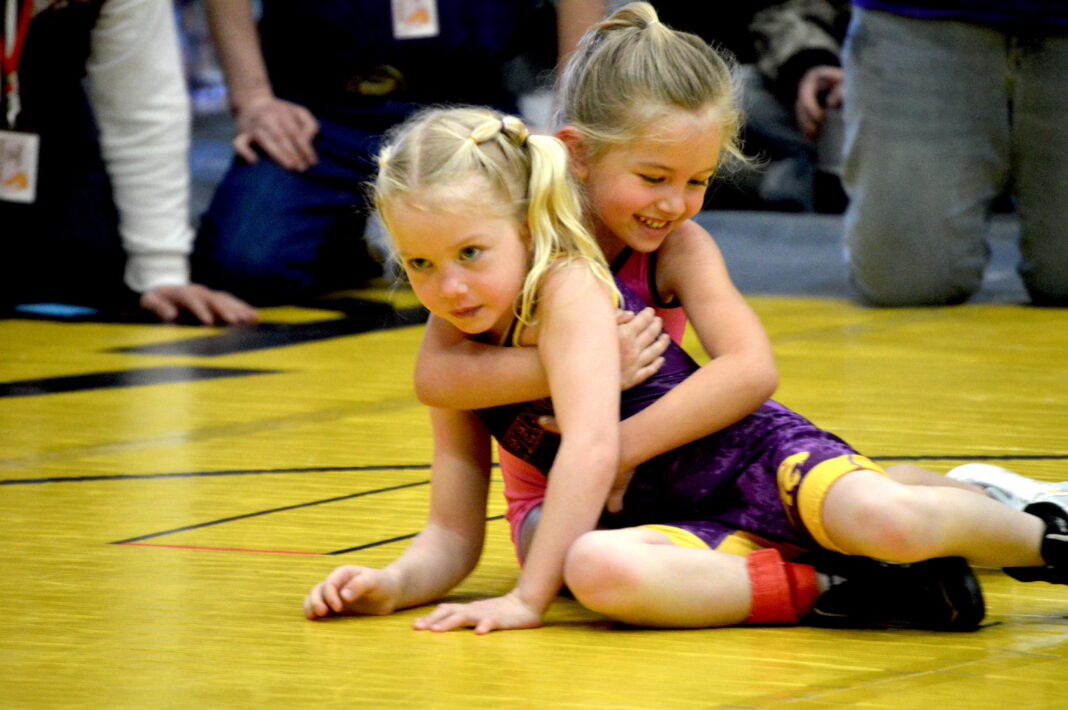




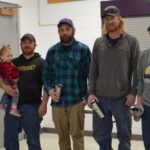
It was a buoyant evening March 30 in the Jefferson High School gym, as around 30 boys and five girls, along with their parents, families, and coaches, gathered for Little Guy Wrestling’s annual end-of-season awards dinner.
While cheesy beef tortillas were heaped onto paper plates, anticipation loomed for the main event: the trophy presentation. Most awards are decided by the coaches, and wrestlers have no idea who the winners are until a name is called. So all eyes were on 9-year-old Beau Hadfield, winner of the highly coveted “hardest worker” award, given in memory of Trysten Strong, a Little Guy wrestler who passed away. Little Guy secretary Samantha DeWit said this is the trophy wrestlers are most encouraged to go for, and she was glad to see it in Hadfield’s hands.
“[Hadfield] worked hard every night at practice and never complained,” she said. He wrestled in novice at 75 pounds – but weighed in before the divisional meet at 75.1, which put him in the tougher 80-pound class. “He didn’t bat an eye,” DeWit said. Hadfield qualified for the state tournament, and won third place there, despite getting banged up by bigger athletes. “There were days he was dog tired and bent up like a pretzel, but he kept pushing,” said Little Guy coach Travis Newman.
The Little Guy celebration didn’t get the same attention as Jefferson High School’s wrestling team had the month before, when it finished fourth at the Montana state championships. For the first time in nearly 20 years, the Panthers had a state champion — John Armstrong, who cruised through the competition at 152 pounds to secure the crown.
In fact, the Panther wrestling program is verging on dynastic: Since 2015, it has grown steadily and achieved progressively greater success. Jefferson High won the Western Class B/C tournament in 2021 and 2022 while placing third in 2023. In addition, a half-dozen or more wrestlers regularly qualify for the state championship.
Part of that transformation is explained by an epiphany experienced by Troy Humphrey, who has been coaching the Panthers for the past 25 years. We’ll get to that later.
But a big part of it is about Little Guy Wrestling – about the efforts of Humphrey and others to build enthusiasm, participation, and skill that, over time, has fed the JHS program. It has been a collective effort, and a very patient one – an overnight success more than 25 years in the making, as they say.
Boulder’s Little Guy program was around before Humphrey got involved in 1999, but it typically didn’t operate every year. Humphrey changed this by assisting the program in forming a board with officers and filing for a non-profit status. At this time the club also changed its name from Boulder Little Guy wrestling to Jefferson Little Guy. This was an intentional act to broaden its base — and to make it clear Little Guy was a vessel that would both benefit the community’s youth and, ultimately, feed the Jefferson High wrestling program. At that point, the Panther program lacked consistency. It had a good run when Humphrey started as coach in the late 1990s, finishing third at State in 1998 and with a state champion wrestler in 2005 (Tommy Clement), but such strong finishes were hard to achieve year after year.
Humphrey and others associated with the program had an idea on how to sustain success: Start young.
* * *
What drives Little Guy? A large part of it is the “have fun” mentality, Newman said, adding “why would it be any other way?”
Newman has coached Little Guy athletes off and on for 28 years. “We’re talking about little kids here,” he said. “It’s like herding cats. Why get mad at them? I try to make it fun. I don’t get mad when they lose. I don’t encourage them to lose, but, as long as they don’t go out there, lay on their back and stare at the ceiling tiles, I’m not going to get upset. They are little – they are four years old to 12 years old. We’re not going to blow up on them. We want them to continue the sport, and, as they get older, we want to see them improve. That’s my goal. I want to build an amazing wrestling team for the high school.”
Through the Little Guy program, athletes from the Jefferson County elementary schools have had an opportunity to learn the fundamentals of wrestling and experience the discipline, confidence and personal growth involved in the sport.
Wrestling parent Miranda Wing said Newman goes out of his way for the children and makes sure each one gets individual attention. He makes sure they are enjoying the experience, encourages them and pushes them. He teaches them how to lose gracefully, and how to win gracefully. He teaches respect. She’s seen this go a long way for the children in the program, including her son Kayner, who won the sportsmanship award at the Little Guy wrestling award ceremony.
“Sportsmanship is something everybody should have,” Kayner told The Monitor. “If a kid is being mean to another kid it isn’t going to encourage them.”
Encouraging – and developing – the youth is exactly what Newman and the new Little Guy directors Samantha and Jeremiah DeWit want to do. For the past two years, they have been running the Little Guy program, and they can’t believe the amount of growth they’ve seen.
“We had 30 more kids than anticipated following COVID, and we expected those numbers to drop off the next year. Instead we had 10 more wrestlers,” Samantha said.
Not only are more students getting involved in the program, Samantha said, but they are sticking with it. They are putting in the work and seeing results.
“Some of the improvement I’ve seen is incredible,” she said. “I have some wrestlers who wouldn’t even shake hands with their opponent after a meet, and now they are picking kids up off the mat and helping them up. Our emphasis on sportsmanship is paying off.”
Kayner agrees.
“Everybody should treat others the same way they expect to be treated,” he said.
The community has picked up on this approach — and has stepped up to support it. “Up until three years ago we only had 20-some kids,” said Newman, “and there wasn’t a lot of help from the community.” But now, as the DeWits can attest, parents, students and other community members have seen the positive impacts on the well-being of the athletes, and support has snowballed, especially once COVID restrictions were lifted.
It’s this support – and dedication – from the parents that makes the program thrive.
“Without the parents we wouldn’t have a team,” said Newman.
* * *
It took many years to turn Jefferson High wrestling into a winning culture, Humphrey said. For most of his time as coach, wrestling hasn’t often been the sport of choice for the school’s more competitive athletes. But that started to change, he said, around 2015. It was also at this time Humphrey also decided to change his approach.
“Up to this point my philosophy was to be intense, have the kids work excruciatingly hard in practice and embrace the grind that came with the sport,” Humphrey said. “Then I had this freshmen class that asked if we could have music during practice. I reluctantly agreed, and I’m glad I did. These kids taught me a valuable lesson: that hard work can be accomplished if I just make wrestling fun.”
From that point forward Humphrey said “having fun” became the number one goal.
Which sounds a lot like the Little Guy approach.
This epiphany has played a large part in the growth of wrestling in Jefferson County, Humphrey said. By 2018, 30 wrestlers had signed up. Only 16 were allowed to compete in the divisional championship (according the Montana High School Association regulations), and a school record 14 of those 16 qualified for state.
Of the current Panther wrestlers, a majority have emerged from clubs or Little Guy programs in Jefferson County or Helena. Current seniors Cole Jeske, Hunter Steele and Jeyden Sullivan – along with junior Dayton Brown – are all graduates of the Jefferson Little Guy and junior high programs. State champion John Armstrong and his younger brother Brady came out of Helena’s Bruin Wrestling Club. Brown joined Little Guy wrestling when he was in fourth grade. It was smaller then, but just as effective, he said, as it taught him a lot of valuable life lessons, including how to lose gracefully. “I’d say I’ve learned more from my losses than my victories,” he said.
The discipline and drive Brown has going into his senior year he attributes largely to coaches Newman and Humphrey. “[Newman] is a straight shooter and he’d often tell me things I didn’t want to hear, but that’s been good for me. It’s helped me soften my ego,” Brown said.
Brown added that both of these coaches saw something in him he didn’t see in myself, and that confidence has helped propel him to where he is today, and, ultimately, where the program is today.
***
Indeed, there seems to be a virtuous connection between Panther wrestling and the Little Guy program: Little Guy has, as hoped, helped to feed the high school ranks. And Humphrey believes that the recent success of Jefferson High’s team has helped fuel the growth of Little Guy’s elementary school program, which has seen record enrollment recently. With Armstrong’s state title, Humphrey expects to see the numbers continue to rise.
“After we placed third in 2022, the Jefferson Little Guy program saw a dramatic increase in numbers, as did the junior high program,” Humphrey said. “This success definitely reinforces that we are moving in the right direction.”
However, Humphrey added, wrestlers alone can’t make for a successful program.
“It takes a huge commitment for parents, too, and not just time-wise, but also financially,” Humphrey said. “Travel, entry fees to tournaments, it makes such a difference when you have the parents behind the program. I can recruit kids all I want but if I don’t have the parents on board they are only going to go so far.”
The elementary Little Guys program is seeing this buy-in now more than ever.
According to Samantha DeWit, the 2023 Little Guy season saw more parent involvement and more volunteer participation than ever before. Volunteering is strongly encouraged, and rewarded. Children can wrestle for free if their parents volunteer more than 10 hours.
DeWit said she’s seeing many parents take her up on this, which is extremely helpful, especially considering how grueling the six-week program can get.
“Four nights a week of practice and a tournament every weekend is a lot to ask of the parents and the kids,” she said.
But when the children are having fun, and when there is support and encouragement from the coaching staff and the fellow athletes, it doesn’t feel like too much for those involved.
“It’s a mixed bag,” DeWit said. Now that the Little Guy season has ended, “my weekends are free, but at the same time I miss it. We have lots of stuff planned for the summer, though, so it never really ends at our home. It’s a year-round thing.”
Which will work just fine for her son, Jaden Anderson – who took home the Little Guy MVP award at the trophy dinner. “When the season ended, [Jaden] was like, ‘What? It’s over?’” It’s not. Jaden and the other Little Guys have a long way to go.