
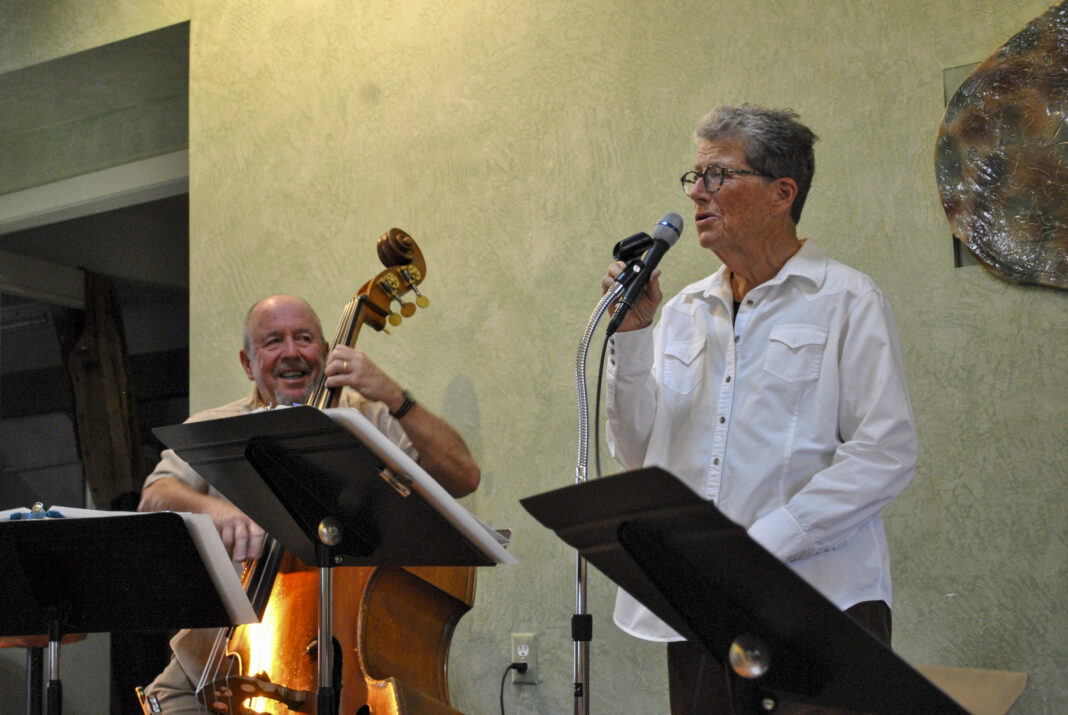
Basin’s resident jazz trombonist and vocalist, MJ Williams, has been nationally recognized as a 2021 Jazz Hero by the Jazz Journalists Association.
Williams was one of 23 musicians to receive the award this year, which is given annually to “advocates who have a significant impact in their local communities,” according to the association’s website. She said she appreciated that Susan Brink from JJA made an effort to look at jazz musicians in smaller communities as well as in big urban areas. She said she thinks it’s “about time” that people recognize how widespread the “true devoted love” of jazz is.
“It’s out here in the boonies, ‘cause that’s how I grew up,” Williams said. She said that although she was honored to be acknowledged, she thinks that the Montana jazz scene is the more “interesting story.”
She recalled her father, who was also a jazz trombonist, driving “in the dead of winter, going up to the Hi-Line to play these little gigs.” She said it was all because they loved the music. There were “fabulous” jazz musicians that came through Montana when she was a kid, Williams said, adding that it “still is that way.”
Williams played a show at Basin Creek Pottery on Saturday night with two other musicians: Bob Bowman on bass and John Stowell on guitar. The trio played songs written by all three musicians, and improvised several songs too, for approximately 50 clapping and cheering listeners. Feet were tapping as many listeners closed their eyes, letting the music wash over them. Bowman’s fingers danced up and down the spine of his bass, Stowell’s eyes were tightly closed as he played, as if he were in a trace, and Williams’ smooth honey voice lathered the walls of the room.
The other two musicians excelled in their own rights: Bowman, “the legend,” as Williams called him at the concert, has worked on several Grammy-winning and Grammy-nominated albums, and Stowell tours and teaches internationally, and has worked with artists including Lionel Hampton and Milt Jackson.
Williams seemed surprised that association had found her and chosen her.
“I don’t know how [Brinks] did this, but she said she kept looking online and finding me,” Williams said.
According to her neighbor and friend, Montana Poet Laureate Melissa Kwasny, Williams has been a promoter of jazz in Montana for more than 40 years.
“She has made an effort to keep jazz alive in a place we don’t normally think of as a jazz center,” Kwasny said, adding that Williams always welcomes young artists to play with her and supports their careers.
She loved to hear her father play the trombone, Williams said, and she never really questioned becoming a musician—she just knew that this was what she wanted to do.
“I just loved it. I loved it from the first time I heard it,” she said, explaining that music is another language for her, and is her “connection with reality.”
She has a distinct memory of listening to “An American in Paris,” by George Gershwin “so closely” on her parents’ record player when she was around 6 years old, she said. The rhythm going on in that song is “very exciting,” she said. The first two jazz voices from the larger jazz world Williams said she remembered hearing were Sarah Vaughan and J.J. Johnson, and she played records of each until she almost erased them.
“Jazz opened up a whole different oral landscape for me,” she said, “for me, it’s stretched over, well, half a century or so, just trying to learn it.”
Williams said she started playing trombone in the fifth grade, and her interest in jazz and folk music grew from there, although she said she was always more interested in jazz because it was more “complex” musically. She went to the University of Montana to study music for a time, but she noted that she “didn’t last very long” at the university. All in all, Williams said, she learned the most from being around other musicians, and hearing other improvisers.
“It takes thousands and thousands of hours, just like any other craft,” she said.
She said she found the Civil Rights music of the ‘70s “very powerful” because it was musically interesting and also had a potent social message. Williams said she also learned about racism from treatment of Black musicians in the jazz world.
Williams said she particularly followed the jazz singer Sarah Vaughan because she was a “brilliant” vocalist. She noticed people would make odd comments about Black musicians, particularly Black female musicians, she said.
“Living in Montana, I knew about discrimination, I knew about how we had treated the native population. But it just became so much more personal when I saw what had happened to the geniuses of jazz music,” she said, citing Miles Davis, a black jazz trumpeter who was clubbed in front of a nightclub that he was working at. She said this was a “potent” message to her that was “difficult to reconcile.”
She said that growing up in a community that hasn’t “fully faced” racism, she did not have the language to understand the discrimination.
Williams read as much as she could about jazz music, she said with the caveat that she’s “not a great scholar or anything.” Then, she visited New York City “just to check it out.” She said she was young and naïve then, and joked that it was “amazing that [she] survived that one.”
She returned to New York in 1986 with a grant from Montana Civil Arts Fellowship. She said she went to listen to jazz in different clubs every weekend for three months.
“It was fantastic!” she said. “I saw the pantheon of jazz players, because they were working in New York at the time.”
Williams spoke fondly of these “small clubs” that she said she would find in every city that maintained themselves “just because the fans and the people who love this music are so dedicated to keeping it going.”
Williams is one of the founders of Basin’s Artists Refuge, which was open from 1993–2011 and was a hub for artists from all over the world. At its genesis, Williams said, a few of her friends got together and they chipped in $25 each to create a mailing list. Williams said she was in the group that come up with the idea of starting a Jazz Brunch at the refuge, which took place in the community center.
“It was due to the generosity of those musicians that we raised the money to be able to do the refuge,” she said.
She said all the music at the brunch was donated by her musician friends who liked the concept, and were “generous enough to work for nothin’.” They did 14 or 15 brunches every year, she said. They started with 25–30 people, and then got “bigger and bigger.”
Williams said the local people are what “truly made the refuge a success,” naming Jennifer Pryor and Karen Davidson as people always supported the brunches, decorated the hall, made food and cut up fruit. She said that she hopes to reopen the refuge soon, although she does not know exactly when.
“I feel like the heart of the music is alive,” she said, “people playing for one another—that’s what music is about.”
Basin resident Rhandi Rachlis, who also played in iconic Montana band Cheap Cologne alongside Williams, has known Williams for half a century.
“Willy just can’t help herself,” Rachlis said, referring to Williams’ love of music. “I mean, that’s who she is, and has been, probably always.”