
Decades after placing Basin on its Superfund National Priorities List to clean up significant mine-related contamination, the U.S. Environmental Protection Agency is committing $31 million to pick up where it left off.
This funding is part of $65 million awarded to three mining areas in Montana as part of President Joe Biden’s Bipartisan Infrastructure Law, according to a March 7 news release by the Environmental Protection Agency. Other Superfund sites receiving funds include the Carpenter Snow Creek Mining District in Cascade County and the Upper Ten Mile Creek Mining Area in Lewis and Clark County.
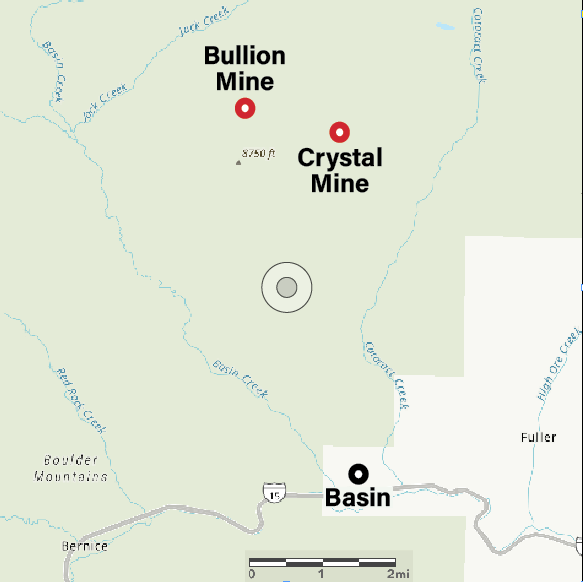
According to Department of Environmental Quality Public Information Specialist Kevin Stone, this $31 million will be used to remediate the Bullion Mine site and the Crystal Mine site, removing high concentrations of contaminants such as copper, zinc, cadmium, iron, lead and arsenic. The funding will also be used to build passive water treatment systems at both sites, as one of the biggest concerns with the Bullion and Crystal mines is how the acid mine contaminants can potentially flow into Basin Creek and Cataract Creek, which in turn flow into the Boulder River.
Stone said in an email to the Monitor that field activities are scheduled to start on the Crystal and Bullion sites in the spring of 2024. The EPA, in consultation with the DEQ, has hired Jacobs Engineering, a Dallas, Texas-based engineering firm, (formerly CH2MHill) to complete the remedial designs. The clean-up is estimated to take three to five years. According to Stone, the need for additional remediation in the watershed will be evaluated following currently planned remediation work.
The Bullion and Crystal mines – located deep in the hills off Basin Creek Road approximately 10 miles north of the town of Basin on the north side of Jack Mountain, between Basin Creek and Cataract Creek drainages – are considered to be the largest surface-water quality threats to the district. The Bullion (located on Jack Creek Road) is particularly of concern, as it was the most productive mine in the Basin Mining Area, operating from 1897 to 1974.
According to a 2022 study by the Montana Bureau of Mines and Geology, the Bullion consisted of three levels, connected by stopes and inclines, with about 4,500 feet of total workings. Over its life, it produced approximately 30,000 tons of ore containing gold, silver, copper, lead, and zinc.
The Crystal Mine was also a productive one. It consisted of both underground workings and open pits, operating periodically from 1883 to 1984, according to MBMG documents. Total ore production was reported to have been approximately 22,500 tons, consisting of gold, silver, copper, lead, and zinc.
Former Jefferson County Commissioner Jim McCauley remembers what the Crystal Mine looked like in the mid-to-late-1980s. That’s when he and the other sitting commissioners heard concerns from Basin community members.
“We had a few really wet winters then, which resulted in some flooding, causing water to come out of the mine portals close to the creek and drag a lot of that sediment with it,” McCauley told The Monitor. “People were noticing that the fish were dying, particularly in Cataract Creek. That’s what prompted us to do something about it.”
McCauley said commissioners had the Montana Tech science and engineering departments take a look at the site, which ultimately led to the 1989 Screening Site Investigation that indicated elevated contamination in soil, sediment and surface water samples collected throughout the Basin Mining Area.
Longtime Basin resident Rhandi Rachlis has seen this contamination, and she said it continues to be a concern.
“The Crystal area looks pretty bad,” Rachlis told The Monitor. “It looks like nothing is coming back to life. I’ve taken a few tours out there. Once I saw brown water running over everything.”
Basin native Sarina Eckman has also spent some time at both the Bullion and the Crystal sites. The Crystal area, she said, is the biggest and most noticeable cleanup location with “yellow dirt and a lack of vegetation.”
“You can tell there has been some remediation work done,” Eckman said, “but it’s definitely not ‘fixed.’”
Remedial designs for cleanup of Crystal and Bullion mines were completed in 2015. Back then representatives from the EPA and the DEQ told the community to “anticipate remedial action pending availability of federal funding.” Now, eight years later, the funding has finally been secured to make remedial action a reality again.
Previous field activities have included excavation, transportation and disposal of contaminated residential soil and mine waste from the town of Basin to the Luttrell Repository (which is still being used as a repository for mine waste material), backfilling of excavated areas with clean soil and revegetation of these areas, and implementation of institutional controls to prevent exposure to areas where removal of mind waste was not feasible, such as under structures.
According to the EPA’s website, the Basin Mining Area site is located in and around the unincorporated town of Basin. The site encompasses approximately 77 square miles and includes the town of Basin and approximately 300 individual abandoned mine sites in the surrounding watersheds of Basin Creek, Cataract Creek and part of the upper Boulder River.
Basin has a rich history in hard rock mining, starting in the 1870s when Irish immigrant Michael O’Donnell journeyed into the Cataract country and located what would become known as the Katie and Hope mines. Mining continued in the area until the late 1960s. Such activity, the EPA and DEQ has determined, released such hazardous substances as arsenic, cadmium, lead, zinc, silver and copper.
The discovery of contaminants led to the Basin Mining Area becoming part of the Federal Superfund, which was established in 1980 as part of the Comprehensive Environmental Response, Compensation and Liability Act enacted by Congress. According to EPA documents, this law gives the EPA the funds and authority to clean up the nation’s most contaminated locations. DEQ is a supporting agency and works with the EPA to ensure these locations get cleaned up for Montana’s people and environment. In 1999, the EPA listed the Basin Mining Area to the Superfund National Priorities, in cooperation with the United States Forest Services and DEQ.
Remedial action in the town of Basin was officially completed in 2004. This included the removal of many contaminants. According to a 2018 report from the Department of Environmental Quality, “approximately 5,000 cubic yards of contaminated soil/tailings were excavated and disposed of at the Luttrell Repository.” These excavated areas, according to the report, were backfilled with clean soil, graded, fertilized, seeded and mulched. Contaminants included arsenic, copper, lead, zinc and manganese.
There have been a number of five-year reviews conducted by the EPA since the clean-up of the Basin mining area began, most recently in 2018. A fourth five-year review is estimated to begin in September of 2023.
Basin residents at the Silver Saddle, the Basin Water and Sewer meeting and those reached by phone were unaware of this significant funding announcement. They were not unaware, however, that such cleanup is needed. The response most common to those informed was optimism. DeDe Rhodes, Basin Water and Sewer Board Treasurer, said she hopes this could lead to some road improvements.
The cleanup is hard on the roads, Eckman said, as what she recalls most about previous cleanups in the late 90s and early 2000s is truck traffic. Rachlis said she also remembers this, but she doesn’t expect it to be tumultuous.
“Trucks eventually covered their loads to keep the dust down,” Rachlis said. “As for the traffic, it was annoying but not unbearable.”
Once EPA and DEQ have completed remedial design for the Crystal and Bullion Mine sites, Stone said the agencies will hold a public meeting in Basin to review the designs and to discuss the potential impacts during construction.
“As construction begins, EPA and DEQ will be on-site regularly to keep the community of Basin updated and informed,” Stone said in an email to The Monitor on March 13.
Those wanting additional information can contact Stone at 406-444-6469 or email him at kevin.stone@mt.gov.