
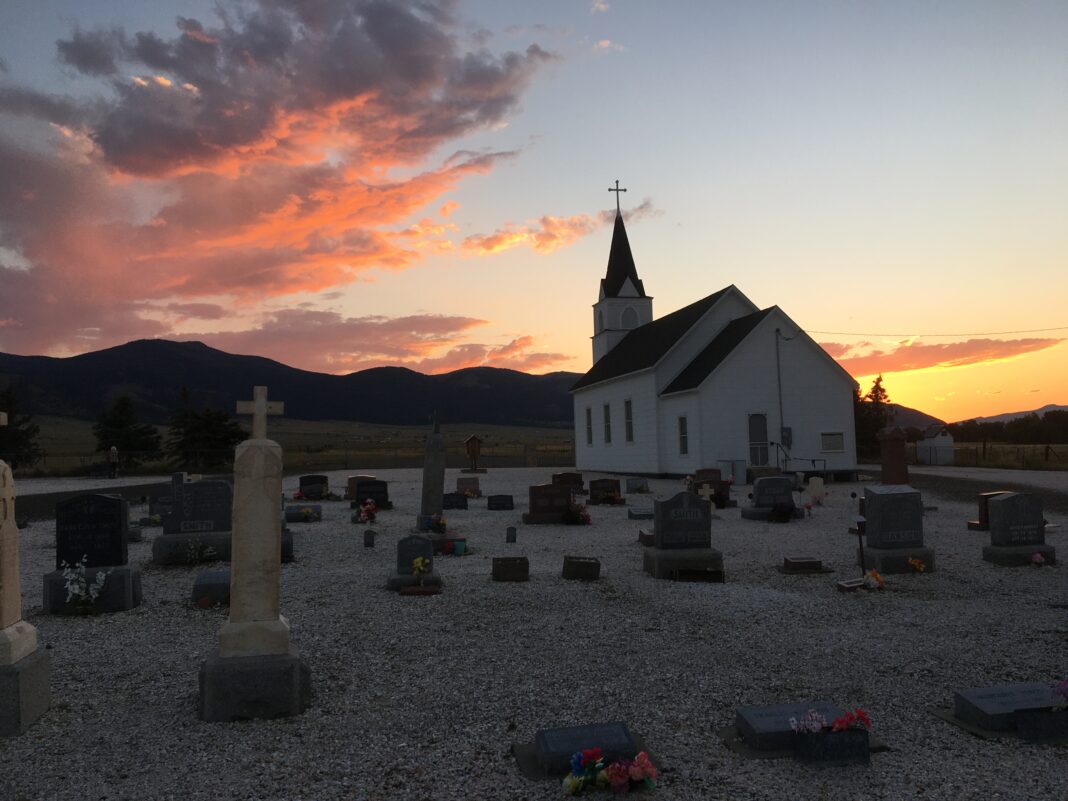
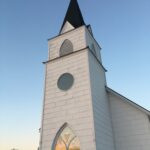
St. Catherine Church is silent this week. There will be no Christmas Eve Mass, and no service Christmas morning. The doors of the 129-year-old house of worship are locked. Candles won’t be lit in the sanctuary; hymns and carols won’t be sung.
Its modest congregation, many of whom have met and prayed at the church for decades, will go elsewhere to celebrate the birth of Jesus, scattering to Masses in Helena, Whitehall, Butte, and beyond. There are no plans to come together in Boulder.
That prospect has left some dismayed. “It makes you want to lose your faith,” says one longtime parishioner. “I hate to say that. But I put my life into that church.”
Adds Kathy Dyer: “It’s really sad.”
On June 4, the Roman Catholic Diocese of Helena announced that St. Catherine would suspend weekly Masses, one of three Montana churches to do so. Its 40-odd regular workshippers suddenly found themselves in limbo: Their church has not been permanently closed, but neither is it open — and there are no assurances that services will resume anytime soon. Or ever.
They have been left to care for their church, to keep the heat and the plumbing in repair, to pay the bills. And to hope.
This was no arbitrary or isolated act; it was, perhaps, inevitable. Church participation has dropped steadily across Christian faiths, and the decline has been especially steep among Catholics. Some 58% of American Catholics said they belonged to a church in 2020, according to Gallup, down from 76% 20 years before. Weekly Mass attendance nationwide has slid from 75% in the 1950s to under 40% today.
At St. Catherine, parishioners say, Sunday Masses in the last few years typically drew 12 to 20 people; a few more at holidays. It is a small congregation, in any case, and Covid didn’t help.
At the same time, and for similar reasons, the supply of priests has dropped precipitously. In 1970, there were 59,192 priests in the U.S., according to the Center for Applied Research in the Apostolate; today, there are under 35,000.
That’s the math that drives St. Catherine’s future. The Helena Diocese, which governs and serves 57 parishes and 38 missions in western and north-central Montana, says there are not enough priests to go around. It is focused on reaching the greatest number of Catholics with fewer priests – a calculus that works against smaller, more isolated parishes. “There’s a population factor,” says Dan Bartleson, the Diocese’s director of communications. “Who needs to be served, and how do we meet those needs?”
St. Catherine’s parishioners have been told that it takes five to seven years to train a new priest, and some are hanging hopes on that number. “That’s what [the Diocese] says,” says Paul “Brud” Smith, president of the parish council. “They’ll keep the church going until then. If we can tread water and keep things going, hopefully there will be another priest coming.”
Hopefully. But while the number of men in formation in the Helena diocese is the highest in decades — including three new seminarians this year — the existing cohort of priests continues to age. And other parishes are competing, in effect, for new priests as they are ordained. “It would be an error to try to predict” the precise availability of a priest for St. Catherine, Bartleson says.
In the meantime, there are buildings to keep up, and utility, insurance, and property tax bills to pay. Smith says the parish is still figuring out how much its annual expenses will total. The main church, financed by local donations, was completed in 1893; St. John the Evangelist Church, built in 1881 by Irish settlers 15 miles south of Boulder, is also overseen by the parish. (Income from a family trust helps to pay for the maintenance of both buildings.) The pastoral center, seated next to the church on South Elder Street, is a large building requiring heat and electricity.
The Diocese is in the process of spinning out St. Catherine’s, along with all its other parish churches, into an independent non-profit entity, which will own and steward the local property. But that won’t change the financial reality: Parishioners will still be responsible for keeping the buildings in reasonable condition, and for paying an overhead assessment to the Diocese.
It helps that the parish has rented out the two-bedroom rectory on the church grounds. And Smith says some parishioners are making monthly donations to replace the weekly collection. But other members say they’re irked that they’re being asked to support a shuttered church without any promise that they’ll see a return, as it were, on their investment. “I have a hard time with that,” says one.
But their real frustration, they say, has nothing to do with money. At heart, a church serves two essential functions: It connects people to their faith; and it joins people of a faith to each other. There are other Catholic churches; they all require a drive, yes, but people will find places to worship. But their community — that’s something more fragile. “When you don’t have a priest, a leader pushing it, it falls apart,” a parishioner observes.
Technically, St. Catherine is served by a priest: Father John Crutchfield, the pastor of the Madison County Catholic Community, has met with the parish and is available to officiate at weddings, funerals and other sacraments. But he is based in Sheridan; he says Mass on Saturdays at St. Teresa of Avila in Whitehall, but he won’t be in Boulder often.
Without stewardship, and without a Mass, “The community is gone,” says Gail Lattin. “We don’t hardly ever see each other.” The parish council is supposed to meet quarterly, but it hasn’t gathered recently, and nothing is scheduled. “I was thinking this morning,” Lattin says, “it would be nice to have a party during the holidays. But we’re all older, and it takes quite a bit of energy to plan those things.”
And so, at least for now, the community has disbanded. This Christmas, Gail and Larrey Lattin will attend Mass at Our Lady of the Valley, north of Helena. Kathy Dyer may go to Butte. Lorie and Tom Carey have been watching the non-denominational Cowboy Church on television, or going occasionally to the Cardwell Community Church. Brud Smith will be “going outside, and praying to God” in his fields.
The Helena Diocese says there is no timetable for a decision on St. Catherine’s fate. Bartleson notes that many factors will determine what happens – the supply of priests, yes, but also broader population, attendance, and financial trends playing out across the state and the nation. Do local people have the resources to support a church? Might neighboring parishes be consolidated? Can traveling priests effectively serve multiple communities? It is a complex, multi-level puzzle.
For Christians, Advent is the season of waiting, a time of anticipation of good news to come. The people of St. Catherine are waiting – for a priest somehow to emerge, for their church to reopen again, for their community to return.