
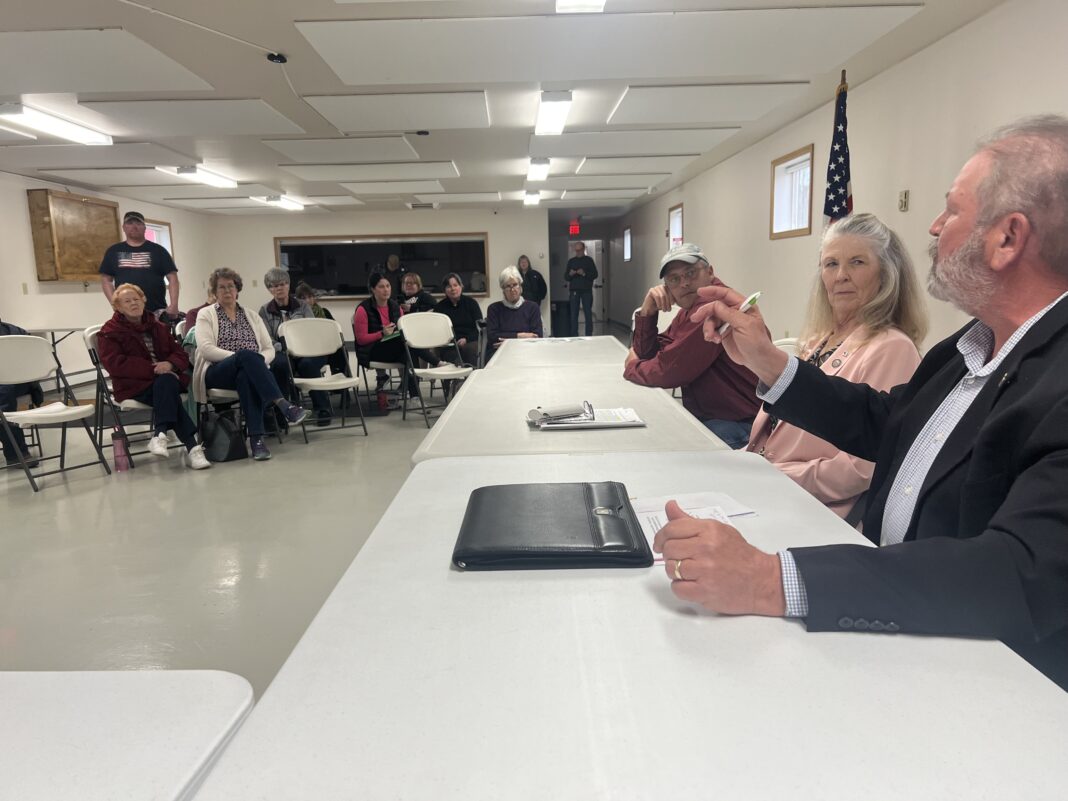
Three of the four contenders for Senate District 38 in the state Legislature gathered at Volunteer Hall in Boulder on May 8 for the first Boulder Monitor/Whitehall Ledger candidate forum, taking on questions about land use, property taxes, public education, and more — sometimes finding consensus, and more often not.
The discussion brought together candidates from across the newly re-formed district, radically enlarged in 2023 to include most of Jefferson, Granite and Powell Counties. Becky Beard, from Elliston, is the incumbent senator for the former District 40. Former executive and consultant Jeffrey Benson resides in Boulder. Jeremy Mygland is a developer and builder in Clancy. Gregory Frazer, who did not participate in the forum, has, like Beard, been redistricted out of a seat in House District 78. He is a corrections officer at the Montana State Prison in Deer Lodge.
(You can listen to the program here; the conversation begins at 3:30 in the recording.)
Beard, Mygland and Frazer will battle for the Republican nomination in the June 5 primary, the winner taking on Democrat Benson in the general election.
As the forum unfolded, Mygland staked out the far right of the political spectrum, recalling the government’s response in the early days of the COVID pandemic as his motivation for seeking office: “They were shutting down our churches, shutting down businesses, shutting down our country,” he said.
“I have never been in politics in my life, but I don’t have any other choice,” Mygland said in his introductory remarks. “I’m in this race because of our freedoms, because of the next generation, because of my boy. I’m going to hand him down a state he can be proud of when I’m done.”
Beard likewise emphasized her conservative ideology and credentials; she entered politics, she said, after advocating against community water and sewer projects that amounted to “unfunded mandates” that caused residents economic hardship.
But she seated her comments in the relatively pragmatic perspective of a four-term lawmaker. “If I get elected, I will make it my mission [to] push for smaller government and less spending,” she said. “That’s what I vote every single time.”
Frazer prepared a personal statement that was read aloud in his absence. His remarks similarly reflected a traditional conservative orientation: “I believe in limiting government overreach. We need less government in people’s lives and in the family unit. Local control should stay local control without legislation micromanagement.
Frazer continued: “Last session there were a total of 4,643 bill drafts and 885 bills adopted. That’s way too much, especially in the short legislative window we have… I believe that if a problem is found, try to fix it. Not bog down the system with a flood of bills, or pass legislation that is deemed unconstitutional which risks wasting taxpayer dollars in court.”
The lone Democrat among the candidates, Benson had left field to himself — but he steered toward the center, casting himself as a fiscal conservative who would fight “a devastating shift in taxes.”
“I want to thwart Republican initiatives that are rewarding high-income people and putting the burden on Montana’s working families,” Benson said. “My responsibilities include assisting people, helping them gain what they want in their life.”
Land use
The Monitor observed that Montanans are increasingly concerned about sprawling development and what they see as the changing character of the state; and asked the candidates what should be done to address the competing claims on Montana’s open spaces.
Benson says he opposed “any transference of federal lands” to Montana, which he said would cost the state over $400 million a year. Residents would foot the bill, and Montana would be forced to sell [the land.] It would go to the highest bidder, [and] there would be less access, less public land for Montanans.
Beard observed that Montana law requires communities to develop comprehensive policies for land use and development. “That was great, but kind of went off on steroids,” placing too many restrictions on development. “Last session, we did a lot of local government zoning reform so we could get more modernized policies to put development into more consolidated areas.”
Mygland said he opposed federal land ownership, and advocated for deregulation of natural resource extraction industries. “Montana absolutely has to take back control of our state lands,” he said. “The federal government has no idea what they’re doing here in Montana… We’re not taking advantage of our resources, and we need to. And Montana needs to control them.”
Property taxes
Increasing property assessments and taxes have become a political flashpoint. The Monitor noted that Gov. Gianforte has established a task force to examine the system and asked candidates what they would recommend.
Beard, who sits on an interim Legislature committee reviewing property tax mitigation efforts, observed that tax values have increased in western Montana because of surging demand for limited real estate — but also because “we’re not allowing the development of affordable housing. We did a lot of bills in the last session to build tiny homes and multi-family units, and cut down permitting periods.”
Mygland said he supported a version of California’s Proposition 13, which limits increases in property tax assessments to the inflation rate, rather than linking them to market value. “Otherwise,” he said, “we’re going to see the same spikes.”
Benson criticized the state for returning some of its surplus to taxpayers rather than investing in human services, infrastructure or health care. And the increase in the state’s school equalization levy, he said, means that “at the end of the month we’ll be paying $515 million in extra taxes that we didn’t pay a year ago. We’re creating a burden for the people, and rich corporations and high net worth people are walking away having a great old time.”
An audience member asked whether a state sales tax, which is allowed by Montana’s constitution, should be invoked to ease property taxes. Beard and Benson said they opposed that alternative — Beard because it could induce higher state spending, Benson because a sales tax would discriminate against lower-income residents. Mygland said he could support a sales tax conditionally — “if counties collect it, as long as it never touches the general fund; and if it permanently reduces property taxes.”
Public education
The Monitor asked the candidates what, in their view, is the most pressing issue facing the state’s public education system — and what should be done to address it.
Mygland, whose son attends a private school, said: “I’m of the mind that a free market is what will fix our public schools. More money doesn’t equal better education. I think money should follow the kids. Rural schools are generally fine as far as the woke and nonsense. But Billings, Bozeman, Kalispell, those schools are not fine. They don’t educate, they indoctrinate. So, money follows the kids: Successful schools will thrive, and schools that aren’t doing their job will have their lights shut off.”
Beard agreed that a market-based response “just might be the ticket right now.” Pointing to her experience on a school board, she noted that “over half of property taxes collected in the state went to support K-12 schools. There’s a lot of money. Everybody’s tired of paying more property taxes, and a lot of your property tax bill includes school levies.”
Benson pointed to the results of the May 7 election, when many school levies statewide were voted down. “It’s a devastating response,” he said. “Our schools have continually been assaulted. We haven’t given them adequate resources to do their job.” The state’s recent initiative to authorize charter schools, he said, has “diluted the pool further. What we’re creating is a parallel system that duplicates efforts, so spending twice as much money to get to the same result.”
The State Senate candidates will appear again at 7 p.m. on Tuesday, May 14 — this time at the Whitehall Community Center. A livecast will be available at bit.ly/WhitehallForum. (The link is case-sensitive.)