
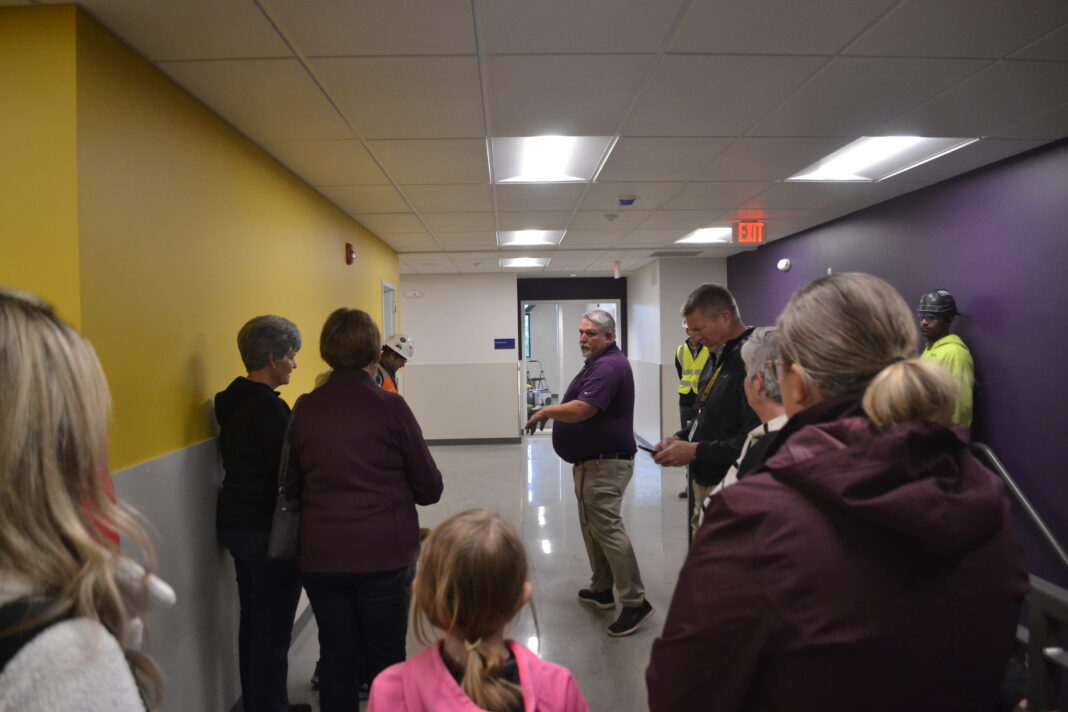

After years of delay, shifting cost schedules, and the COVID-19 pandemic, a long-anticipated expansion and renovation effort is nearly complete at Jefferson High School. District board trustees and invited community members were given a private tour of the 13,000-foot, two story addition to the main JHS facility last Tues.
The project, which school administrators expect to be complete in time for the start of the upcoming school year in late August, caps a sometimes tortuous, five-year-long effort to increase capacity and upgrade learning facilities.
Voters in 2021 approved a $12.5 million bond issue to pay for the work, and fortuitous market timing lifted the total bond proceeds to $14.72 million. Even so, unexpectedly high construction costs, a casualty of the Covid pandemic, forced the school to scale back its plans, deferring resurfacing the athletic track and improvements to the football stadium.
“It’s been quite the process, but we’re super excited about what we’ve got here,” said JHS Principal Mike Moodry, who led the tour alongside Superintendent Erik Wilkerson.
The project adds 10 new classrooms to the JHS campus, as well as laboratory and scientific material storage spaces, a band room, and an art room suited for ceramics and materials projects. The new classrooms will also be used to host advanced mathematics, foreign language, English, and special education courses. The new wing includes an elevator between floors compliant to the Americans with Disabilities Act, and four bathrooms.
“We designed this around what we call breakout or collision spaces,” said SMA principal architect Jason Davis, addressing the tour. “We’re trying to create opportunities for students to work together outside of the classroom, and also to organically connect with one another.” SMA is a Helena based architecture firm with experience in school design.
While only a selection of teachers will be placed into the new classrooms, all will receive new SMART boards, which are large wall-mounted interactive displays akin to an electronic easel. The smartboards are funded as part of a furniture allocation in the initial bond issue.
“Some teachers won’t get ‘brand new everything,’” said Moodry. “But we really made an effort to make sure that everyone upgraded equipment, in some way.”
In addition to the new construction, several existing spaces have been renovated or repurposed. Four older classrooms received asbestos abatement treatment, eliminating the contaminant threat from older parts of the school grounds. As the band room has been relocated to one of the new spaces, its previous home, which is directly connected to the JHS main stage, will be allocated to the drama department and used as a rehearsal space and potentially for small, “black box” theater productions. The guidance counselor’s office has been moved to a multi-room space that includes a private enclosures for students to connect with mental health professionals, both in-person and through telehealth platforms.
And the library will spread to two additional, connected, now vacant rooms with a new digital workspace for students. “So many resources are digital now. By scaling down some of the physical collection, we’ll be able to make more space for different things,” said Moodry. “Most seriously pared down will probably be the reference section; we have some really old encyclopedias in there!”
Also being renovated is the JHS workshop, which will include a new welding station and a dedicated room for computer numerical control (CNC) machines, which use pre-programmed software to control factory tools, and computer aided design (CAD) machines, which help students create precise manufacturing specifications. The woodshop will also be renovated, with new insulated spaces for wood and metal storage. The dust collector and ventilation systems will be replaced, and students will have access to a variety of new equipment, such as welding boots.
Two older classrooms will also be converted to student commons and potentially be home to a student greenhouse. “We’re going to start small. It doesn’t seem too cost efficient to create a large, year-round school garden,” said Moodry. “But we can probably start with some small hydroponics in the new commons.”
The addition brings JHS’s maximum capacity to 360 students. Its previous capacity was roughly 310 students, a figure which included three soon to be removed modular classrooms. Those units were not contiguous to the rest of the school’s main facility, requiring students to leave the main building to get to classes there. The new layout, administrators say, will create fewer disruptions and a more secure campus and allow staff to more easily manage a larger student population.
While construction work is still being finished, JHS officials are certain the wing and renovated spaces will be fully operational by the first day of school. A community open house, open to any who are interested in seeing the school’s dramatic changes, is planned for Aug. 29.