
In Washington on Feb. 26, President Donald Trump issued an executive order requiring federal agencies to review most contracts and grants within 30 days to determine whether they should be terminated, modified or re-negotiated. Meanwhile, the Administration’s Department of Government Efficiency claimed it had already saved $65 billion by ending nearly 2,300 federal agreements.
The flood of activity represents an unprecedented attempt by the newly re-elected President to radically downsize and restructure the federal government. And In Jefferson County, officials are trying to figure out how to navigate it.
Some cuts, mostly modest ones, have already started trickling down to local agencies and government in the form of paused or cancelled programs. For many more programs, the ultimate impact of shifting federal policy remains unclear.
“This is so fast and furious, it’s almost impossible to keep up with,” says County Public Health Director Pam Hanna, whose budget includes three federal grants totaling about $56,000. Leah Lewis, who is charged at the Jefferson Local Development Corp. (JLDC) with finding and securing grants on behalf of the County, reports: “It’s really hard to get information right now. Everyone’s like, ‘We don’t know.’”
Federal funding finds its way into rural communities in myriad ways; if nothing else, threatening to shut off the spigot has revealed how pervasive U.S. government grants and contracts have become, and how reliant many entities are on them to sustain services.
For example, funding from the National Endowment for the Humanities supports Humanities Montana’s “Montana Conversations” program, which last year made three small grants, totaling $1,876, for events in Boulder and Whitehall. The NEA said in February that it had eliminated its “Challenge America” program, which awarded small grants to underserved groups and communities.
The Rocky Mountain Development Council receives funding from the Older Americans Act, the U.S Agriculture Department’s Child and Adult Care Food Program and the Commodity Supplemental Food Program, which in turn supports the organization’s senior lunch and food distribution programs in Boulder. A statement from Rocky said that “ongoing federal program evaluations could lead to future uncertainties.”
And the Bureau of Land Management provides grant funding through its Range Communities program to support a grazing training program for local agricultural producers run by the state Department of Natural Resources’ Rangeland Resources Program. Lewis says those funds have recently been frozen.
U.S. government funding also flows into local government, often via state programs. Some of these federal programs are substantial and account for large portions of municipal budgets, often offsetting cuts or deceleration of other revenue sources. In its 2022 Survey of State and Local Governments, the Census Bureau reported that the federal government sent $341 million directly to local governments in Montana, accounting for 6.5% of municipalities’ total revenue — about the same proportion as in 2010. That doesn’t include federal money received by towns and cities via a state intermediary, as was the case with funding from the American Rescue Plan Act (ARPA) enacted in 2021 in the wake of the COVID pandemic.
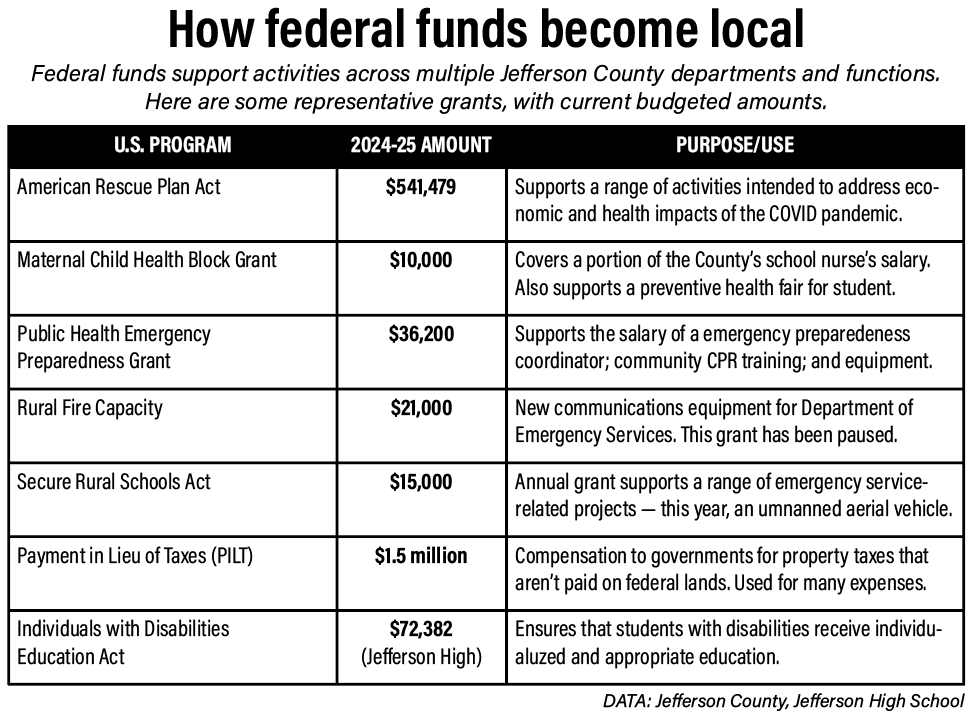
Ginger Kunz, who as Clerk and Recorder oversees the County’s budgeting process, says that large sums from previously committed federal grants such as ARPA, which this year accounts for $541,479 of the County’s budget, and the Local Assistance and Tribal Consistency Fund ($883,184) should not be at risk.
But Hanna’s Public Health Department gets $10,000 a year through a Maternal Child Health Block Grant, which covers part of School Nurse Erin Ritchie’s salary and, last year, made possible a preventive health fair for students at Jefferson High School.
The Public Health Department also receives a $10,000 immunization grant, which covers more staff salary and gives the county access to free vaccines for children. And a Public Health Emergency Preparedness Grant of $36,200 funds the salary of half-time Emergency Preparedness Coordinator Jessie Hauer; community CPR training; and purchases of equipment such as defibrillators.
“I feel like all of [the grants] are at risk,” Hanna says.
Kunz says that the Agriculture Department has paused funding for its Rural Fire Capacity program, which provides grants to rural fire departments and on which the County’s Department of Emergency Services (DES) was counting on for $21,000 to fund new communications equipment.
The County’s director of emergency management, Doug Dodge, says he’s also eyeing the federal Secure Rural Schools Act, which historically has provided the County funds for a variety of emergency service-related projects — including, this year, $15,000 for the proposed purchase of an unmanned aerial vehicle.
And about $200,000 in federal grants flow into Jefferson High School’s $4.9 million budget, according to Superintendent Erik Wilkerson. Of that, $72,382 comes from the Individuals with Disabilities Education Act (IDEA), and $60,308 from the Elementary and Secondary Education Act, with smaller amounts from other sources. Incoming Education Secretary Linda McMahon has proposed that IDEA be moved to the Department of Health and Human Services; others have called for shifting the funding into block grants to states.
The biggest vulnerability for County is the federal government’s Payment if Lieu of Taxes (PILT) which is meant to compensate local governments for property taxes that aren’t paid on federal lands, such as those owned by the U.S. Forest Service. PILT accounts for $1.5 million of the County’s total $28 million budget this year, covering a range of expenses across departments.
That’s a lot of uncertainty for local officials to reckon with. Kunz says: “I am just kind of holding my breath and waiting for the next guidance to come down from State and Federal agencies. We haven’t received much yet.”
As for Lewis, she is steering clear of potential federal grants for now. She says the Department of Energy paused a grant program she had considered pursuing to support ground source heat pumps for County buildings. Other federal grants are still open, but she says the risk of investing work in an application for a program that could be killed off is too great.
For now, she says, “it’s really hard to say what ripples and impact will be caused.”