
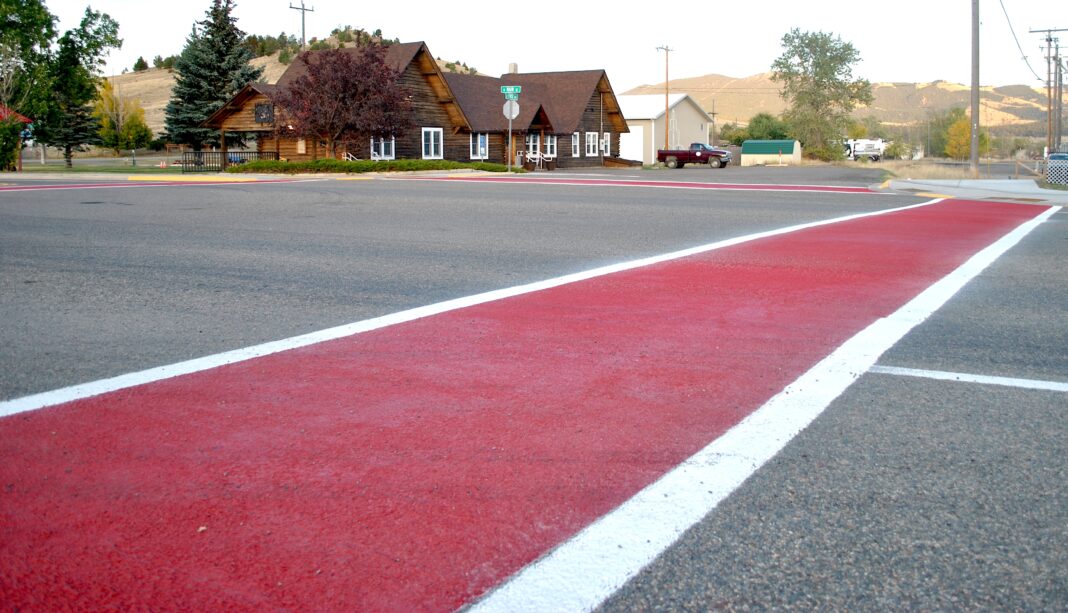
The final phase of road work in Boulder on Sept. 19 and 20 left a colorful surprise: The crosswalks on Main Street have been painted a bright red. The answer to why the Montana Department of Transportation (MDT) chose to paint the crosswalks this way involves a little bit of old and new.
Traditionally, crosswalks across the United States have been marked with white, or sometimes yellow, lines to maintain uniformity and comply with federal standards outlined in the federal Manual on Uniform Traffic Control Devices (MUTCD).
But some states and localities, including cities in Montana, have adopted variations in design and color to address specific concerns, such as poor visibility in low-light conditions or the need to alert drivers to specific pedestrian crossings.
MDT began testing iterations of painted crosswalks in recent years in urban areas like Billings, Missoula and Bozeman, which see a higher rate of pedestrian and vehicle traffic. The variations included different colors, filling the interiors, and art work.
In the Experimental Feature Work Plan published by MDT in March 2023, which laid out the proposed renovation of Boulder’s Main Street, engineers prescribed the use of Color-Safe, described in the proposal as “a methyl methacrylate resin system that can be used for area markings on concrete or asphalt while maintaining a skid resistant surface.” They noted that Color-Safe is easily applied and cures in about 45 minutes.
But why red?
MDT noted that the crosswalks already were red. At least, they were at one time, before the effects of weather and traffic wore the coating to more of a grey-brick color. The MDT proposal noted “this product is proposed on the Boulder-Urban project to maintain the aesthetics of the downtown area. Currently, the area of Boulder that is within this project has red concrete crosswalks and asphalt roadways… During final paint markings, the crosswalks will be marked with Color-Safe to resemble the original crosswalks.”
“For this project, to match the original colored concrete, adobe Color-Safe product will be used,” the proposal states, referring to the specific shade of red.
Several key factors influenced Montana’s choice to use red paint for crosswalks, according to the MDT: Increasing driver awareness, improving visibility of pedestrian crossings, and community aesthetic appeal.
Do the colored crosswalks actually help? Preliminary data from the MDT’S pilot programs suggest that red crosswalks have improved road safety. MDT surveys also found that more drivers were likely to yield to pedestrians at red crosswalks. And, says MDT, pedestrians reported feeling much safer in red-painted crosswalks.
Critics of the crosswalks say use of non-traditional colors may confuse drivers and pedestrians. When Ames, Iowa, painted its crosswalks in rainbow hues in 2019 to support a LGBTQ celebration, according to The New York Times, it received a letter from the Federal Highway Administration noting that the color “diminishes the contrast between the white lines and the pavement, potentially decreasing the effectiveness of the crosswalk markings and the safety of pedestrian traffic.”
According to news reports, others complain the red paint is more expensive than standard white and yellow paint for road lines, or that the materials may not be as easily maintained and may not hold to traffic and weather.
As the state continues to evaluate the effectiveness of red crosswalks, the MDT says further studies will be needed to determine whether this approach should be expanded statewide or refined in specific areas. The Experimental Feature Work Plan for Boulder states that the Department will inspect and evaluate the durability of the markings annually, with a final report due to be presented in 2029.