
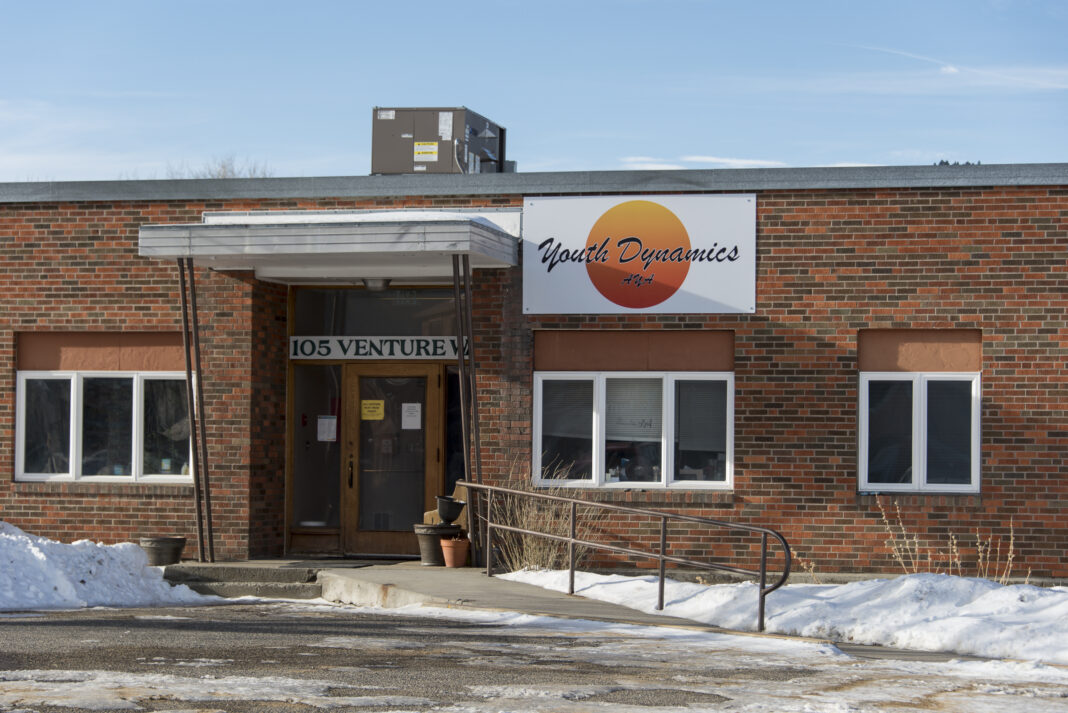




Boulder, a town once awash in care workers who helped power the local economy for decades, has a new and unfamiliar problem: The town’s residential facilities are struggling to find workers. One facility that is overcoming staffing shortages has found success with the same tactics that seem to be proving effective in the broader economy—higher wages and geographically broad recruitment—but other facilities refused to provide any detailed information.
Worker shortages are not unique to facilities that provide residential care. By the end of last year, according to the U.S. Bureau of Labor Statistics, the national unemployment rate was 3.9%—in Montana it was 2.8%—meaning that nearly all workers in the labor force were already employed, leaving few workers available to take open positions.
The four residential facilities that remain on the campus of the former Montana Developmental Center, which closed in 2018 and took about 250 jobs with it, house a diverse array of people, from male prisoners with medical needs at the Department of Corrections’ Riverside Special Needs Unit to teenagers struggling with behavior issues rooted in trauma at Youth Dynamics’ Alternative Youth Adventures facility. The Elkhorn Treatment Center serves women working to break free from addiction. The state of Montana’s Intensive Behavior Center—the last remnant of the MDC—houses up to 12 people with profound mental disabilities.
By last October, nagging staffing shortages at Youth Dynamics led to the closure of one of the facility’s four group homes, meaning its overall capacity dropped from 32 to 24, according to Program Manager Ashley Santos.
Santos said that the ongoing coronavirus pandemic greatly affected Youth Dynamics’ staffing over the past year. Part-time summer employees didn’t return last year, while some year-round employees dropped to part-time or left altogether because they lost child care, she said, and hiring to fill vacancies became more challenging.
“Generally there are six positions, full-time positions, that will staff a group home throughout the week. We were down quite a few. We were down probably about eight, nine people,” Santos said of the facility’s staff level in the fall.
Now, the three operating group homes are fully staffed and Santos recently hired three of the six employees needed to reopen the fourth group home. Part of the shift from losing workers to attracting new hires, she said, was due to increased wages—starting hourly wages increased from $13 to $16—and a 50-cent hourly wage incentive for workers commuting from Butte or Helena.
Workers finding child care also helped, she said.
Santos grew up in Boulder and still lives in town. She’s worked at Youth Dynamics for about nine years, the past five of which she’s been involved in hiring. She’s had to hire from farther afield than Boulder to find workers, she said, because of Boulder’s small labor force.
“I think that pay increase absolutely made a difference. The job is not an easy job, it’s mentally just a lot,” she said. “Definitely the pay, previous to the $3 increase that we just did, was obviously a deterrent. A lot of our staff do commute from Butte or Helena. They could work at McDonalds. I think that was probably the biggest thing.”
But higher wages haven’t fixed everything. Santos said it can be challenging to meet prospective employees’ increasingly rigid scheduling requests, and she’s not able to hire anyone younger than 21. And she’s hiring for hard work.
“It takes a special kind of person to stick it out and work with these kids,” she said.
At the Elkhorn Treatment Center, a more measured approach to financial incentives has led to mixed results. The the center has been offering hire-on and retention bonuses in an effort to recruit and retain staff, Dan Krause, the chief operations officer, previously told The Monitor this winter. And while things have “slightly improved” since spring, he is still struggling to find people to fill security and nursing positions.
He said he originally thought the lack of workers was due to temporarily increased unemployment benefits offered during the pandemic. But those expired months ago, and he’s not sure why he hasn’t been getting more employees. While the treatment center is still meeting its contractual requirements, Krause said, clearing that bar has stretched thin the staff he already has, and he wants to make sure that those individuals are getting bonuses for sticking around.
Krause said he’s had instances where people applied for a job and then didn’t show up to the interview, and people who were offered a job and then disappeared—both of which he said are frustrating.
State facilities quiet on staffing
The staffing dynamics at the Riverside Special Needs Unit and the Intensive Behavior Center are less clear.
In response to a request for interviews with people who oversee staffing at Riverside, Alexandria Klapmeier, a spokesperson for the Department of Corrections, emailed The Monitor a three-sentence statement attributed to Clinical Services Administrator Connie Winner.
“Like other states across the country, Montana is impacted by the current shortage of nurses. The Riverside Special Needs Unit is no different from other health care providers who are competing to hire these valuable employees,” Winner wrote. “That said, the department is committed to ensuring our residents receive the best care possible from our staff.”
Klapmeier and Carolynn Bright, the department’s communications director, denied repeated requests over two months to coordinate a phone call or in-person interview with anyone who could discuss staffing at Riverside.
“We feel that the statement we sent summarizes what the department is facing at Riverside as far as staffing,” Klapmeier wrote in a later email.
John Walker, a correctional officer who answered the phone at Riverside in December, directed inquires to Bright’s office. Administrative officials in the department, including Winner, did not reply to phone messages.
In a report to the Boulder Transition Advisory Committee ahead of the committee’s Aug. 5 meeting, Riverside reported 42 residents and full staffing. Riverside has not reported to the committee since early October, when Winner took over as the facility’s representative to the committee.
At the Intensive Behavior Center, an employee who answered the phone last month said that staffing was better than in the summer and fall, primarily due to the hiring of traveling certified nursing assistants (CNAs). The employee directed inquiries about staffing and hiring to Michelle Boone, the director of staffing operations.
Boone did not reply to requests for comment.
At the Dec. 2 Boulder Transition Advisory Committee, Drew Dawson, the committee chair, shared a report from the Intensive Behavior Center stating that as many as 20 positions were vacant, including nursing positions. He said the facility reported that traveling CNAs and nurses were filling some of the vacancies.
In a report shared with the committee at its July 1 meeting, the center stated that 11 of its 12 beds were filled and that staffing was an issue.