
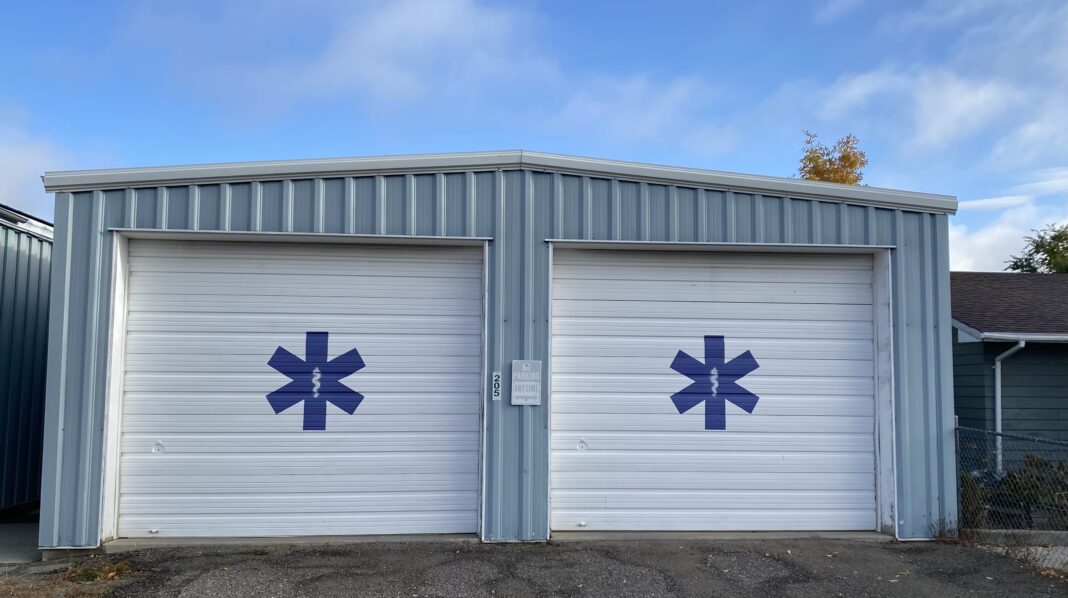
What can be done to improve the Boulder Ambulance service? And can current ambulance service volunteers and Boulder City Council members work together to find a solution?
That’s one topic of discussion at a public meeting on Tuesday, Oct. 10, at 5 p.m. at City Hall, a meeting requested by Boulder Mayor Rusty Giulio.
“We are going to sit down with everyone in the same room to reach our common goal to do what’s best for the community,” Giulio said. “We want to keep things moving in a positive direction.”
The meeting will give long-time Boulder Ambulance volunteers Michele St. George, Molly Carey and interim ambulance service manager Jack Trethewey – who was hired in April – an opportunity to address concerns, one being the need for more volunteers.
Trethewey told The Monitor he agrees that it’s critical to get more volunteers and to get those volunteers trained as soon as possible. He wants to get everyone up to speed and get training started (a training was scheduled to start on Oct. 3). The training takes place twice a week (Tuesdays and Thursdays) and runs until February of 2024. Those who complete the training (and pass the test) will be nationally registered and state licensed. Skills involved with the training include CPR and First Aid, communication, problem solving, critical thinking, organization and teamwork.
City Council member Drew Dawson – who has an extensive background in emergency services – said he hopes the City Council can work with Trethewey, St. George and Carey to resolve as many issues as possible, especially when it comes to recruiting volunteers.
“This meeting is an opportunity for Boulder Ambulance representatives to have some constructive two-way dialogue,” he said.
It’s imperative, Dawson said, for the ambulance service representatives to be on the same page, and to feel secure in their jobs. After all, Carey has been an ambulance service volunteer for 15 years, a role inspired after she was bucked off and stomped by her horse while moving cows.
“Just seeing that we were there for her when she needed help motivated her to come by when she recovered and ask, ‘what can I do?’” St. George said.
St. George has been a Boulder ambulance service volunteer for more than 20 years, joining initially as a way of giving back and helping the community. Both her husband and her son are in law enforcement, so it’s also a way she can be there to support the deputies.
Carey and St. George are interested in leading the way for the ambulance service, working with Trethewey and others to ensure the ambulance service runs efficiently.
“As far as [how efficiency is gaged], the question we ask is, ‘did I make a difference in somebody’s life that day?” Carey said. “That is part of the reason why I got my license because I wanted to make a difference in one person’s life – and I think after 15 years maybe I have…at least once or twice.”
According to Carey, a driver and a basic EMT is all it takes to run an ambulance, but having two individuals ready to go at any time takes around seven volunteers or more.
“A minimum of 12 volunteers would be wonderful,” Carey said.
St. George said that over the past weekend, there were four calls, and she took three of them.
As daunting as that might sound, Carey said being an EMT volunteer is not an intensive role. It requires 120 hours of training, followed by a commitment, one that’s not all-consuming. “Just give us one 24-hour period when you are available,” Carey said.
“And we are willing to work with people. If you can’t work from 8 a.m. to 5 p.m. but you can work from 6 p.m. to 10 p.m. when your husband is home and your kids are up, I’m good with that,” St. George added. “We are very accommodating.”
But finding individuals to sign on has been harder than ever, St. George said, and Boulder’s ambulance service is not alone. According to the National Rural Health Association, about 53% of rural Emergency Medical Service agencies are staffed by volunteers, compared with 14% in urban areas – and 70% of these rural agencies report difficulty finding volunteers. And Carey doesn’t expect the situation to get better, as the average age of volunteers is 58, and 60% are over the age of 40. Carey said she’s concerned the younger generation is reluctant to volunteer.
“It’s worth it,” St. George added. “Not all calls turn out the way you want them to, but that’s not up to us. Like Molly says, that’s up to a higher power. But being able to help the community, and maybe save a life, is rewarding…and important.”
What can inspire more volunteers? Ideas are welcome at the Oct. 10 meeting, which begins at 5 p.m. at Boulder’s City Hall (304 N. Main Street).