
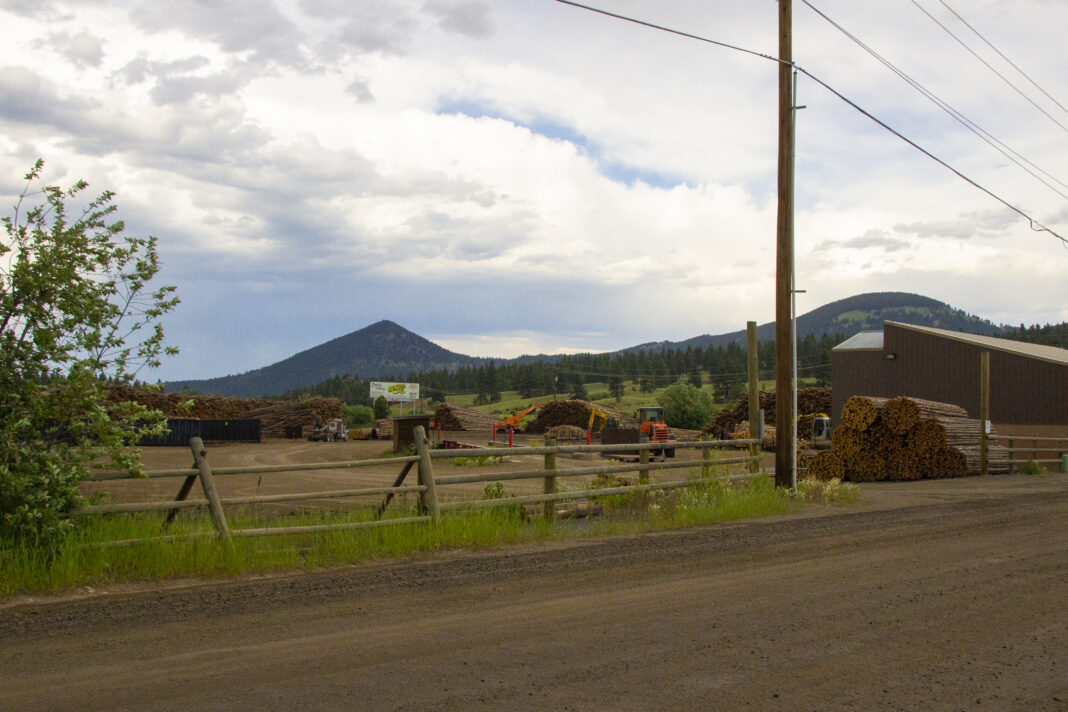
On Dec. 11, 1894, three Helena men filed articles of incorporation for the Hartford townsite in North Jefferson County, a mile north of modern day Clancy.
It is unknown why the town founders, Franklin R. Wallace, Walter Matheson and Geo. B. Hopkins, selected Hartford as the name; however, the name was then used for the local mining district, which was approximately six miles wide and 10 miles long and consisted of mines in Lump, Strawberry and Clancy gulches. Although Hartford sat at the center of the so-called district, it was only referred to by this name in the Hartford Pioneer, which published for the first time on Jan. 1, 1895.
The Pioneer, owned by John H. Harris and Robert G. Bailey of the Hartford Publishing Company, sought to inform community members mostly of the mine and agricultural happenings of the district and Jefferson County. “We will not make any vain boasts as to what we will do in the future, but will endeavor to conduct a paper of which the people of this community and our friends will not be ashamed,” the publisher wrote in the first edition. “This venture is the result of considerable thought, and is intended to be a fixture — not merely an advertising medium for a few weeks.”
The Pioneer claimed the title of the first newspaper in North Jefferson County by only four days before The Lump City Miner became the second on Jan. 5, 1895. The Miner’s first publication called The Pioneer a “handbill sort of an affair, which it would be stretching a point to call a newspaper, for the purpose of booming their townsite location.”
A feud ensued.
The editor of The Pioneer responded to The Miner’s prods in its Jan. 12 issue, saying, “Let the public be the jury that passes upon the relative merits of our papers. We are too much absorbed in our legitimate work of advancing the interests of the entire Hartford mining district — Lump City, the birthplace of the Miner, included — to indulge in low personalities or answer insulting [references]. Fire away, brother editor, we rather enjoy your discomfiture.”
By the time Hartford received its first newspaper, the town was home to Thompson & Greer General Merchandisers, Nilsen & Erickson Carpenters and Builders, the Hartford Blacksmithing and Horseshoeing, the Liverpool Saloon and several ore haulers. These businesses advertised in the first edition of The Pioneer. According to The Lump City Miner, 30 people lived in Hartford, “some days.”
On Jan. 12, 1895 reported that a Helena surveyor, last name McElroy, had visited town and “engaged in making a plat of Hartford mining district.” Work to complete the plat of the town of Hartford itself had taken place between Nov. 26 through Dec. 1 of the prior year. The original plat, constructed by Charles W. Helmick, now resides in a “wall of maps” housed at the Jefferson County Clerk and Recorder’s Office after it was filed there on Jan. 5, 1895.
As the profit from local silver mines attracted attention from prospectors, the town of Hartford appeared to be on the rise. The Pioneer reported that the Northern Pacific Railway had begun construction of a depot in Hartford. The 18-by-48 structure containing an office, a waiting room and a freight room. From here, local miners could ship out the ore retrieved from their claims. Passenger cars for both the Northern Pacific Railway and the Great Northern Railway Line made frequent stops in Hartford on their way to Helena.
To further establish the railroad’s presence in Hartford, a station house in Calvin — a town near Bernice — was moved there for use.
Although the town grew in size for some time, settlers began focusing their expansion in nearby Clancy. On July 27, 1895, exactly 127 years ago, The Pioneer published its farewell to the residents of Hartford in the paper’s final edition: “We wish it distinctly understood that the Pioneer is not closed down from any fear the publishers entertain as to the permanency of the camp, but simply from the lack of support.”
The same day, The Miner took the opportunity to send its old foe off: “The Hartford Pioneer has succumbed to the inevitable and ‘gone over the range.’ It struggled manfully for a time, but after a short and erratic existence has ‘lane down and died.'” The following week, The Miner published its last jab at The Pioneer, calling it an “alleged newspaper.”
Two weeks after closing its doors in Hartford, the Pioneer publishing team moved to Wickes, almost 12 miles south of Hartford. The new Wickes Pioneer published until April 1986 before it, too, shut down due to a lack of support. “If the people of Wickes want the Pioneer to remain here, then they will have to support it in more decent shape than they have bone [sic.] for the past few months — else we are prepared to shut down at once,” read the final edition of The Pioneer.
Despite the publishers’ confidence in the permanency of Hartford, soon after the newspaper ceased publication, Clancy’s growing suburbs swallowed the town and it disappeared into time.
According to notes compiled by the Jefferson County Museum, Hartford’s downfall began when the Western Federation of Miners attempted to unionize. The Federation picketed the depots, train yards, local businesses and access to the town. Ellen Rae Thiel, a volunteer at the Heritage Center in Boulder, told The Monitor she believed that the town had burned to the ground in the commotion; however, she could not remember where the rumor had originated.
A July 25, 1896 edition of The Clancy Miner, the evolved form of The Lump City Miner, clarifies that the north county strike occurred when a majority of the Clancy Miners’ Union No. 30 voted to no longer be required to stay at company boarding houses. “It is unjust to compel a married man to board at the company boarding house where it costs on the average about 33 cents a day to feed him and then charge him a dollar for it,” read the article. “We would still regret to see them take such action as would close down any of the mines of Lump gulch and throw everybody out of work.”
By Aug. 22 of the same year, the miners were on strike and companies had begun moving equipment out of the camps, guaranteeing the demise of the mine-based towns.
The Jan. 16, 1896 edition of The Jefferson Sentinel reported that workers would relocate some, if not all, of the buildings in Lump City and Hartford, ultimately proving that the town survived the union’s riot. The Miner reproduced this report in its Jan. 18 edition. The destinations of Hartford’s buildings are unknown.
A week later, W. H. Orr, a Helena contractor, visited the area to determine the cost of moving a building owned by R. Dorn, proprietor of the St. Louis mine and the Lump Gulch hotel, from Hartford to Clancy. The building was to be deconstructed shortly after, and was expected to be rebuilt at its new location within another two or three weeks. At that time, the Dorn building was the biggest and most ornate building in Clancy, measuring 34 by 60 feet and standing two stories tall.
When the Dorn building was set to be relocated to Clancy, the Hartford townsite office had already sat dormant for some time. On Feb. 1, 1896, Anna Porterous opened a laundry house in the vacant office. Two years later, the building was listed for sale at $300 in The Clancy Miner.
On Oct. 11, 1896, one or two “suspicious looking characters seen lurking” around the Lump Gulch hotel at 4 a.m., according to a report in The Clancy Miner. An hour later, fire had engulfed the hotel’s ice house, a structure built at the back of the building. “In about half an hour afterwards there was nothing left to mark the site except a heap of ashes and the excavation. The Miner’s report explained that negations to move the building to Clancy were still in place when the structure caught flames.
On March 12, 1898, an article titled “The Last of Hartford” ran in the The Miner. According to the article, the Northern Pacific Railway station was the final building to remain in Hartford. The station was placed on wheels and moved to Clancy. “The building will be thoroughly renovated, enlarged and fitted up with all modern appliances befitting its more exalted position,” read the article.
With the final building removed, Hartford no longer existed on any Montana map. As for the buildings that were relocated to Clancy, Thiel and Jefferson County Museum volunteers believe that many succumbed to the Clancy fires of 1902 and 1903. The 1902 fire resulted in the destruction of the Albany Hotel, Leary’s hall, Sophia Gordon’s frame lodging house, James Ryan’s building, H. M. Hill’s grocery, a barber shop, T. J. Chestnut store and J. J. Haab’s building, according to research done by Raemarie Bruce, the Jefferson County Museum assistant director.
While the fires caused more than $11,000 worth of damage, the newspapers of the time published very little about it. “The burning of Leary’s hall at Clancy will interfere with dances and entertainments there for some time as there is no other suitable place for such purposes,” wrote The Boulder Age. It is unclear whether any of the destroyed buildings were original to Clancy; however, historical records state that none of the original Hartford buildings still stand.
Hartford was not the first town to disappear from this location. James Brown, vice chair of the Jefferson County Museum’s board of trustees, found evidence that 22 years before the incorporation of Hartford, a subdivision referred to as Lewistown existed “at or near the same location.” The town received its name from I. I. Lewis, the owner of the Legal Tender mine and the subdivision.
The main business in Lewiston was the Kemp and Bro. silver reduction mill, formerly the Porter & Bro. The mill helped turn out a profitable amount of silver from both the Legal Tender and Mammoth mines, according to Brown’s research.
In 1876, the mill burned down and research suggests it was never rebuilt. Though other businesses existed in Lewiston, such as a hotel, an ore house, a shaft house, a blacksmith shop, an assayer’s office and a public hall, Brown did not find any historical records concerning their whereabouts.
A hundred years after the burning of the Kemp & Bro mill, the Montana Department of Transportation built an interstate on top of the former townsites, paving over their stories.
Today, the story of Hartford isn’t found in any mainstream history books. In fact, very little record of the town’s happenings exists beyond that of the early north county newspapers.
For more information about and access to local historical newspapers, visit montananewspapers.org.


