
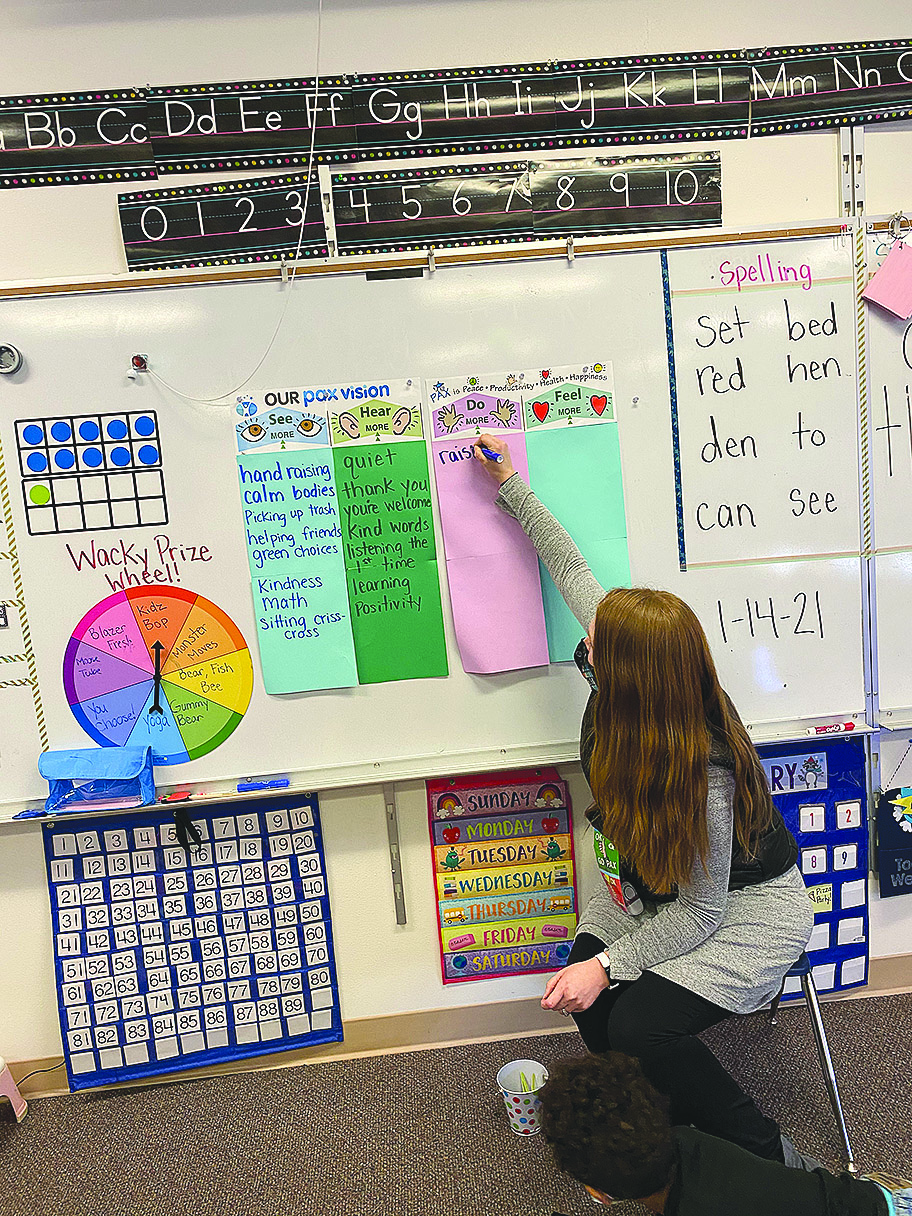
Granny’s Wacky Prizes, Spleems, Tootles and a vision board — it’s an odd-sounding group of concepts, but they’re part of a social and emotional learning model called PAX that Jefferson County wants to implement in more of its elementary schools over the next three years.
Currently, only Clancy Elementary School uses the PAX program, which focuses on enhancing social and emotional learning as a way to prevent negative behaviors — both in school and beyond.
The goal to implement PAX in two of the county’s six elementary schools by 2023 was included in the recently completed Jefferson County Community Health Improvement Plan, and is seen as a way to address the issue of mental health.
Clancy School Counselor Krista King said the school received a $15,000 grant in 2018 from the Montana Department of Public Health and Human Services to fund the training and supplies for the program. The school has received additional funding from the University of Montana to continue funding teacher training.
King said she was attracted to the program because of its benefit to students, as well as supporting teachers by reinforcing positive behaviors in the classroom. So far, it’s being implemented in kindergarten through fifth grade, with 20 teachers having been trained, said King.
Also known as the “Good Behavior Game,” PAX begins with the teacher and students creating a “vision board,” which outlines what they want to see, hear and feel more of in the classroom, and conversely, what they also want to see, hear and feel less of, said King.
The desired behaviors, called PAX, could include less name-calling, for example, or anything that promotes peace, productivity, health and happiness, said Carol Ewen, director for school mental health programs with the University of Montana.
Undesirable behaviors, such as talking out of turn or being disruptive, are called Spleems.
Ewen helps Montana schools implement PAX into their curriculums, and 41 schools across the state have done so.
So far, it’s mostly elementary schools because research shows that the earlier the training begins for students, preferably in kindergarten and first grade, the better, said Ewen, adding that it’s also easier to get cooperation from elementary school teachers because of the advantages of starting young.
The Good Behavior Game works like this: The classroom is divided into teams during a specified timeframe, with PAX and Spleems counted toward each team. PAX and Spleems are tallied up and the team with three or less Spleems gets a Granny’s Wacky Prize, said Ewen.
Prizes are not material things, like stickers, but rewards such as allowing the team to engage in silly behaviors or get a break for a specified amount of time, said Ewen.
This is a way to help children learn to de-regulate and re-regulate for increasingly longer periods of time — a way to develop self-management skills, said Ewen.
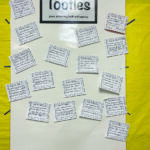
Other components of the game include Tootles, or positive, encouraging messages that students can write to each other.
PAX games start out as brief, a minute or two, then increase in time and are played at least three times a day, according to the PAXIS Institute, which offers the program.
The games can be played during math and reading lessons, on bathroom breaks or other transitions, according to the PAXIS Institute.
King said the goal is to increase positive behaviors and reduce teacher turnover, although the latter is low at Clancy.
Clancy second grade teacher Kathy Igielski said PAX has helped increase her instructional time, especially between transitions.
“Students utilize time more wisely and want to beat the timer to earn a prize,” she said, referring to the time frame given to complete a task and the Granny’s Wacky Prizes.
“The students get excited to earn the prizes and it is a great way to encourage positive and expected behaviors,” she said.
The idea behind PAX is not new — it was developed in the 1960s by a teacher, and there is an abundance of research supporting social and emotional learning (SEL) models such as the Good Behavior Game.
Social and Emotional Learning programs are geared to foster interrelated core competencies — self-awareness, self-management, social awareness, self-management, social awareness, relationship skills and responsible decision-making.
The Collaborative for Academic, Social and Emotional Learning (CASEL) in Chicago has compiled the results of numerous academic and scientific studies showing that SEL increases academic performance, improves classroom behavior, increases a student’s ability to manage stress and depression and develop more positive attitudes about themselves, others and the school.
Results have also been shown to extend beyond the elementary school years and create positive outcomes for students as they grow into young adults in the areas of education, employment, criminal activity, substance use and mental health, according to “Early Social-Emotional Functioning and Public Health: The Relationship Between Kindergarten Social Competence and Future Wellness,” and published in 2015 in th American Journal of Public Health.
Despite its track record, SEL programs, such as PAX, have been slow to be implemented on a wide-scale basis in the United States.
A review of U.S. school practices found that about 59% of schools have programming in place to address the development and support of children’s social and emotional competencies, but many do not use evidence-based prevention programs or use them faithfully, according to a 2011 analysis published in the peer-reviewed academic journal, “Child Development.”
Ewen thinks that schools and the public are just beginning to understand the importance of social and emotional learning and self-regulation, and the need to teach it in the schools.
“Schools historically have expected students to come ready for school. If they had behavior problems, they were punished (sent home, sent to the principal’s office, kept in from recess) rather than teaching behavior as a skill. So the first thing that needs to happen is for educators and the community to see behavior as a skill that needs to be taught and reinforced, and our systems for dealing with problem behavior have to change,” said Ewen.
Another problem with implementing PAX is that there are many competing initiatives in schools going on at one time, and along with turnover, makes long-term implementation an issue, she said.
“I do not think we as Americans have a good vision for what we want our education system to do,” said Ewen.
Ewen said parents usually love the program once it starts, and resources are available to extend the PAX strategies at home.
“I have not heard of or experienced any resistance from parents if teachers are using PAX well.,” said Ewen.
King said the feedback from teachers at Clancy has been positive. One wrench in the works, however, has been the pandemic, she said.
Not only has it impacted how teachers manage the game, it’s also making it hard to collect data on its effectiveness, particularly with the lock-down last year, said King.
Despite the difficulties posed by the pandemic, Clancy Title I Reading Specialist Jolene Edwards has been pleased with the results.
“I am so grateful that we are using PAX GBG for our students. I work with kindergarten through sixth grade students and I am pleased with how the PAX program has helped provide a universal “language” for all learners on behavioral expectations. It makes me so proud of the students when they ask if we can play the “PAX Good Behavior Game,” which means they are asking to demonstrate their growing PAX skills, while completing meaningful work during our reading sessions,” said Edwards.