

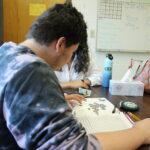
Students enrolled in Jefferson High’s life skills class do so as part of their “legal education plan,” which includes a confidentiality agreement. Of the four students in the class, The Monitor received permission to use three of their names. To maintain the fourth student’s anonymity, the fourth student chose a pseudonym, “Shaniqua Anderson.”
“I wish they’d taught me that in schools.”
How often have you heard – or potentially said – that phrase? The chances are fairly high.
People often use this phrase when it comes to building and using a budget, filling out taxes, practicing time management in the workplace and maintaining a tidy space. Although Esther Kirsch doesn’t teach her life skills students how to file a tax return, her course for students with unique needs should prevent them from ever feeling the need to say the aforementioned phrase.
Although Kirsch’s life skills class offers lessons in budgeting and job readiness, the real goal is to provide students with unique needs with the skills they need for life after high school.
***
Jefferson High’s four life skills students – Gabriel Muston, Jacob Corpron, Paxton Elbert and Shaniqua Anderson – meets Monday through Thursday from 1 p.m. to 3 p.m., participating in lessons intended to teach them job exploration and readiness skills, financial literacy, as well as social and community building abilities.
Kirsch first introduced the life skills class to Jefferson High during the 2021-22 school year after five years of working at the school without a similar program. Kirsch said that without these lessons, there was a learning gap for high needs students.
Since its introduction, Kirsch said others have called the program “cutting-edge.”
Kirsh said the program is especially effective because the students are comfortable with the environment, having grown up in Boulder.
“It’s a great place to do this,” she said, adding now she’s passing on what she’s learned to Chris Day, a paraprofessional who assists with the program.
***
Jefferson High’s life skills class has received its funding from a Pre-Employment Transition Services grant from the Montana Vocational Services, a division of the Department of Health and Human Services.
Local businesses such as City Hall and the Boulder Community Library have also partnered with the program to provide students with job experiences.
Brian O’Leary, communications director for the Montana Office of Public Instruction, said the partnership addresses two of Superintendent of Public Instruction Elsie Arntzen’s main initiatives: Montana Hope and Montana Ready.
“Montana Hope is a whole-child approach to education that includes family and community engagement. Montana Ready is about making our Montana students career and college ready,” O’Leary said. “It is wonderful to see the Boulder community supporting these students through a partnership to provide job training … This program truly puts all Montana students first!”
During the 2021-22 school year, Corpron and Muston earned their job experience at City Hall and the library, respectively.
Ellen Harne, city clerk, said Corpron helped take and give receipts for customer payments, shredded outdated documents, watched court proceedings and helped with cemetery and park maintenance.
This experience was about more than just a job for Corpron. Cleaning the cemetery allowed him a touching moment where he was able to feel closer with his late grandmother.
“The students were eager and willing to learn, and city staff enjoyed working with them,” Harnse said. “We commend the high school for implementing such a worthwhile program and wouldn’t hesitate to participate in the program again.”
At the library, Muston helped stack books and set up activities for patrons.
“I miss working there,” he said.
Boulder Library Director Jodi Smiley said she chose to partner with the life skills class to improve its engagement with high school students and to “show them that the library is still an essential part of the community.”
Although the primary purpose of the program is to provide the students with job skills, Smiley said the library learned from the experience, too.
“He gave us insights and ideas about what his age group [is] interested in, as well as helping label, cover and shelve books, create library displays and prepare materials for programs,” she said. “I believe the program has a lot to offer not only the kids, but the communities as well!”
Because only juniors and seniors can partake in the job experiences, freshman and sophomores like Anderson cannot participate.
Still hoping to provide the younger students with time in a work environment, Kirsch plans to open a school store for the students to run.
In the meantime, Anderson has already begun planning and preparing for her life after high school as a cosmetologist.
Anderson decided she wanted to become a cosmetologist after having a conversation with her friend about living together while obtaining her degree. With a goal in mind, she got to work.
First, her father taught her how to braid her own hair and then she began teaching herself more complicated styles. While braiding is her favorite, Anderson said she’s best at curling.
Cosmetology encompasses a variety of beauty treatments and Anderson has already started expanding her skills from solely hair to hair and nails.
***
Jefferson High’s life skills class begins like most adults’ days would: with chores.
“This sucks,” Anderson said while wiping down tables in the cafeteria after lunch.
In exchange for a $25 weekly allowance, courtesy of the Pre-ETS grant, the life skills students divide into groups to clean the cafeteria and do laundry.
Each of these chores are similar to tasks the students would face while living independently, Kirsch said.
After completing their tasks, the students return to their apartment-style classroom for their daily lesson.
Thursdays are what Kirsch and Day call the “fun day.” On this day, the students gather together to review a shopping list, selecting various snack and meal items. Despite there being only four students in the class, this task still allows them plenty of opportunities to practice making compromises.
White bread, wheat bread, honey bread: Muston listed these among the potential bread options the group had to choose from. With specific items in mind, the students search the web for average prices and determine whether their purchases will put them over budget. If there’s room, the class considers purchasing themselves a candy bar.
While making and spending money is always a fun activity, Kirsch and Day ensure the students learn how to save by requiring that $5 of their weekly allowance go into savings.
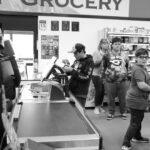
With their shopping list in tow, the students walk to L&P Grocery to purchase their items; and unlike most other adults, they only purchase items on their list.
Having paid for their items, the group returns to the school while clearly enjoying their time together. Perhaps as the winter weather sets in, this walk will become a bit more hurried, but until then, they make it last.
Upon their arrival, the students sort their groceries into the pantry and fridge before sitting down to enjoy a snack. Although shopping takes up a large portion of Thursday class, the main lesson being taught is community building.
Day and Kirsch emphasize this lesson by playing get-to-know-you games and encouraging teamwork in all tasks.
And as the three o’clock hour rolls around, the day ends the same way it began: chores. But the “this sucks” sentiment is no longer there. Instead, Muston, Corpron, Elbert and Anderson clean with a smile.
Their time together has clearly strengthened their community and is likely why Day enjoys the class period so much: “It’s my favorite part of the day.”