
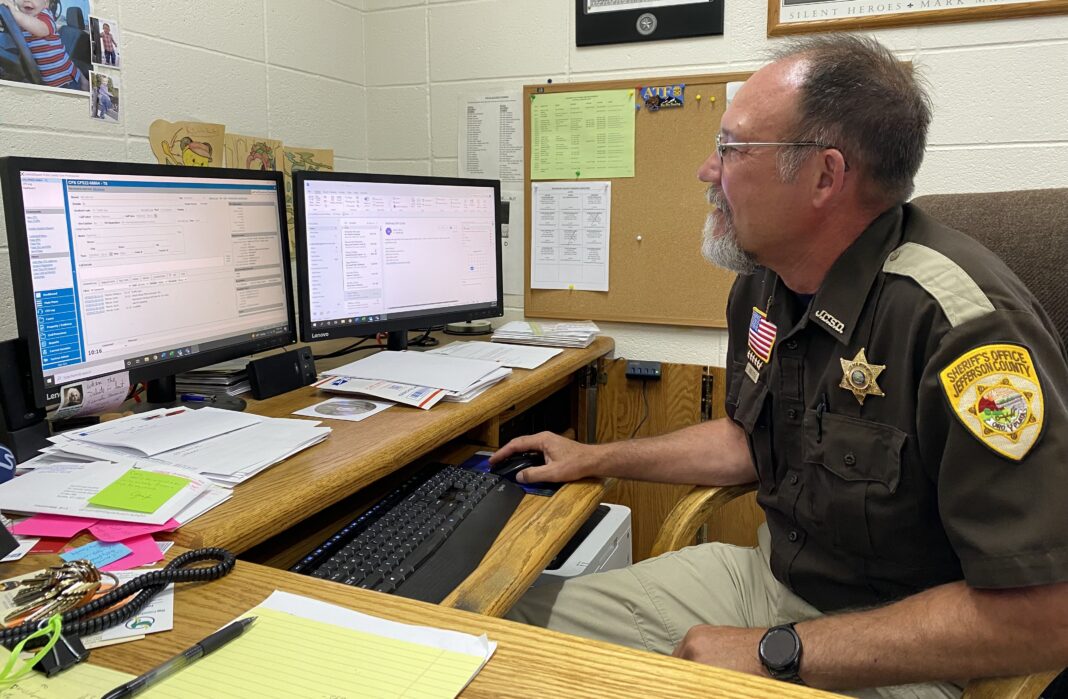
There’s good news and bad news for local law enforcement, said Jefferson County Sheriff Craig Doolittle.
“The bad news is there are more calls coming in, and the good news is we have more staff to handle them,” he said.
Doolittle said this rise in calls is not surprising.
“As the population grows, the call numbers go up,” he said. “It’s the natural progression of things.”
It’s also the natural progression of more responsibilities falling on the sheriff’s department in June of 2021, when the city of Boulder’s police department went unstaffed, leading to a contract between the city and country to provide police services in Boulder.
Now the sheriff’s department has more officers than they’ve ever had, and they’re busy, as indicated by the number of traffic stops.
Similarly, calls regarding assaults, domestic disputes, DUIs, neighborly disputes and suspicious activity are also above average.
Traffic stops are also on the rise, as there were 1,009 in 2021 and there are already 1,650 in 2022. This, Doolittle said, is a prime example of the increase in work for the sheriff’s department now that the Boulder’s police office is defunct.
Nevertheless, Doolittle said, the Jefferson County Sheriff’s Department is up for the task.
“I think we’re better equipped than we ever have been in the past, as far as law enforcement goes and having people on the street,” he said.
Getting to this point has been a long time coming for the Jefferson County Sheriff’s Department, said Doolittle, as he’s been wanting to expand the number of deputies available at any given time in order to protect and serve the county 24/7.
“We want to be proactive, not reactive,” he said.
And this is more the case now than ever, Doolittle added, as he projects around 1,000 more calls in 2022 than what the department experienced in 2021.
“In 2021, there were 11,533 calls, and, in 2022, we’ve already had 8,289 calls, which means we’re averaging around 1,000 per month, and we’re on track for over 12,000 calls this year.
Some of these calls are seasonal, Doolittle said. For example, in the summer more calls come in regarding campers, fishing access sites and other recreation-related incidents. In January, on a given day, Doolittle said the department averaged a little over 20 calls a day, whereas in July calls were closer to 50 a day.
“Calls are typically down in the winter and up in the summer,” he said.
Considering the rise in calls, Doolittle said he’s trying to stay ahead of it by having the right amount of deputies out per shift. Same goes for the dispatchers.
“We’re trying to run two dispatchers most of the shifts,” he said. “We’re still trying to figure out what’s busy and what isn’t. We did ask for – and budget for – a seventh dispatch position, a part-time one. I won’t know how that goes until we get the budget approved.”
It is Doolittle’s intention, he said, to have deputies out in the community at all hours of the day and night, and he’s staffed to do so, but still there are challenges.
“When you have sick time and vacation time to deal with it can be difficult to cover shifts, especially with covid making its rounds again,” Doolittle said. “We have several people in our office who have had [the virus] again, or for the first time.”
Overall, however, Doolittle said he is optimistic about where the department is at and is encouraged by the staff. “There are 16 of us doing what 10 of us were doing before,” he said. “Really it’s where we need to be. Honestly this is the first time in my career that Jefferson County has had true 24/7 coverage on the street. We try to have at least two cops out at all times.”
This being the case, Doolittle said, the department is in good shape, but that doesn’t make the job easy, as there is more ground to cover. The phone keeps ringing, and – so far this year –the calls indicate a rise in assaults (35 calls this year as of Aug. 22 versus 48 total in 2021), domestic disputes (81 so far in 2022 and 130 total in 2021) and suspicious activity (212 calls this year already versus 291 total in 2021).
There are many factors for the rise in calls, Doolittle said, but despite more activity, it’s not enough of a rise for it to be concerning. The department, he said, can continue to keep the public safe.