
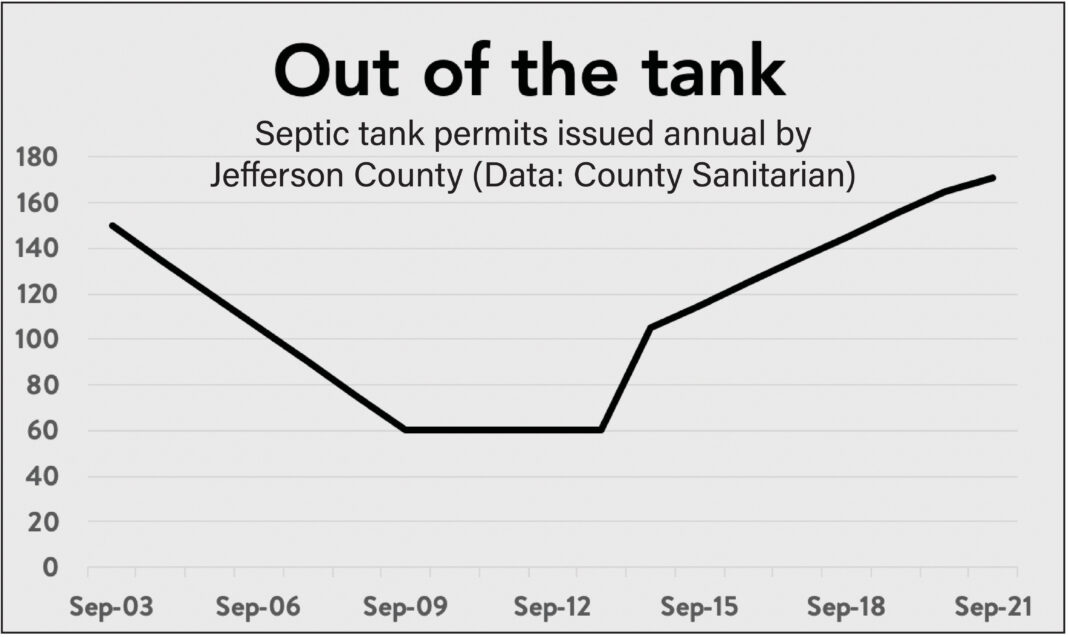
For 27 years, Sanitarian Megan Bullock has kept track of septic tank permits issued in the county — the “pulse of the economy,” as she says. So she knows: Jefferson County is witnessing a septic boom.
A sustained increase in housing development over the last decade has produced a spike in the issuance of septic tank permits. Bullock says that 171 permits were issued in the 2020-21 fiscal year — the highest in her tenure, and nearly three times the 60 permits issued in 2009, the lowest year.
Bullock credits the record breaking numbers to development in the north county, Whitehall, Willow Creek and Milligan Canyon areas, although her records don’t distinguish between permits for new homes and those for replacement systems.
What’s driving new housing in the south end of Jefferson County, Bullock said, is the increased cost of housing in the Bozeman area. “The Whitehall, Willow Creek and Milligan Canyon areas are seeing a lot of people coming from the Bozeman area,” she wrote in an email. “Due to the price increases in Bozeman for land and homes, they are choosing to commute.”
Although the septic tank permit surge signals growth, Bullock warns that more homes could tax the environment. “An increase in the number of septic systems can result in degradation of the quality of surface and groundwater,” Bullock wrote. “This is becoming evident in areas with dense development where elevated nitrates are being seen.” To reduce the impact new developments have on the environment, high density areas require more advanced wastewater treatment.
Clancy provides a perfect example of such stress. As the number of houses with individual, shallow septic tanks has increased, nitrates and pharmaceuticals have infiltrated the community’s drinking water. A recent water sampling collected from six private Clancy wells conducted by the Clancy Water and Sewer District found four of them to have more than 5.0 milligrams per liter of nitrates, with one reaching levels as high as 12.8 milligrams per liter, exceeding the maximum contaminant level of 10 milligrams per liter.
The district also tested two of the wells for the presence of pharmaceuticals, both of which tested positive.
The process of obtaining a septic tank permit can be quite complicated, according to Bullock. For most lots under 20 acres, the Department of Environmental Quality must conduct a review to lift sanitary restrictions before development can begin. Before the DEQ can initiate the review, a sample from a nearby well must be collected and tested, a test pit must be dug near the proposed septic system, the Department of Natural Resources and Conservation must determine the property owner’s water rights and a plan for stormwater runoff mitigation must be established.
Bullock said the most important part of the DEQ review is the non-degradation calculations. “These are typically performed by an engineer or consultant and include a nitrate sensitivity analysis in addition to a phosphorus breakthrough calculation and in cases where surface water is within half mile of the property, a trigger value analysis,” Bullock explained. In other words, the property owner must prove that the new septic system will not degrade the ground or surface water.
If the review meets the DEQ’s satisfaction, the agency will issue a certificate of subdivision approval. Only then can Bullock issue a septic permit.
However, parcels larger than 20 acres or lots that existed before the Sanitation in Subdivision Act, are exempt from DEQ review. These properties only require an eight to 10-foot test pit in the proposed area of the septic tank. This test pit identifies the type of soil in the area and any limiting layers, such as bedrock. The results of the test pit determine the type of septic system needed for appropriate waste treatment and a permit is issued.