
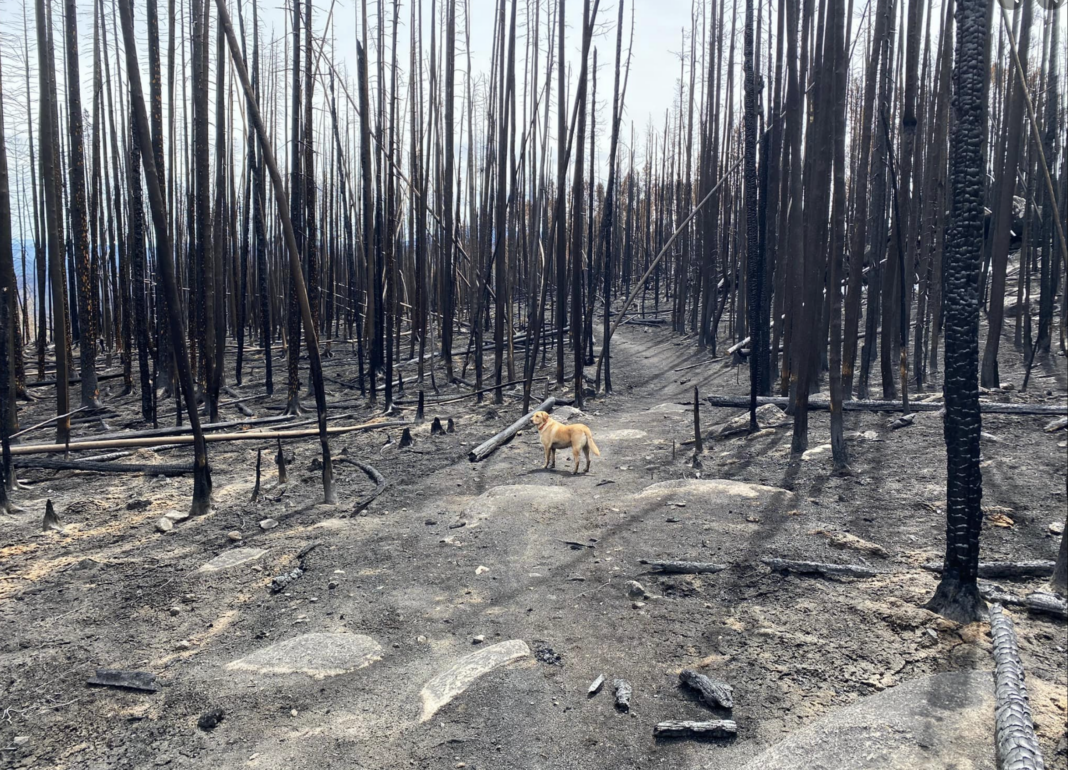
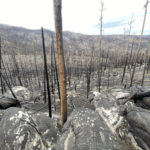
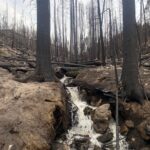
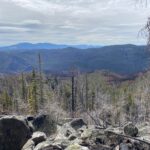
In late May, the snow receded enough from the Little Boulder country so that the dog and I could get in there to hike within the boundaries of last September’s Haystack burn. From the Little Boulder River, we hiked to the top of Mount Pisgah – the Boulder Mountains’ 13th highest summit, coming in at 8,066 ft. It may not look like much, due to being forested to the top and lacking stark relief, but if you were to walk up it you may think otherwise. Pisgah is a biblical name, and refers to a condition of life when you are on the brink of something new but a challenge stands in your way – a place where force collides with hope.
The Haystack Fire cooled after consuming 21,000 acres — not particularly large as far as big fires go, but 10,000 of those acres torched in a single afternoon, driven by big winds at the time. I was camping on the east side of Canyon Ferry Lake the evening it occurred, and even on the other side of the Elkhorns it looked, as Norman Maclean would put it, “like a leak in a lobe of the brain of the universe.”
A month ago, a large reservoir of snow was still melting in the Boulder Mountains, and the Little Boulder River and the tributaries that feed it were thick with the guts of last year‘s conflagration — cleaning out the country. I strolled in a straight line rarely having to step over anything, including chunks of ground impossible to navigate over the last decade due to the beetle kill, once thousands of contiguous acres of deadfall. Nearly all that had been on the ground in the Elder and Wilson Creek portions of the burn is gone, and the trees that were still standing when the fire came through are skeletons yet to repose.
It was a pleasant walk.
Upper Wilson Creek and Elder Creek seemed a moonscape – lifeless earth and boulders with a veneer of slag. The few parks that existed in that country didn’t burn as hot, and in late May they contained the only vegetation growing in the heart of the fire’s perimeter. They were a juxtaposition — where the char of black and white met the green Emerald Isle of Montana’s springtime mountain meadows. It will be an education watching the transformation of this chunk of earth in the coming years.
There were not many critters or signs, but on the hike out I bumped into two elk, a cow and a calf covered in ash. The calf was brand new — maybe in the last day or two — and was shaky but seemingly well. It was wearing the remnants of last September’s cinders in the only world it’s ever known. Hope and force.