
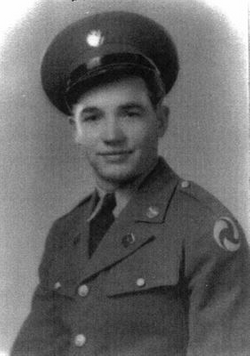
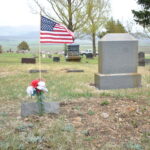
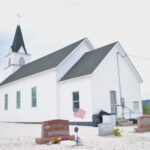
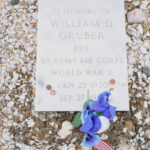
On Aug. 5, 2017, Frank Gruber attended a memorial for his older brother, Pvt. William Dawson Gruber, at St. John’s Catholic Church in the Lower Boulder Valley.
This was no ordinary service, as William—known to friends and family as Bill—died in the Philippines in September 1942, a prisoner of war who was starved to death by the Japanese during World War II. He was 22.
It took nearly 75 years for Bill to have the proper burial he deserved, and—for the family in attendance—it was worth the wait.
“That ceremony was quite a thing,” said Frank, the youngest and last remaining of nine siblings. “We had the Honor Guard, a flyover, and when the hearse went through Boulder people stepped outside to stand at attention.”
Community members came out in droves for the Clancy native, some even held up “in memory of” signs off the overpass.
It was a special day full of honor and memories, one cherished by Frank. Born in 1933, Frank didn’t get to know his older brother very well. By 17, Bill was in the Civilian Conservation Corps, working to help the family through the Great Depression. This ultimately led Bill to the service, where he was stationed in the Philippines when Japan struck Pearl Harbor.
Although Frank didn’t get much time with Bill growing up, he has some stories, ones that appropriately tie in to Bill’s favorite pastime of working on automobiles.
“He put an engine on an old Model T once,” Frank recalled. “It made so much noise some of the neighbors would get upset. I heard one time it made so much noise one neighbor’s horses ran away.”
The Japanese also caught wind of Bill’s pastime while he was a prisoner of war, Frank said. By this time Bill had suffered through the Bataan Death March and could have survived longer, but he refused to assist the Japanese with any kind of mechanical work.
“When Bill was asked to help the Japanese with their vehicles he said, ‘no thank you,'” said Mary Ann Carey, a relative of Bill’s who also attended the ceremony in 2017. She, too, was moved by the experience, one that was made possible by Frank taking a trek to the Philippines to find his brother’s remains.
In June of 2004—while in the Philippines for his grandson’s wedding—Frank and his family visited the Manila American Cemetery, where close to 17,000 soldiers are buried.
Frank was the only one of his nine siblings to take the journey, and seeing his brother’s name on the stone plaque there was very moving for him.
“There was a burial site there, a common grave, which means a hole was dug and a bunch of people were put in the same grave,” Frank said. “I wanted Bill to come home. I wanted him to be buried in the Boulder Valley.”
Thanks to advancements in DNA tracing, this wish was granted.
“DNA was taken from me and two brothers,” Frank said. “The U.S. exhumed the grave and that’s how they found his remains.”
Thirteen years later, Bill would receive the burial he deserved: one fitting for a soldier who received the Bronze Star and the Purple Heart, one who gave his life to fight for his country, one whose loyalty to his country never waned, not even in the face of death.
“I never wanted him to be forgotten,” Frank said, “and now he never will.”