
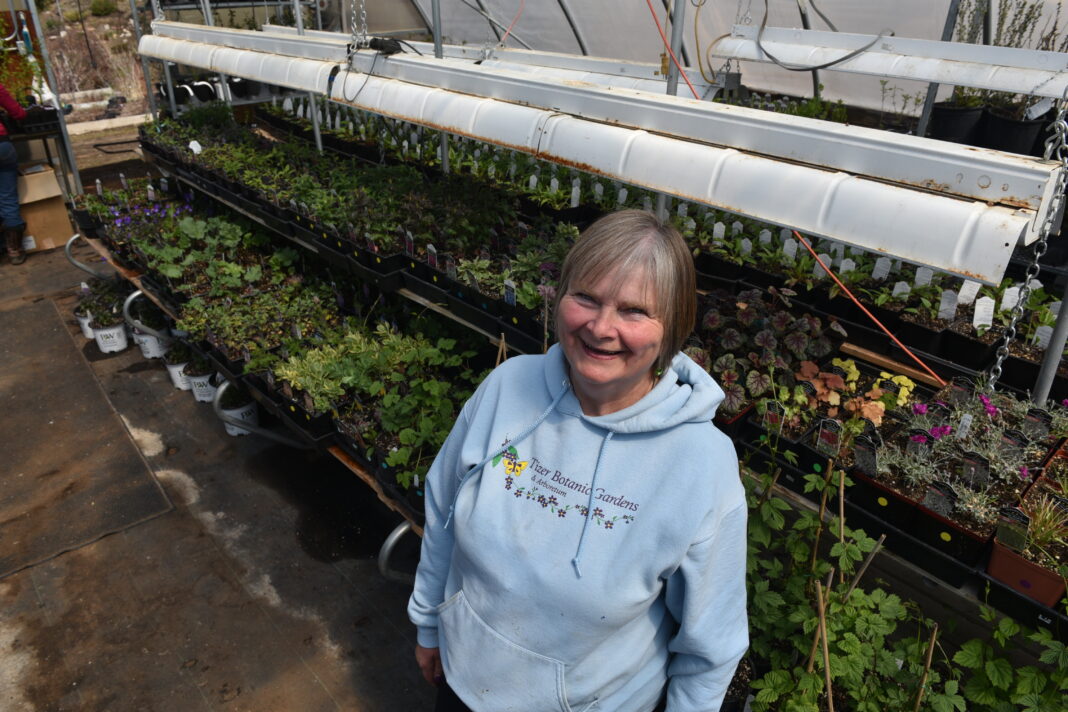




After everything, spring had arrived — and a week before opening day, Tizer Botanic Gardens and Arboretum was coursing with energy.
A half-dozen volunteers – friends, neighbors, kids — were raking the trails, picking up branches, watering shrubs, and laying straw to dry up the mud around the nursery. The greenhouses were packed with annuals and perennials, and trees, balled and bare-root, were crammed outside; a truck had delivered 1,300 the day before.
Belva Lotzer was on top of things: After more than two decades here, she understood that the operation has a certain rhythm and inertia. Soon, nearly everything would be in place: A few more deliveries would come in over the next week or so, and the trees and shrubs would have to be priced – not an inconsequential task. But her energetic staff had been around this block before, and at this point, she said, “it just steamrolls ahead.”
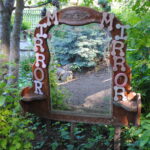
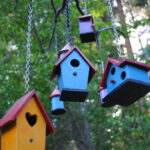
The gardens are a quirky, eccentric jewel, a beloved Jefferson City icon with a regional and national fan base. Its half-mile of trails wind through perhaps 1,500 varieties of woody plants and 1,200 of perennials, presented with, in, and around carved stumps, old bicycles, brightly colored birdhouses, and more. It is a curiosity tightly entwined with both nature and the spirits of its creators.
“There’s so much herzblut in this place,” remarked Uschi Beck, a volunteer from Boulder, using a German word. “Heart blood. It’s passion, care, and love.”
Indeed, that’s all there. But someone is missing.
***
Richard Krott was a serial entrepreneur, a promoter, an artist, and an outdoorsman. He was a polymath: His knowledge of history, the outdoors, politics, and Montana was vast and eclectic. He was passionate about what he knew, and a conversation about any of it, with anyone, was more likely to last two hours than two minutes. “He was a kook, right?” says Belva.
Richard came to Belva, and to trees, late in life – and pretty much at the same time. After stints as an engineer, planning bridges across Montana, and as an entrepreneur – he started or co-founded the Inkspot Graphics Shop, the Made in Montana Store, and a string of businesses in Helena’s Reeder’s Alley — he was named executive director in 1995 of the Rocky Mountain Trade Corridor, an organization aimed at helping businesses expand to Canada and Mexico.
Belva was the Corridor’s Canadian director — but it was two years before they met. By that time, coming off a divorce, she had moved to Vancouver. Richard, also divorced, asked her to visit Helena to help organize a conference. The gig was supposed to last a month – “but I fell in love with the boss, and never left,” she says.
On a day trip to Tizer Lake, the couple saw an old house on a wooded acre by Prickly Pear Creek. It was lovely, but they didn’t think they could afford it. A month later, they passed the house again – and this time, they decided to make it theirs. They eventually bought some neighboring property, and they started to garden.
Richard began reading about trees, and discovered he had a passion for them. He and Belva began visiting growers, and they connected with Clayton Berg, a tree expert in the Helena Valley. “Clayton was an eccentric old man,” Belva says; he smoked cigars non-stop, and a pet goose had the run of his home. “But Richard loved him, and all the time, he wanted to go and listen to Clayton talk about trees.
“And he learned.”
There was no plan, just then, to start a commercial garden or nursery; Richard had been hired as the Montana manager for Silver State Helicopters, a flight training school. But after three years, the company filed for bankruptcy. And on Tizer Lake Road, people had begun noticing Belva’s expanding plot of flowers and asking to come in. After learning how people were visiting the property, the couple’s insurer quadrupled its premium.
“So, we had to decide,” Belva says: “Do we close the gates and make this our home, or open the gates and make it a business?”
A business was born, and the next 20 years of their lives set in motion. Belva, whose passion was perennials, oversaw the gardens and the gift shop, looked after the volunteers, and handled administration and marketing. Richard took care of the trees and the nursery. Together, they made it work. “Everything,” Belva says, “just flowed into each other.”
Richard’s consuming curiosity about trees crystalized, over time, into profound expertise. Tizer’s distinctive location, in a protected canyon at 4,500 feet, with multiple exposures and soil types and some pretty radical weather swings, became a laboratory of sorts. Over time, it came to include, among other things, more than 400 kinds of coniferous trees and shrubs.
Tizer was designated an official Botanic Garden and Arboretum, the only one in western Montana. In 2007, it became a demonstration garden for the Denver Botanic Garden and Colorado State University’s Plant Select Program. Last year, it received that program’s Showcase Garden Award.
Richard began writing on Facebook, typically several times a day, attracting nearly 10,000 followers. Often, he was just showing off Tizer’s bounty or pitching the nursery’s inventory. Other times, he shared his ongoing experimentation and learning. Last fall, among other posts, he wrote about chestnuts – some of which, he noted, are toxic. He described the problem of included bark that forms at the junctions of co-dominant tree stems. And he wondered why a very young Rocky Mountain Bristlecone Pine on the property was developing cones, when most of that species take 20 to 40 years to cone.
To the extent he had an enemy, it was ignorance. He railed against commercial nurseries and home centers that sold trees and plants without explaining where and how they should be planted, sometimes without understanding why those details could be important. He criticized the U.S. Department of Agriculture’s zone ratings for plants, which sacrificed precision for accessibility and were, as he wrote last year in The Monitor, “pretty much useless.”
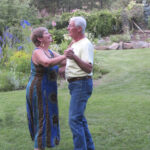
He was relentless, in that way and others. During the season, he and Belva worked 12-hour days, every day. And then, two days a week – or three, when Helena’s “Alive at 5” street parties were on — they’d go out dancing. Belva says Richard had her take dance lessons when she first came to Helena from Vancouver, 25 years ago. Dancing was his thing, and it became theirs.
“People would ask me why I didn’t get upset when he danced with [other] women,” Belva wrote after his death. “Well, the reality was, as much as I loved to dance with him, I couldn’t keep up; he always wanted to dance every dance. And I always knew who he was coming home with.”
***
Early last October, Richard was stacking firewood for the winter when he first felt ill. It was a flu, maybe, but it degraded quickly into severe pneumonia. He wrote on Facebook: “I have been bedridden for 6 days and still sleeping 19 to 20 hours a day. This condition is expected to continue for at least another week or two.”
Still ill, he wrote a gardening column for The Monitor, and he posted three times more on Facebook, the last on trees in the rose family — including the startlingly long-lived Cercoparpus ledifolius. “We have three different varieties of this tree in the Rocky Mountains,” he wrote. “I see some in Montana that must be 600 to 900 years old.”
On October 25, Belva posted to Facebook: Richard was in the hospital, and she had contracted pneumonia, as well. “For all of the many, many that are sending us prayers and love, please hold the vision of us dancing together in our garden, until I can send you a picture of us doing just that.”
Richard died on October 30, at the age of 75. On Facebook, hundreds of commenters marked his passing:
“I met Richard once this past August, he spent two hours with me and my friend as I picked a memorial tree out for my husband. He talked about the trees with so much love and was so compassionate to me and passionate about his garden. He touched my life in those two hours.”
“The knowledge he so easily shared with us all will ensure his legacy lives on in many corners of the world. I will plant a tree in the Rockies for him in the spring when the ground thaws.”
“The man was an amazing person with a huge heart, and a contagious smile. He had a true zest and love of life.”
“When I was there a few weeks ago, I saw him puttering amongst the trees, as he was so often, and I noted to myself that looked so at home. You two built a magical place for those of us who can only dream.’
‘I wonder if Richard finds heaven any different than his Tizer Garden? When he died, perhaps he was surprised to find he was still home!”
***
After Richard’s death, Belva went to visit her family in Canada. And she began planning a trip in March to Egypt – a journey that Richard, a confirmed homebody and unadventurous eater, likely wouldn’t have signed up for.
She says she never gave any thought to the possibility of not reopening Tizer this year. “I promised myself I wouldn’t make a decision about the nursery for a year,” she says. “And I love what we do.” It helped, she says, that Richard had already ordered thousands of trees for the nursery in September; she’s not sure she could have done that without him.
But Richard’s foresight only went so far. While Belva was traveling, a thermostat in one of the greenhouses gave out, and $2,000 worth of perennials froze. Later in March, the heat in another greenhouse broke down, and Belva woke in the middle of the night, for 10 nights, to make sure the portable heaters she had swapped in were still working. One day, she discovered the tractor wouldn’t start.
And on Easter weekend, two and a half feet of snow fell on Tizer Gardens. “Bring your boots and a shovel,” Belva wrote prospective visitors on Facebook. It was a heavy snow, and it collapsed two car ports that she was using to shed young trees – knocking one port through a greenhouse roof.
All of that, one small blow after another, was enough to “make you wonder if you want the stress,” Belva says. “But one thing I’ve discovered from all this is how kind and caring people are.” When the tractor broke down, a neighbor drove to Belgrade to find parts. After the Easter storm, two friends came over with plows and four-wheelers to dig the gardens out. A customer found Belva’s office door stuck and, unasked, fetched a screwdriver to make the repair. “So kind. People have stepped up to do so many things I didn’t even know needed doing.”
During the season, Belva employs an officer manager, Priscilla Oliver, and three full-time nursery staff: Jeremias Auch, Shaun Scott, and Isaiah Mead, all of Boulder. Auch, 22, has been working at Tizer since he was a teenager; this year, he will step up to nursery manager, taking on much of Richard’s work.
With that crew, with its volunteers, and with herzblut, Tizer Gardens and Arboretum will operate mostly as it always has. This weekend, the gardens will officially open — and on Sunday, Mother’s Day, hundreds of visitors will come for a picnic amid the trees and plants. Summer high teas and the fall color event will happen as they have for years.
But on Father’s Day, June 19, Tizer will host a different sort of celebration. The gates will open that morning for country music and huckleberry ice cream — another of Richard’s passions. At 4 pm, it will close for a private memorial service; Richard’s family will come from Pennsylvania, Las Vegas, and Detroit, and Belva’s from Canada. They’ll celebrate that evening with barbecue and dancing, a party Richard would have liked.
After that, Belva will keep going. She knows that being in the gardens will make her sad. Most evenings, when they weren’t dancing, she and Richard would stroll the gardens with glasses of wine, talking and enjoying the odd and beautiful place they had built together.
He’s still there, of course, in every twisted stump punctuating the paths, in the footbridges spanning Prickly Pear Creek, and in the countless trees. Gardens are, after all, formed from plants that live and die at varying cadences. The loss of each one changes the world a bit — but the whole evolves and persists.