
Twenty-five months after schools and businesses closed, people isolated at home for weeks, and Americans hoarded mountains of toilet paper, Jefferson County, like most of the U.S., has settled into a sort of new normal, shedding many changes brought on by the pandemic and living—however grudgingly—with others that remain.
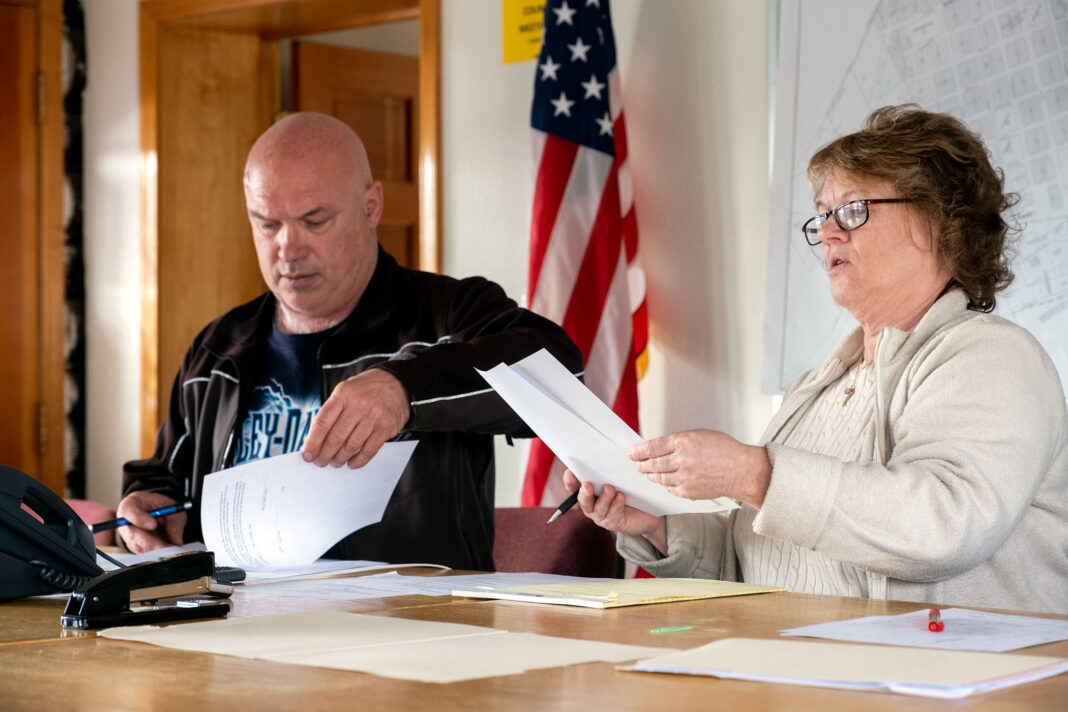
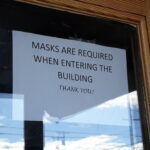
Mask mandates are mostly gone, except for some places under federal jurisdiction, like airports and commercial flights, and many vaccine mandates are tied up in litigation, although one mandate for federal employees was recently allowed on appeal. There are no mask or vaccine mandates imposed by Jefferson County or the state of Montana, nor any restrictions on business operations.
Things were much different little more than a year ago. The county imposed a mask mandate on Feb. 19, 2021, effectively extending within the county a statewide mask mandate previously imposed by then Gov. Steve Bullock in July 2020 and repealed by Gov. Greg Gianforte on Feb. 12, 2021. The Whitehall School District threatened to sue the Jefferson County Health Board over the mandate, and the board eventually repealed the mandate April 2, 2021, in response to a drop in cases last spring that continued into early summer.
Also last spring, the health board increased its event attendance cap to 50 people, up from a 25-person cap that mirrored former state regulations under the Bullock administration. That too is no longer enforced.
A year before that, on March 16, 2020, then President Donald Trump announced his administration’s “15 days to slow the spread” campaign, aimed at blunting the pandemic by having Americans stay home for two weeks. Bullock imposed a stay-at-home order on March 26, 2020, and schools shifted to remote learning around the same time. Some precautions taken early in the pandemic—washing groceries and sanitizing everything possible, but little mention of masks—seem nonsensical given what is now known about airborne transmission of the coronavirus.
“I think there was a lot of not knowing back in March 2020, and we’ve learned a lot since then,” Pam Hanna, the county’s public health supervisor, said. “Some of the things we thought about and worried about at the beginning are not the things we worry about and think about now.”
She added that things like hand washing, covering coughs and staying home if you’re sick are still generally applicable for overall health and wellbeing.
Leonard Wortman, a longtime Jefferson County commissioner who has publicly encouraged voluntary vaccination and criticized what he views as federal overreach in the pandemic response, joked that The Monitor “won’t be able to print” what he thinks about the past two years grappling with the pandemic. “Profanity, profanity,” he said, laughing.
“It’s been a very difficult time, and I think we all … have learned a great deal. And I’ve learned enough to know I don’t know anything. It’s been a real challenge,” he said, adding that in the beginning of the pandemic, “I think the government overreacted in many ways, with all of the shutdowns and that stuff. I would never have believed that they could ruin our economy so fast, in such a short time. I think there was a lot of mistakes made at the very beginning of the pandemic, from the President on down, and I think there are people who are still making mistakes.”
However, Wortman said, “at the local level, I think our health board heard what people were saying. I think at the local level, over the past year or so, things are going pretty well.”
Around March 2020, Wortman said, his mindset was “probably that they better get it under control before it gets here. We’re the United States of America, I thought we could handle anything.”
Now, he said, he’s realized that “this may stick around for a while and we may get another one that’s worse. But I hope that our leadership have learned that they can’t bully the population, the people, that it would be much better to use other methods to convince them of what they need rather than laying down the hammer of, ‘You will do this or you will be fired.'”
Jefferson High School Superintendent Tim Norbeck, asked how the pandemic had changed education, first mentioned a positive change: increased flexibility in instruction due to an embrace of remote learning.
“All the remote [learning] and the flexible styles of learning, I think they’ll be here to stay, which is a positive from that standpoint,” he said, pointing out that the school has already reverted back to regular in-person instruction. “I can see it growing in education. We hadn’t seen a lot of it where we’re at, just that flexibility of learning. Some kids it was good for, a small percentage. But still, a different opportunity for them.”
He also noted that “there’s been an increase in cleanliness and hygiene. I think it was taken for granted.”
A downside, though, has been hiring during the pandemic, as the school, like other employers, combats a nationwide labor shortage and housing crunch. Norbeck, whose career in education spans 35 years, said that the number of current vacancies at public schools statewide “has been hard for me to fathom.”
“We’re fortunate at Jefferson,” he said. “We’re looking for one position right now, but everything else is in place.”
Jefferson’s school board is also hunting for a new superintendent; Norbeck elected not to return after the expiration of his third consecutive three-year contract, which ends June 30.
At the onset of the pandemic and initial shutdowns, Norbeck said, he and the JHS administration and staff focused on “how you were going to keep the education process moving. Ours went online and in packets, and that whole summer was spent planning how to have in-person instruction knowing that, any day—and this was before vaccinations—any day you had positive cases the contact tracing would close you for days at a time.”
Once school returned, it initially didn’t come back as normal. Social distancing kept classmates apart, faces were largely masked and lunches were pre-made meals in brown paper bags, “and extracurricular wasn’t fun when you’re confining the number of people that could watch,” he said.
However, “I think there’s been some herd immunity with the infections, not only in our area but around the state, which has helped,” he said of a current lull in cases. “I think those things weigh in to driving down those numbers. I can’t say if it’s over or not, you read about different variants all the time.”
Norbeck stressed that “the mental health part of this whole thing, not just with students but with adults, is something that’s really going to have to be watched.” The worst thing for the students in the past two years, he said, was “all the structure they had to be subjected to outside the normal structure, and all those things they lost, all the social events.”
And although much of the structure imposed in the early stages of the pandemic and its initial surges has been dismantled, Hanna cautioned that “some people are ready to move on and not think about it, and I don’t think we’re there yet.”
“There’s some things we’ll have to do, I think, going forward where we assess situations and assess risk and we make the best decisions for ourselves and those we care about. And that’s not all bad—it gives us responsibility,” she said. “I think we all want to move forward … moving forward isn’t what we considered normal before the pandemic. Moving forward is moving forward into something new.”
In that new normal going forward, Wortman said, he hopes that governments have learned something from the first two years of the pandemic. With full-blown containment measures imposed in the earliest days of the pandemic, he said, many people tired of restrictions before the more significant surges of the pandemic even reached rural areas like Jefferson County.
“I think not only fatigue … with the heavy-handed way that the federal government came down for the first year or so, it wasn’t only fatigue it was anger. People in America aren’t accustomed to having everything taken away from them by the stroke of one person’s pen,” he said. “And to make it so much worse was that the information we were getting changed all the time. And when our leaders—supposed leaders—Fauci and all them would … totally change their mind and then berate people for not falling in line. I think the federal government berating people was one of the worst things that I’ve ever seen. What the hell do they expect people to do?”
He concluded: “I hope to hell they’ve learned something, and that it’s [to] just work with people and not lay a hammer on them and pound them into submission.”
Hanna also cited changing information as a stumbling block in initially combatting the pandemic, but she said that with a new and unknown pathogen that the scientific and medical communities were racing to understand while it was already killing people, “we didn’t know, and you can’t do what you don’t know.”
However, she said, governments at all levels could have tried harder to “be open with what we don’t know, so that people can understand where we’re at.”
“It’s easy from our position now to look back and say this was a mistake or that was a mistake. I really think we did the best we could with the knowledge we had,” she said. “The hopeful thing is that we’re in a lot better place. We have more things we can do and we have more knowledge. I don’t think we’re done with this, but we’re in a better place to navigate it than we have been in the past.”
Or, as Norbeck said: “Keep pushing forward.”